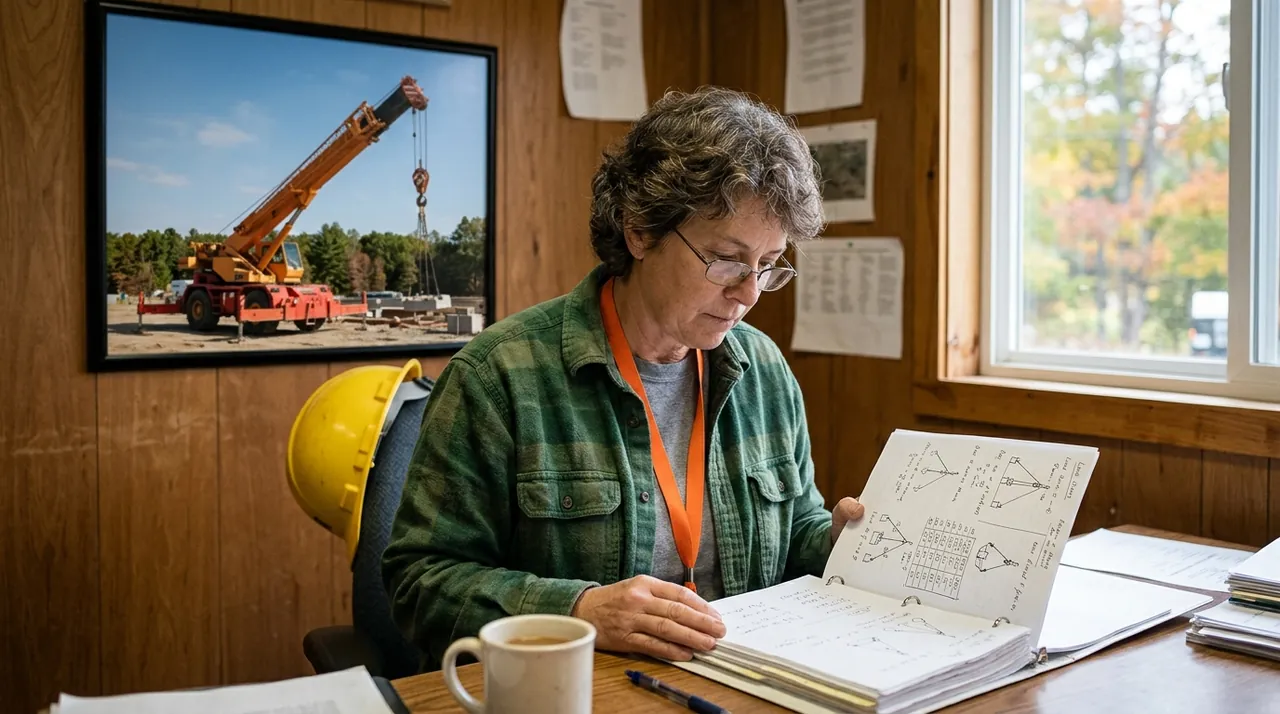
You have covered the licensing law, the machine, load charts and setup, rigging, operating hazards, and inspection. This final session pulls all of it together in exam format. The goal is not to learn new material — it is to confirm that what you have studied is organized and retrievable under time pressure. Along the way you will sharpen a few test-taking habits that routinely separate passing scores from near-misses, and you will make sure the logistics of your actual application are squared away before test day.
What the exam is actually testing
The Massachusetts hoisting written exam tests four content areas: the working parts of the machinery, safe operation practices, hand signals, and inspection procedures. For a 1B candidate, that maps directly to the modules you just completed. Working parts means the telescoping boom system, the wire-rope hoist drum, the sheave train, and the safety devices. Safe operation covers load chart use, outrigger setup, power-line clearance, swing-radius control, and anti-two-block awareness. Inspection covers both the pre-shift walkthrough and the removal-from-service standards for the wire rope, the ATB device, and the structural and hydraulic systems.
Knowing this breakdown matters because it tells you where your time is best spent in the final hours before the exam. If you are uncertain about load-chart reasoning or wire-rope discard criteria, those are higher-yield topics than memorizing less-tested details. Spend your last study session there.
Reading questions carefully — the distractors to expect
A predictable category of wrong answers on this exam involves outdated or slightly off terminology. The regulation governing Massachusetts hoisting machinery is 230 CMR 6.00. Any answer that cites 520 CMR 6.00 is referencing the former code citation — the content was recodified under 230 CMR and the old number is no longer correct. Similarly, the issuing agency is the Division of Occupational Licensure (DOL) and its Office of Public Safety and Inspections (OPSI). If a question names the Department of Public Safety as the licensing authority, that is a legacy distractor — that agency no longer issues these licenses.
Numeric problems require a specific habit: always subtract the rigging weight before comparing to the load chart. The chart gives gross rated capacity at a given radius; the net payload the hook can carry is that number minus the weight of all slings, shackles, hooks, and spreader bars. Candidates who skip this step select a load that appears to be within capacity but actually exceeds it once rigging is counted. Watch for questions that provide rigging weights as part of the scenario — they are included for a reason.
Finally, watch for questions that offer multiple plausible safe-sounding options. When you see 'stop the lift,' 'take the crane out of service,' or 'do not proceed until resolved,' those answers are almost always correct in any scenario involving a malfunctioning safety device, an uncertain load weight, or a hazard in the work area. The exam rewards the instinct to stop rather than proceed under uncertainty.
Time management and the process of elimination
The written exam is multiple choice. Read the entire question before reading any answers — especially words like 'always,' 'never,' 'only,' 'except,' and 'must' — because those qualifiers often determine which option is correct. Eliminate answers you are confident are wrong before choosing from what remains. If two options look equally correct, go back to the question stem and look for the qualifier you may have missed.
If you draw a blank on a question, mark it, move on, and return at the end. A later question often jogs the memory needed for the one you skipped. Do not leave any question unanswered — there is no penalty for an incorrect response.
Application logistics and renewal reminders
Before you sit for the exam, confirm that your application is complete. The fee is $75 per restriction class, paid through OPSI. You must be at least 18 years old. Bring a valid government-issued photo ID, arrive early, and leave your phone outside the testing area.
Once licensed, the term is two years. The renewal window opens 60 days before your expiration date, and continuing education under 230 CMR 6.04 is required before the license renews. Do not let the license lapse — renew on time to avoid any gap in your authority to operate.
Key Takeaways
- •The MA hoisting exam covers four areas: working parts, safe operation, hand signals, and inspection — focus final study on load charts and wire-rope discard criteria, which are the highest-yield topics.
- •230 CMR 6.00 is the current governing regulation and OPSI is the current issuing authority — answers citing 520 CMR or the Department of Public Safety are legacy distractors.
- •Always deduct rigging weight from the load chart's rated capacity to find the true net hook capacity before deciding whether a lift is within limits.
- •When a safety device is malfunctioning or a hazard is unresolved, the correct exam answer is to stop the lift or take the equipment out of service — the exam rewards the instinct to stop.
- •The license fee is $75 per restriction, the minimum age is 18, the term is two years, and renewal requires continuing education under 230 CMR 6.04 within the 60-day window before expiration.