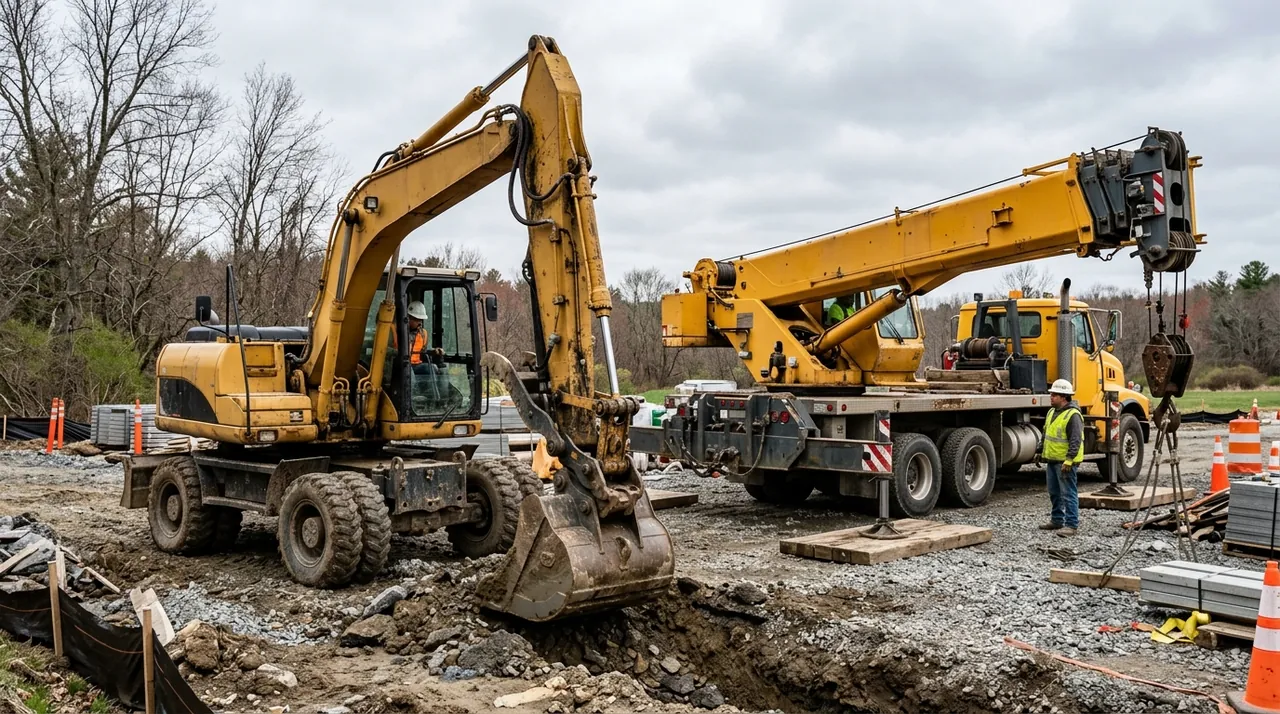
Before you can safely operate an excavator, you need to know what you are sitting inside. An excavator is built around two main assemblies connected through a rotating joint, with a hydraulic arm reaching out in front and a counterweight anchoring the rear. The 2A exam tests whether you can name the major components, explain what each one does, and recognize when a condition requires pulling the machine from service. This session covers the structure, the hydraulics, the undercarriage, and the safety limits that apply to all of it.
Upperstructure and undercarriage: the two main assemblies
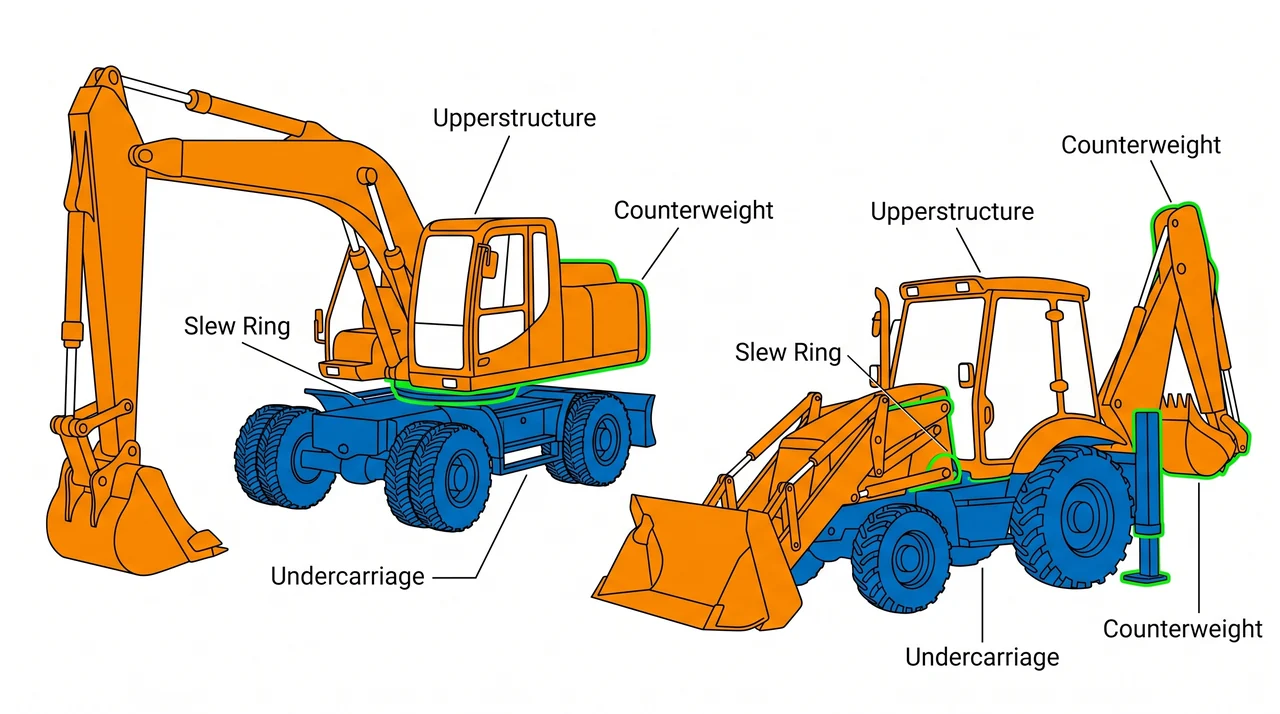
Every excavator is divided into an upperstructure and an undercarriage. The undercarriage is the base that contacts the ground — on a crawler machine, that means the track system with its sprockets, drive rollers, idlers, and track links. The upperstructure is everything above: the cab, engine, boom, hydraulic system, and counterweight. The two assemblies are joined by the slew ring, a large-diameter bearing driven by the slew motor that allows the upperstructure to rotate a full 360 degrees without repositioning the tracks. That rotation is what makes an excavator efficient — you dig on one side and swing to deposit the load on the other in a single motion.
The counterweight is the heavy cast block bolted to the rear of the upperstructure. Its job is to balance the moment force created by the boom and whatever load hangs at the end of it. The counterweight is sized by the manufacturer for the machine's rated capacity. It cannot be removed, modified, or substituted in the field.
The working arm: boom, stick, and bucket
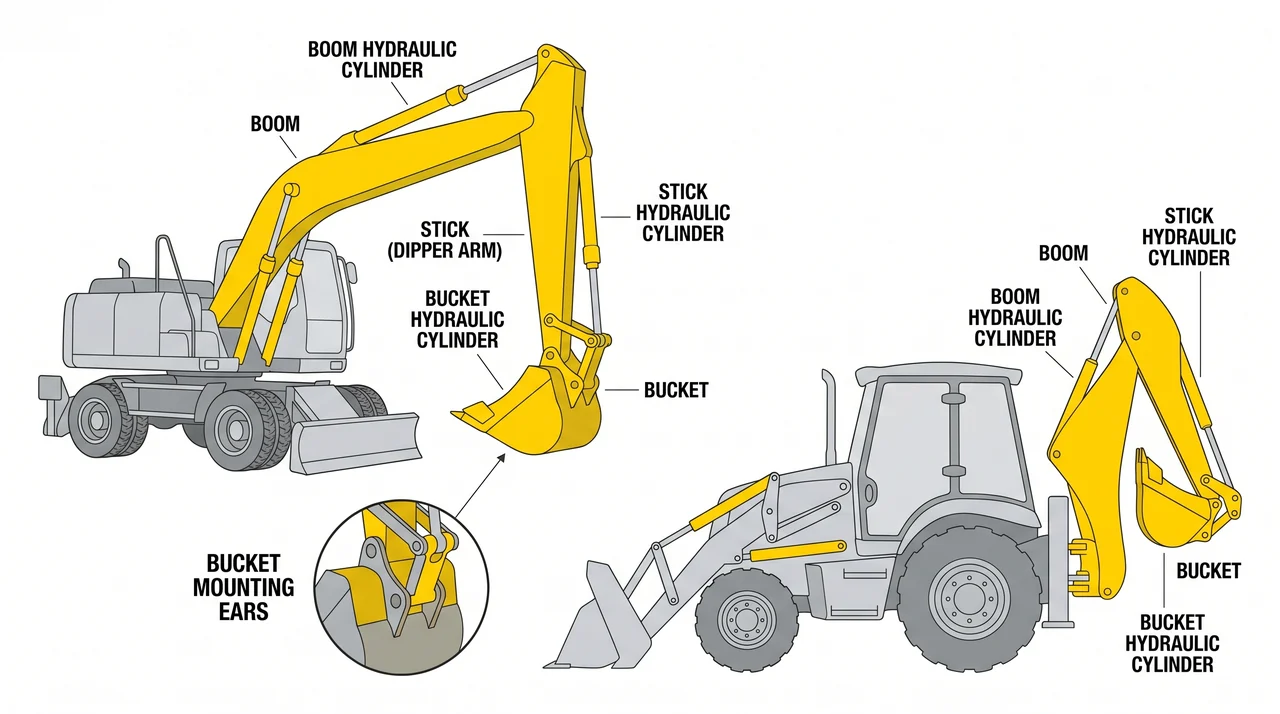
The digging system is made up of three linked components, each driven by its own hydraulic cylinder. The boom is the main structural arm, pinned to the front of the upperstructure; it establishes how high and how far out the machine can reach. The stick, also called the dipper arm, connects the boom to the bucket and controls reach and digging depth. The bucket does the actual cutting, with replaceable teeth along its edge and side cutters at the corners.
The bucket mounts to the stick through the mounting ears — heavy steel lugs at the back of the bucket. These ears carry the full load of every dig cycle, which makes them a primary inspection point. A crack in the mounting ears is an immediate removal-from-service condition. No patch, no field repair — the machine gets tagged out and the supervisor is notified.
Undercarriage inspection, rubber-tired machines, and approved attachments
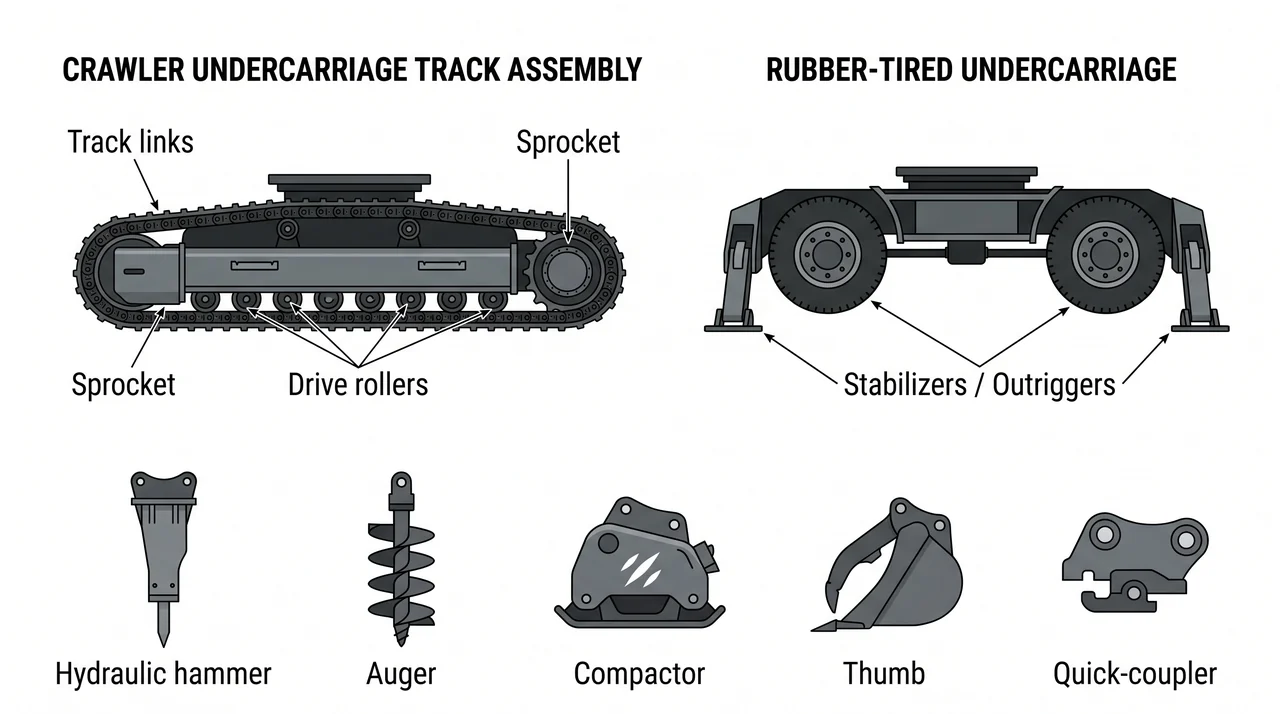
On a crawler, track tension must be checked regularly. The undercarriage system includes sprockets, drive rollers, idlers, and track links — all of which depend on proper tension to function. Too tight and the sprockets and links wear prematurely; too loose and the track can derail under a side load — which is itself a condition that removes the machine from service. A pre-shift walk includes checking for derailed or broken links, cracked undercarriage components, and missing hardware.
Rubber-tired excavators and backhoe loaders run on axles and can travel on public roads, but they require outriggers or stabilizers to be deployed and on firm ground before any lift or dig begins. A 2A license covers this full range of excavating machinery. Capability can be extended further through manufacturer-approved attachments: hydraulic hammers, augers, compactors, thumbs, and quick-couplers. The critical word is manufacturer-approved — an unapproved attachment or one used beyond its rated capacity creates a hazard for the operator and everyone on site.
Cab protection and removal-from-service conditions
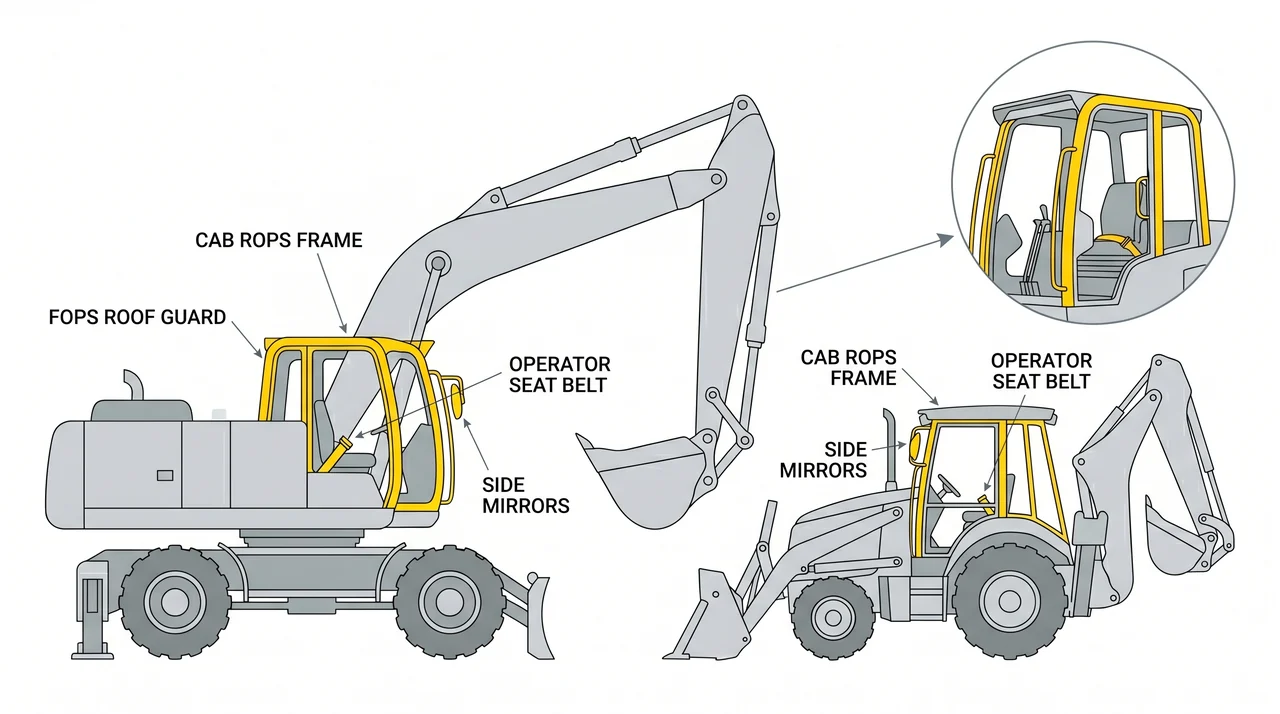
The cab gives the operator both controls and protection. ROPS and FOPS — roll-over and falling-object protective structures — are engineered to absorb specific loads. A cracked, bent, or modified ROPS or FOPS no longer provides that protection and requires immediate removal from service. The seat belt works as part of the same system, keeping the operator inside the protected zone if the machine rolls; a non-functional seat belt is a no-go condition. Mirrors and other visibility aids extend the operator's awareness of the work zone around the machine; blocked or broken mirrors should be corrected before operating.
The complete list of conditions that pull a 2A machine from service includes structural cracks in the boom or stick, cracked or damaged bucket mounting ears, a derailed or broken track, a damaged or modified ROPS or FOPS, and non-functional cab safety equipment. When you find any of these, the action is always the same: tag the machine out and notify your supervisor. Production pressure never overrides this call, and the exam will test that instinct directly.
Key Takeaways
- •An excavator is two assemblies — upperstructure and undercarriage — connected by the slew ring, which provides 360-degree rotation of the cab and boom.
- •The working arm has three components — boom, stick, and bucket — each with its own hydraulic cylinder; cracked bucket mounting ears require immediate removal from service.
- •The counterweight balances boom and load forces and must never be removed or modified in the field.
- •Crawler undercarriages require track-tension checks every shift; rubber-tired machines need stabilizers on firm ground before any lift or dig.
- •Structural cracks, derailed track, damaged ROPS, and non-functional cab safety equipment all require tagging the machine out — no exceptions.