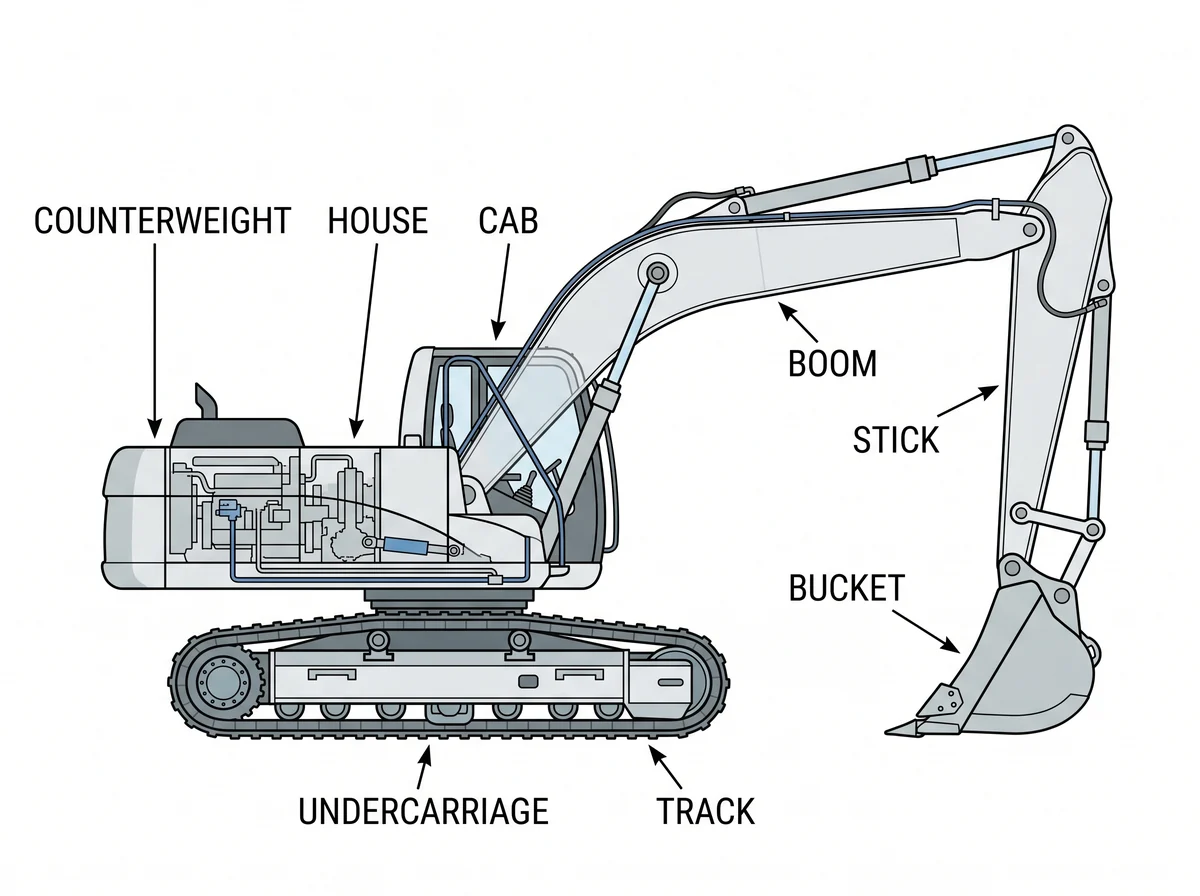
Hydraulics are what separates a modern excavator or boom truck from a pile of steel — they are the reason a machine can place a load with precision or dig through rock. But the same physics that create that power also create hazards invisible to the untrained eye. Whether you operate under the 2A restriction or the 1C restriction, you are working with a system that runs at pressures high enough to push fluid through your skin. Understanding how these circuits work, what can go wrong, and how to inspect them safely is core to the exam and core to coming home at the end of the shift.
How a hydraulic circuit converts power into force
A hydraulic circuit has a small number of major components. The reservoir stores the fluid. A pump — driven by the engine on an excavator or a power take-off on a boom truck — pushes fluid into the circuit under pressure. Control valves direct that fluid to whichever cylinder or motor the operator commands. Cylinders convert pressure into linear force: fluid pushes against a piston, moving the boom, stick, bucket, or outrigger. Filters catch contaminants before they reach precision pump and valve surfaces, and a cooler prevents overheating during long work cycles.
Construction hydraulic systems routinely operate at thousands of pounds per square inch. A small cylinder can lift enormous weight because pressure multiplied by piston area equals output force. That stored energy must be treated with the same respect you give electrical lines or suspended loads.
High-pressure hazards every operator must know
The most underestimated hydraulic hazard is injection injury. A pinhole in a hose can produce a jet of fluid so pressurized that it passes through skin without leaving more than a small red mark — while the fluid fans out destructively beneath the surface, causing tissue death that requires emergency surgery, sometimes amputation. Workers have mistaken the entry wound for a scratch and waited hours before seeking care. Treat any suspected leak with that urgency.
A burst line sprays scalding oil and, if that line was supporting a raised boom or load, the load drops. Circuits also stay pressurized after shutdown, sometimes for hours. A hose you disconnect well after engine shutdown can still inject you.
Safe leak detection and pre-service depressurization
Because searching for a leak by hand can result in injection injury, the correct method is to use cardboard or a mirror to locate the spray pattern while keeping your hands clear. Stay out of the line of any jet. Never use your bare hand.
Before any hose or fitting is disconnected, the circuit must be depressurized per the equipment manual — typically by lowering all attachments, shutting down the engine, and cycling the controls to bleed residual pressure. Skipping this step because a job is running behind is one of the most reliable ways to create a serious injury.
Relief valves, holding valves, and what happens when they fail
Relief valves are the system's pressure safety: when pressure rises above a set limit, the valve opens and routes fluid back to the reservoir instead of blowing a hose. If a control seems to bottom out without completing its movement, the relief may be opening due to an overload — and the cause needs to be found, not forced.
Holding valves, sometimes called counterbalance valves, lock a raised boom or load in place against gravity. Without them, a raised excavator boom would drift down the moment you released the control, and a suspended load on a boom truck would settle. If a boom or arm drifts with the controls in neutral, a holding valve has failed — that is a removal-from-service condition, not something to monitor and work around.
Reading fluid and hose condition
Hydraulic fluid tells you the system's health. Normal fluid is amber or clear. Milky or cloudy fluid means water contamination, which destroys pump clearances and causes rust. Dark or burnt-smelling fluid means overheating. Either condition calls for the machine to be pulled from service until corrected — not topped off and run.
For hoses, the removal-from-service criteria are clear: any visible bulge (the inner braid has failed and rupture is imminent), cracking or abrasion through the outer cover, a kink that restricts flow, or any weeping at a fitting. A bulging hose is especially urgent — it represents imminent failure under thousands of psi. Tag it out immediately.
Key Takeaways
- •A hydraulic circuit converts engine or PTO power through a reservoir, pump, control valves, and cylinders — every component has a defined role and a failure mode.
- •Hydraulic injection injury is a surgical emergency. Never use a bare hand to find a leak — use cardboard or a mirror and stay out of the line of any jet.
- •Circuits stay pressurized after shutdown. Depressurize per the manual before disconnecting any hose or fitting.
- •Relief valves protect against overpressure; holding valves prevent a raised boom or load from drifting. Unexpected drift means a holding valve has failed — tag the machine out.
- •Remove a hose from service for any bulge, abrasion through the cover, kink, or weeping fitting. Milky fluid signals water contamination; dark or burnt fluid signals overheating — both mean out of service.