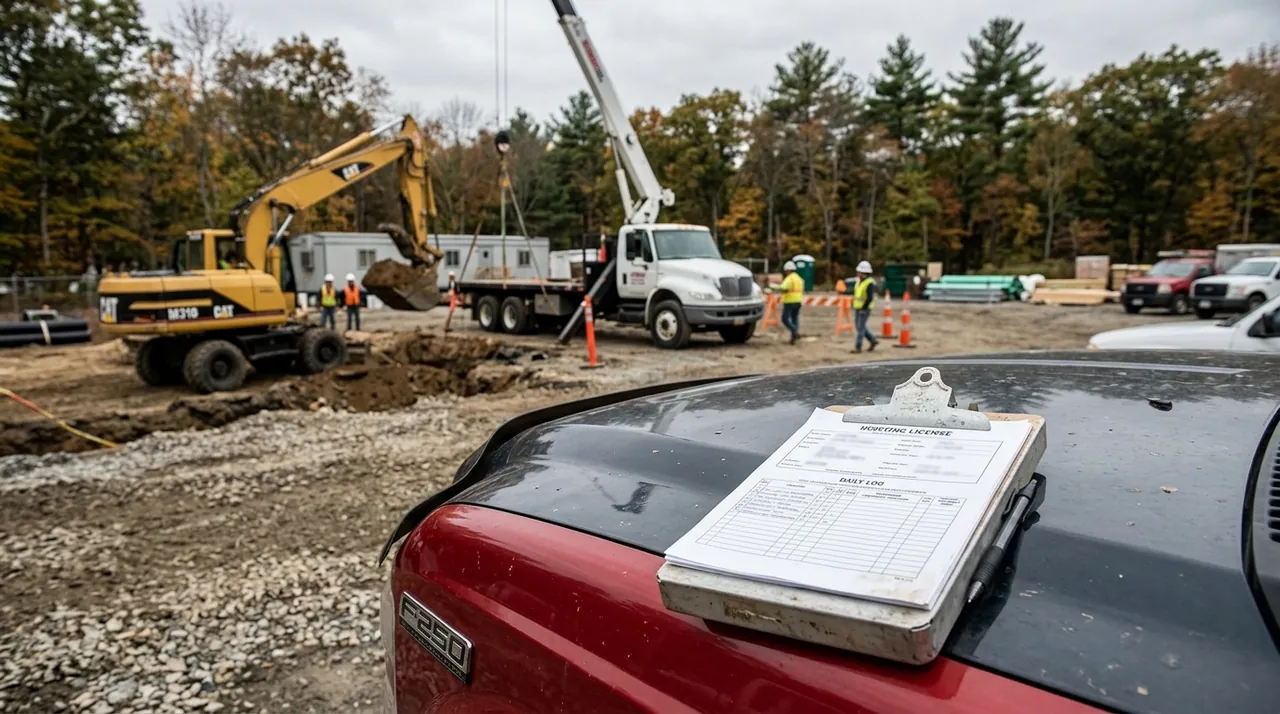
Trench collapses kill fast — a wall can fail in seconds, and a cubic yard of soil weighs well over a ton. The regulations in 29 CFR 1926 Subpart P and Massachusetts 520 CMR 14.00 exist because investigators studied those deaths and identified exactly what could have prevented each one. As an operator on a Massachusetts job site, you sit at the center of a regulated system that requires advance utility notification, qualified soil evaluation, and a protective system in place before anyone enters the hole. This session explains how those requirements connect so the rules make sense rather than just being a list to memorize.
Depth thresholds: when the rules kick in
OSHA Subpart P draws two firm lines based on trench depth. At four feet, a means of egress — a ladder, stairway, or ramp — must be in place and positioned so no worker has to travel more than twenty-five feet laterally to reach it. At five feet, a protective system is mandatory, period. There is no exception for a quick job or a short-duration entry. The only narrow carve-out applies to trenches shallower than five feet, where a competent person has personally evaluated the ground and documented that no cave-in hazard exists — a deliberate site-specific finding, not a default assumption.
Massachusetts 520 CMR 14.00 runs alongside the federal standard. Where state rules are stricter, the state governs. Your state inspector will cite 520 CMR, so knowing both standards exist and reinforce each other is part of what the 2A/1C exam expects.
The competent person and soil classification
Every excavation must have a competent person on site — someone trained in soils and protective systems who can recognize hazards and has the authority to stop work and clear the trench. That authority is real. A competent person who sees a tension crack forming or water collecting at the base must clear personnel immediately, even over schedule pressure.
Soil classification is the competent person's first duty. Type A is the most stable cohesive soil; Type B is intermediate; Type C — granular, submerged, or previously disturbed material — is the least stable. Water in the trench, visible fissuring, or a history of prior excavation all push the classification down. Classification is not a one-time morning task: if rain hits mid-shift or a freeze-thaw cycle runs overnight, the competent person re-inspects and may need to reclassify before work resumes.
Choosing and installing a protective system
Soil type determines which protective system is appropriate. Sloping and benching cut the walls back to an angle the ground can hold on its own — the required angle flattens as soil becomes less stable. Trench boxes and shields do not prevent a collapse; they protect workers if one happens, so the box must be rated for the depth and soil conditions. Shoring systems brace the walls directly and must be installed and removed in the sequence the manufacturer specifies, with workers kept out of the trench during that process. Any system installed from tabulated data must be used exactly as written; field modifications void the rating and remove the legal protection.
An engineer-designed system is required when standard tables do not cover the conditions — unusually deep trenches, high surcharge loads, or soil that falls outside the classification charts.
Dig Safe, spoil setback, and machine positioning
Before any digging starts, Massachusetts law requires you to notify Dig Safe by calling 811. Dig Safe coordinates utility locates so underground gas, electric, water, and telecom lines are marked before your bucket moves. Striking an unmarked line is not just dangerous — it carries serious legal and financial consequences, and the notification requirement gives you no excuse to skip it.
Once you are digging, keep spoil piles and equipment at least two feet back from the trench edge. Soil or machine weight sitting close to the edge surcharges the wall — applying downward pressure that can cause a collapse even in a properly protected trench. The 230 CMR 6.00 operating rules also prohibit straddling open trenches and require that all personnel stay clear of the excavator's swing and working radius. Positioning the machine correctly is not just a licensing requirement — it is the fastest way to prevent the most common serious incidents at an excavation site.
Key Takeaways
- •A protective system is required at five feet or deeper with no exceptions; egress must be within twenty-five feet of any worker in a trench four feet or deeper.
- •The competent person classifies soil before work begins and must re-inspect after rain, freeze-thaw, or any hazard-increasing event — classification is not a one-time morning call.
- •Soil runs Type A (most stable) to Type C (least stable); water, prior disturbance, and fissuring all push the rating down and require a more protective system.
- •Call 811 (Dig Safe) before any digging — it is required by Massachusetts law, not optional.
- •Keep spoil and equipment at least two feet from the trench edge to prevent surcharging, and never straddle an open trench.