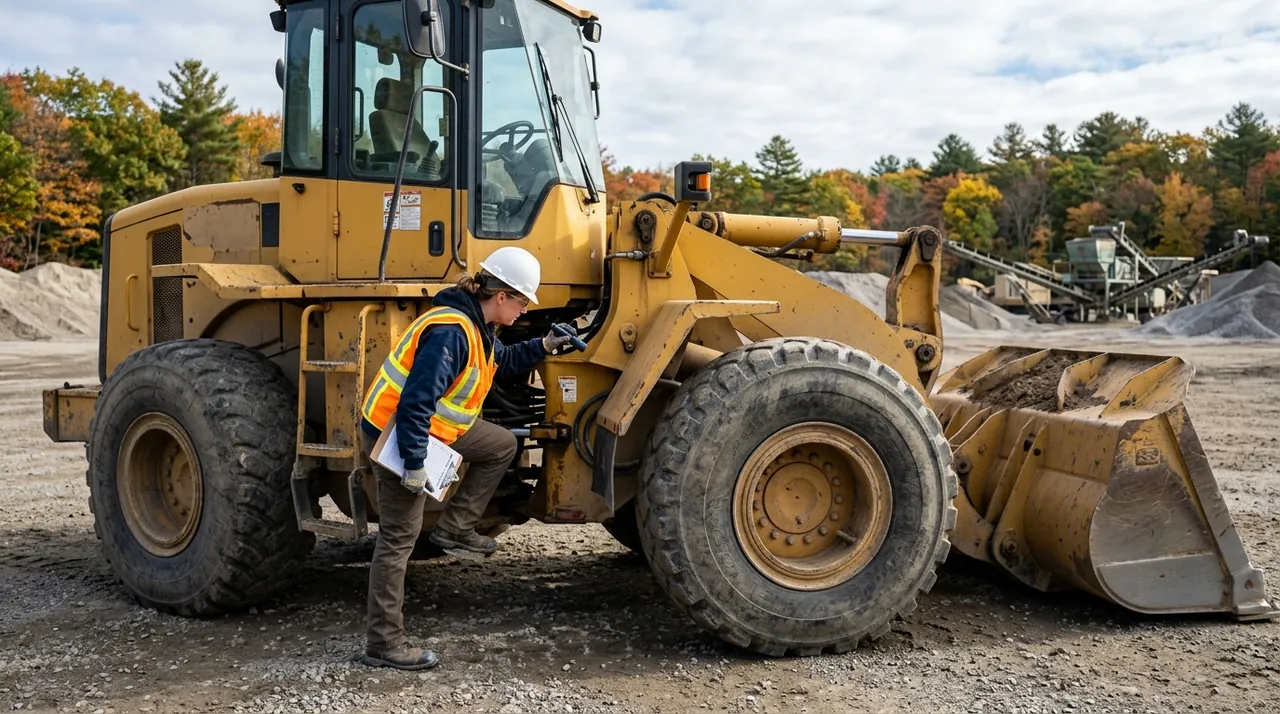
A wheel loader starts every shift with one unknown: what degraded since the last operator touched it. The pre-shift inspection is how you close that gap. It is not a paperwork ritual — it is the deliberate look that tells you whether the machine is ready to work or needs to come out of service before anyone gets hurt. For the Massachusetts 2C exam, inspections are a core competency. In the field, they are what keeps a mechanical problem from becoming an incident.
The regulatory basis: who inspects, when, and why
OSHA requires construction equipment to be inspected by a competent person on a frequent and regular basis. For wheel loaders, that requirement comes from 29 CFR 1926.601 and 1926.602 together with the general equipment standard at 1926.20. In practice, "frequent and regular" means before every shift without exception, and again after any relocation — because ground conditions and transport stress can change what the machine has been exposed to.
A competent person is someone trained to recognize hazards and empowered to correct them, including pulling the machine from service. As the operator, that is you. You cannot assume the previous shift caught everything, and you cannot hand the inspection off to a bystander. If you operate over a defect you missed, the responsibility is yours.
The 360-degree walk-around
Start at a fixed point — typically the cab door — and work around the machine in one direction. A fixed route is what keeps areas from being skipped.
Begin at ground level. Fresh fluid on the ground under the machine is the fastest indicator of a developing leak — check for engine oil, hydraulic fluid, coolant, and fuel. Move to the tires: inflation, cuts or bulges in the sidewall, exposed cords, and lug condition. Then work through the lift arms, bucket linkage, and bucket: look for cracks in weld seams, bent members, worn or loose pins and bushings at each pivot, and condition of the cutting edge and teeth. Inspect hydraulic hoses and cylinders for chafing, bulges, weeping at fittings, and cylinder rod condition.
The articulation joint needs specific attention. The frame lock bar must be properly stowed before operation — if it is not, it can restrict steering or hold the frames rigid. Check the joint's pins and look for excessive free play. Finish at the ROPS and FOPS: no cracks, bends, or unauthorized modifications.
Fluid levels, cab items, and start-up checks
With the engine off and the machine on level ground, check engine oil, hydraulic fluid, coolant, fuel, and brake and transmission fluid as applicable. Milky hydraulic fluid indicates water contamination; a burnt smell suggests overheating. Either condition stops work.
Before starting, check cab and safety items: seat belt, mirrors, windshield condition, horn, backup alarm, lights, gauges, and the fire extinguisher. Confirm the extinguisher is mounted and shows a full charge.
After starting, complete the operational checks before leaving the yard. Confirm service brakes hold, the parking brake holds on grade, and steering is responsive with no unusual lag. Cycle all controls. Sound the horn. Verify the backup alarm activates in reverse. Watch gauges as the machine warms up — any reading outside normal range is a finding, not something to watch and hope about.
Removal from service: when the machine does not go to work
Certain conditions require immediate removal from service before any work begins, regardless of schedule pressure. These are: inoperative service brakes or steering; a damaged, bent, or modified ROPS or FOPS; a non-functional seat belt; any active hydraulic leak; a non-functional horn or backup alarm; structural cracks in the lift arms, linkage, or bucket; and a missing or discharged fire extinguisher.
When you find one of these, the procedure is fixed. Tag the machine "Do Not Operate," secure the keys, and notify your supervisor. The machine stays out of service until a qualified person clears the repair. No job urgency changes that. The exam tests exactly this instinct, and so does every real shift where a supervisor pushes back.
Key Takeaways
- •Inspect before every shift and after each relocation — OSHA 29 CFR 1926.601, 1926.602, and 1926.20 require it, and you as the operator are the competent person responsible.
- •Walk a fixed 360-degree route: ground and leaks, tires, lift arms and bucket (including cutting edge and teeth), hydraulic hoses, articulation joint, ROPS/FOPS, and cab items.
- •Check the articulation frame lock bar specifically — it must be properly stowed before operation.
- •Cab and safety items include seat belt, mirrors, windshield, horn, backup alarm, lights, gauges, and the fire extinguisher — all must be verified before the shift.
- •After start-up, verify service brakes, parking brake, steering, all controls, horn, backup alarm, and gauges before leaving the service area.
- •Immediate removal-from-service conditions (inoperative brakes or steering, damaged ROPS/FOPS, bad seat belt, active hydraulic leak, non-functional horn or alarm, structural cracks, missing or discharged extinguisher) mean tag out and report — no exceptions.