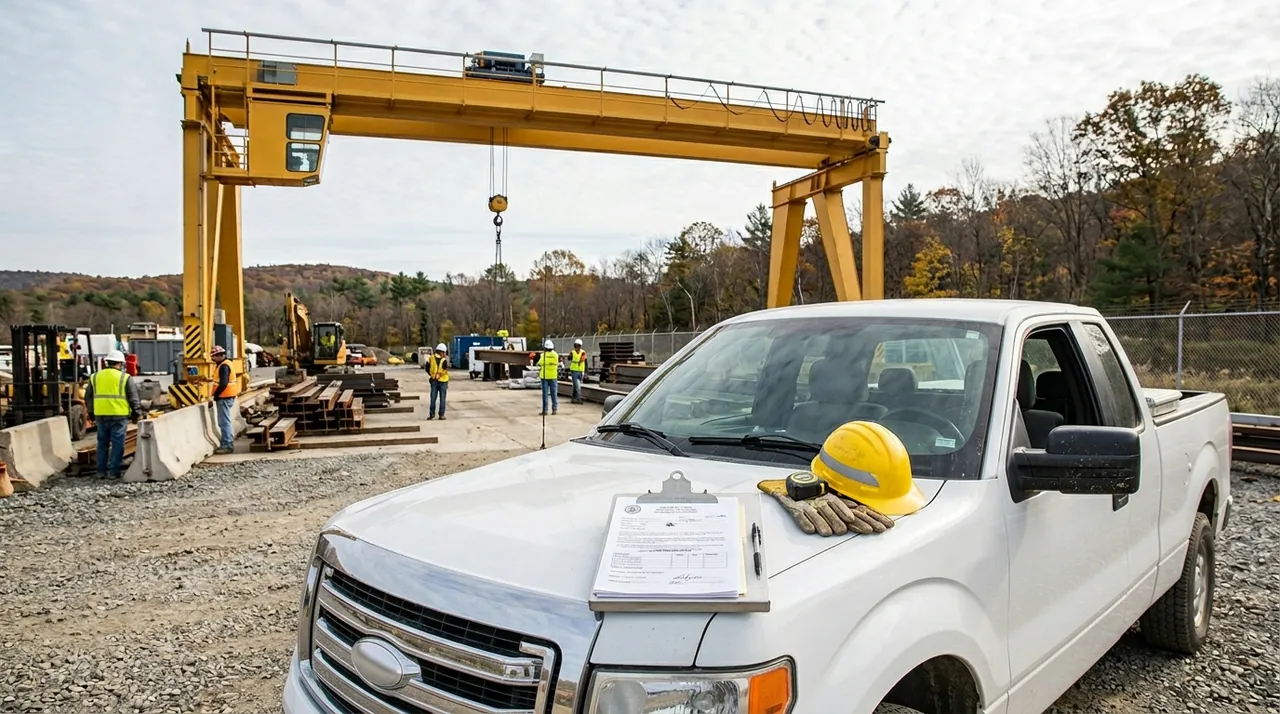
Before you can legally operate an overhead crane, a gantry, a marine hoist, or a tugger on a Massachusetts job site, you need to understand the law that puts the license in your hands. M.G.L. c. 146 is the statute that created the requirement, and the 3A restriction is the specific authorization for the equipment class you work with. This lesson covers what the law says, what the 3A license actually authorizes, and who falls outside the requirement. Getting this foundation right matters on the exam and on the job — inspectors, employers, and coworkers all assume a licensed operator knows the rules that govern them.
The statute behind the license
Massachusetts General Laws Chapter 146 is the source of the hoisting license requirement. Sections 53 through 54A define who must hold a license, what the license authorizes, and how it is obtained. Section 53 is the core provision: it prohibits operating covered hoisting equipment without a valid license issued by the state. The law does not leave this to employer discretion — the obligation sits with the operator.
Sections 65 through 67 layer on additional duties covering the examination process and issuance, employer responsibilities for verifying that operators hold valid licenses, and accident reporting requirements. These sections explain why your employer checks your card and why incidents on hoisting equipment trigger a formal reporting chain.
What the 3A restriction covers — and what it does not
The 3A restriction authorizes overhead and gantry cranes, marine lifts, jib cranes that operate without a load chart, and tugger hoists. If the equipment runs on a fixed overhead rail, lifts from a bridge structure, or hoists in a marine environment, the 3A is likely the right credential. Tugger hoists — the simple rope or chain drums used in industrial and construction settings — fall here as well.
Two common points of confusion are worth knowing cold before the exam. Pile drivers are not 3A equipment; they fall under the 4B restriction. Derricks are not 3A either; those require a 1A license. If a piece of equipment has a friction winch drum and a lattice or A-frame structure, it belongs to a different license class. The 3A is specifically about the overhead and marine hoist category, and operating outside the scope of your restriction — even if you hold a different class — is unlicensed operation under the law.
The practical requirements: age, fee, and license term
To apply for any Massachusetts hoisting license, including the 3A, you must be at least 18 years old. There is no partial or provisional license for younger operators under the hoisting statute. The application fee is $75 and it is nonrefundable — whether you pass the exam or not, that money stays with the Division of Occupational Licensure.
Once issued, the license is valid for two years. You can begin the renewal process up to 60 days before the expiration date. Letting the license lapse means you cannot legally operate covered equipment. The issuing agency is the Division of Occupational Licensure (DOL), which operates through the Office of Public Safety and Inspections (OPSI). When someone asks which state agency handles your license, DOL and OPSI are the correct answers.
Exemptions and who falls outside the requirement
The statute does not require every operator of every piece of equipment to hold a license. Agricultural operators working on their own land are exempt — if a farmer is running a hoist on property they own and the work is agricultural, the license requirement does not apply. Certain supervised programs also qualify: operators working within approved public-utility training programs, registered apprenticeship programs, and vocational school programs may operate under supervision without holding an individual license.
These exemptions are narrow. Working under a supervisor who happens to hold a license does not make you exempt. The exemption attaches to the formal program, not the individual relationship. On the exam, questions about exemptions typically involve a scenario where one element of the exemption is missing — the operator is not in an approved program, the work is not agricultural, or the supervision is informal. When in doubt, the default rule applies: a licensed operator must hold a valid 3A before operating covered equipment.
Key Takeaways
- •M.G.L. c. 146, Sections 53-54A require a hoisting license; Sections 65-67 add employer duties, exam rules, and accident reporting requirements.
- •The 3A restriction covers overhead and gantry cranes, marine lifts, jib cranes without load charts, and tugger hoists — not pile drivers (4B) or derricks (1A).
- •You must be 18 years old, pay a $75 nonrefundable fee, and renew every two years; the issuing agency is DOL/OPSI.
- •Exemptions are narrow: agricultural operators on their own land and participants in formally approved utility, apprenticeship, or vocational programs — informal supervision does not qualify.
- •An expired license means you cannot legally operate covered equipment — keep track of your two-year renewal window and start the process up to 60 days before expiration.