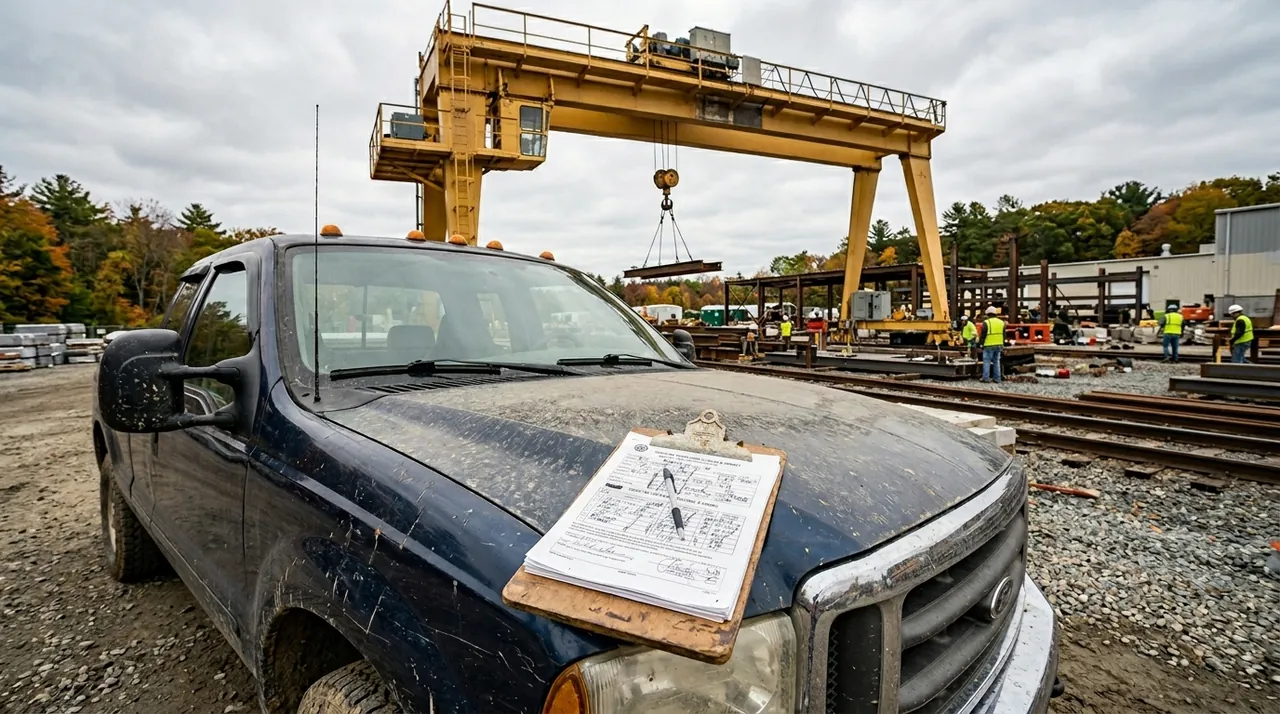
Every rule you follow on the job as a licensed 3A operator traces back to two documents: a state statute and the regulation that puts it into practice. Understanding how those two layers work together is not just an exam topic — it tells you exactly where your legal obligations come from, how they get updated, and where to go when you need a definitive answer. This lesson covers 230 CMR 6.00, the regulation that governs hoisting machinery in Massachusetts, and the specific duties it places on operators of overhead, gantry, and marine hoists.
Statute and regulation: two different things with one shared purpose
Massachusetts General Laws chapter 146 is the statute — the law passed by the Legislature — that establishes the Commonwealth's authority to license and regulate hoisting machinery operators. A statute sets the broad framework: who needs a license, what the penalties are, what agency is in charge. What it does not do is spell out the operational details: what hand signals to use, when to pull a hoist out of service, or how many hours of continuing education you need before you renew.
That is where 230 CMR 6.00 comes in. A CMR — Code of Massachusetts Regulations — is the implementing regulation written by the agency (in this case the Office of Public Safety and Inspections, or OPSI, under the Division of Occupational Licensure) to fill in the specifics that the Legislature left to the experts. The regulation has the force of law, but it lives in a different place than the statute and can be updated more easily. When the exam asks you to distinguish between M.G.L. c. 146 and 230 CMR 6.00, the answer is straightforward: the statute grants the authority; the regulation defines how you exercise it.
Recodification and why the citation matters
Until relatively recently, the hoisting machinery regulation was cited as 520 CMR 6.00. The regulation was recodified and the agency prefix changed, so the correct current citation is 230 CMR 6.00. The content of the rule did not disappear — it moved. But if you cite the old prefix on the exam or in a compliance context, you are citing something that no longer exists at that address.
This matters in the real world because inspectors, supervisors, and compliance personnel all reference the current citation. Knowing that the regulation used to live at 520 CMR 6.00 protects you from being confused by older study materials, job-site documents, or references that have not been updated. When in doubt about any citation, fee amount, or renewal deadline, the authoritative source is mass.gov — not a handout from a prior year and not a third-party summary.
What 230 CMR 6.00 requires of 3A operators on the job
The regulation establishes the 3A restriction as a classification — the license category that covers overhead, gantry, and marine hoists. Inside that classification, the regulation imposes specific operating duties that apply every time you take the controls.
You are responsible for operating within the manufacturer's specifications and the equipment's rated capacity. Rated capacity is not a suggestion; it is the outer limit the manufacturer certifies the machine can handle safely, and exceeding it puts the entire lift at risk. The regulation also requires the use of a qualified signaler to direct crane and hoist movements. Standard hand signals exist for overhead and gantry operations, and both parties are expected to know them. Only authorized personnel may operate the machine — if someone is not licensed and authorized, they do not touch the controls, regardless of who asks. Finally, when you discover a defect that makes the hoist unsafe, the regulation is unambiguous: remove the equipment from service. That duty outweighs production pressure.
Continuing education and keeping your license current
Section 230 CMR 6.04 establishes the continuing education requirement that applies before each license renewal. The regulation requires that operators complete continuing education prior to renewing — the specific hours and course requirements are set by the Office of Public Safety and Inspections (OPSI) under the Division of Occupational Licensure, and the current figures are maintained at mass.gov. Do not rely on word-of-mouth or old study guides for the exact requirement; fees and hour thresholds are the kind of detail that gets updated between regulatory cycles.
The broader lesson here is that holding a 3A license is an ongoing obligation, not a one-time achievement. Staying current with 230 CMR 6.00 is part of what it means to be a licensed operator.
Key Takeaways
- •M.G.L. c. 146 is the statute that grants authority; 230 CMR 6.00 is the regulation that spells out the operational details — both have the force of law.
- •The regulation was recodified from 520 CMR 6.00 to 230 CMR 6.00; always use the current citation.
- •3A operators must stay within rated capacity, use standard hand signals with a qualified signaler, allow only authorized personnel on the controls, and remove unsafe equipment from service.
- •230 CMR 6.04 requires continuing education before each renewal; verify current hours and fees at mass.gov.
- •When you need authoritative current figures — fees, deadlines, course requirements — go to mass.gov, not older secondary sources.