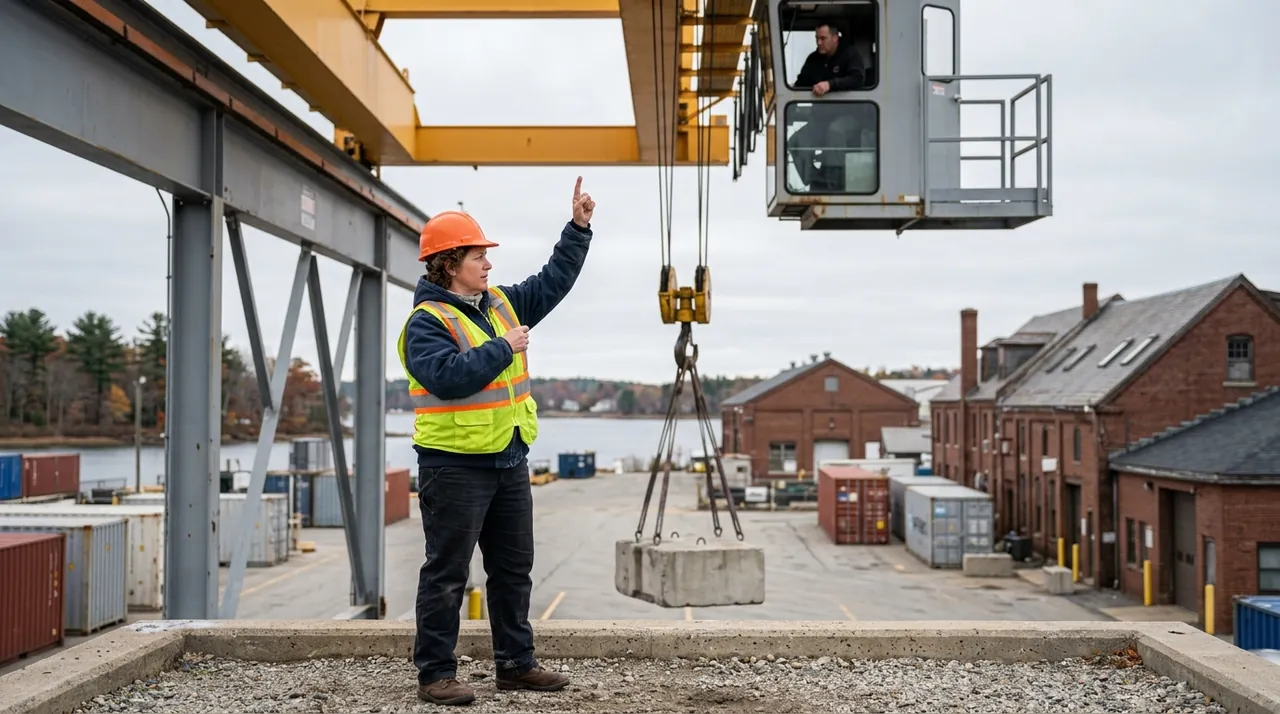
A hoist operator works through a chain of communication, and that chain is only as strong as its weakest link. Hand signals give every person on the floor or dock a shared language that does not depend on hearing over engine noise and cannot be misunderstood when everyone trains on the same system. For the 3A exam, know the standard signals cold, understand who can give them and when, and be clear about what happens when the communication channel breaks down.
The Standard Signal Set: Hoist, Lower, Stop, and Beyond
The core hand signals used in overhead, gantry, and marine hoisting are standardized so any trained signaler and operator can work together on the first day without confusion. The fundamental set covers the moves the hook makes: Hoist (raise the load), Lower (bring it down), Stop (hold position), and Emergency Stop (freeze everything immediately). The travel signals tell the bridge or trolley where to go: bridge travel moves the entire hoist unit along the runway, while trolley travel moves the hook block laterally across the bridge beam.
For precision work — spotting a shaft into a bore or landing a motor on a mount — the Move Slowly signal is critical. It tells the operator to move in small increments rather than at operating speed. Combining a travel or hoist direction with Move Slowly is how you get exact placement without overshoot. The distinction between gross positioning and fine control is exactly the kind of detail the exam tests.
Who Gives the Signals, and From Where
Only one designated signaler directs an operator at any one time. If two people give conflicting signals, the operator has no reliable information and the lift becomes dangerous. Before the lift begins, everyone agrees on who the signaler is — after that, the operator follows their signals and no one else's, with one critical exception discussed next.
The signaler must be positioned so the operator can see them clearly throughout the entire move: clean sightline to the cab or control station, clear of any swing zone, and never directly under the load. In marine settings, distance, obstructions, and glare force the signaler to choose their position carefully and consider a backup communication method when hand signals alone may not reach.
Standard signal charts are required to be posted at the operating station. Reviewing them before a lift removes any ambiguity about what a given gesture means.
Emergency Stop: The One Signal That Belongs to Everyone
The rule about a single designated signaler has one absolute exception: the Emergency Stop signal. If any person on the job — a rigger, a ground worker, a bystander — gives an Emergency Stop, the operator must obey it immediately. No questions, no hesitation, no checking whether that person is the designated signaler.
A developing hazard is often visible to someone who is not the signaler: a load shifting in the rigging, a pedestrian stepping into the drop zone, a sling about to fail. The operator cannot afford to filter the signal. Obey first, then sort it out once the load is stopped and the scene is safe. The exam tests this directly, and so will the job.
Lost Sightline and Conflicting Signals: Stop and Resolve
Two situations require the same response: the operator loses sight of the signaler mid-move, or receives conflicting signals from different people. In both cases, stop the load and hold position until communication is re-established or the conflict is resolved. A move without reliable guidance is unsupervised, and an unsupervised overhead load is an uncontrolled hazard.
Where noise and distance make hand signals impractical — particularly in marine environments — radio communication is the appropriate tool. Radios extend working range and cut through ambient noise, but they introduce their own failure modes: dead batteries, dropped calls, channel confusion. The pre-lift signal review is how you stay ahead of those problems. Before any lift, the operator, signaler, and riggers confirm the communication method, agree on a backup if the primary fails, and make sure everyone understands the commands being used. That short conversation prevents most communication failures before the load leaves the ground.
Key Takeaways
- •The standard signal set includes Hoist, Lower, Stop, Emergency Stop, bridge travel, trolley travel, and Move Slowly — know each one precisely.
- •Only one designated signaler directs the operator at a time; the signaler must always be visible to the operator and never positioned under the load.
- •Emergency Stop is the only signal that any worker on the site can give — the operator must obey it immediately, regardless of who gives it.
- •Lost sightline or conflicting signals both require the same response: stop the load and hold until communication is restored and clear.
- •A pre-lift signal review between operator, signaler, and riggers prevents most communication failures before the load ever leaves the ground.