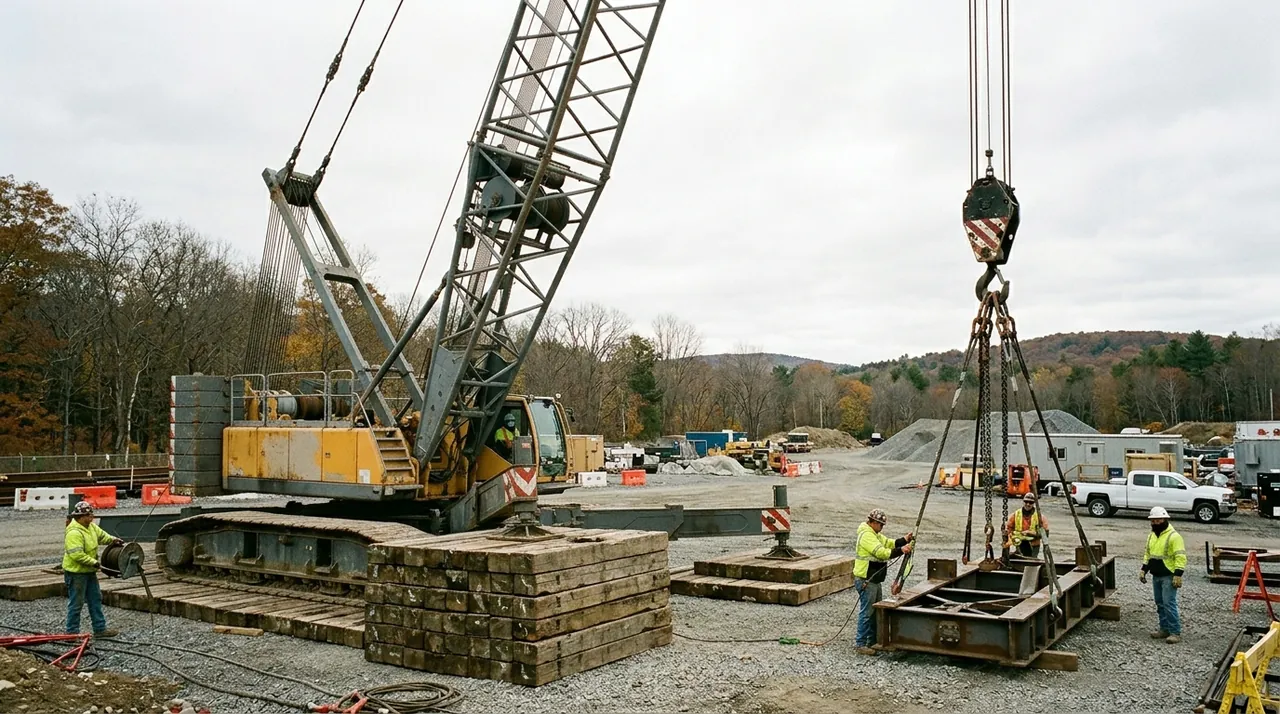
Before you attach a sling or take up slack on a hoist line, you need to answer one question: is this lift within the machine's rated capacity for the exact configuration I am working in right now? The load chart is how you answer that question. This session builds the skill of reading a load chart as a working tool and explains the OSHA rules that make it your legal responsibility as the operator.
How a load chart works — and what it is actually telling you
A crane's rated capacity is not a single number. It is a family of numbers, each tied to a specific combination of conditions: the load radius, the boom length, and the machine configuration. Change any one of those variables and you are reading a different cell in the chart.
Load radius is the horizontal distance from the center of the crane's rotation to the center of the suspended load — not the length of the boom, but the horizontal reach. As the load moves farther out, the overturning moment on the crane increases, which is why rated capacity falls as radius grows. Boom angle and radius are directly linked: a steeper angle means a shorter radius and higher capacity; lowering the boom to extend reach drops capacity fast.
Configuration produces entirely separate capacity columns. A crane on fully extended outriggers is more stable than one on partially extended outriggers, which is in turn more stable than one on rubber tires or crawlers — and the chart reflects those differences with different capacity figures for each setup. Over-front, over-rear, and 360-degree columns exist because the crane's geometry is not symmetrical — lifting over the side at a given radius may be rated lower than over the front. ASME B30.5 requires that load rating charts include capacities for all operating radii, boom angles, and work areas applicable to the machine. If a lift falls outside the chart's coverage, it cannot proceed without additional engineering analysis.
Lattice booms and jib sections
On a lattice-boom crane, adding a jib to the tip of the main boom changes the machine's weight distribution and its structural load path. The chart will have separate sections for the main boom alone and for the boom-plus-jib combination at various offset angles. You cannot apply the main-boom ratings when a jib is attached. The machine is a different configuration, and the chart values that govern it are different too.
Your OSHA obligations at the cab and on the load
OSHA 1926.1417 requires that rated capacity charts be readily available in the operator cab at all times. This is the operator's responsibility — if the chart is missing or does not match the configuration on the machine, the crane is not authorized to operate.
The same regulation sets a specific threshold: if a load appears to exceed 75 percent of rated capacity for that radius and configuration, you must confirm the actual load weight before proceeding. Estimating is not confirming. This rule exists because dynamic forces — wind, load acceleration, and swinging — add to the effective load beyond what the scale ticket shows. Those forces consume margin fast near the top of the chart.
OSHA 1926.1417 also requires a minimum of two full wraps of wire rope on the hoist drum at maximum hook lowering. Those wraps anchor the rope and prevent it from unseating under tension. Operating below that minimum is a violation regardless of whether the lift is within rated capacity.
Rigging hardware and the full capacity chain
The load chart governs the crane, but it is not the only rated-capacity number on the job. Every rigging component — slings, shackles, and hooks — must have a documented Working Load Limit. The weakest link controls the entire lift. A crane that is within rated capacity on the load chart cannot safely make the pick if the slings or shackles are rated below the actual load weight. Hardware without visible WLL markings should not be placed in service.
This is where derating factors become practical. Wind, acceleration, and swinging all increase the effective load on the hook beyond the static weight. Experienced operators stay well inside rated capacity when conditions are less than ideal, and the 75-percent rule is the regulatory floor for that discipline.
Key Takeaways
- •Rated capacity is always specific to the combination of load radius, boom length, and machine configuration — changing any one requires reading a different number from the chart.
- •Load radius is horizontal reach from the center of rotation, not boom length. Capacity falls as radius increases because the overturning moment grows.
- •OSHA 1926.1417 requires the load chart to be in the cab at all times and the operator to confirm actual load weight before proceeding when a lift may exceed 75 percent of rated capacity.
- •At maximum hook lowering, at least two full wraps of rope must remain on the hoist drum per OSHA 1926.1417.
- •Every rigging component has its own Working Load Limit — the lowest-rated piece controls the lift. Wind, acceleration, and swinging all add to effective load beyond static weight.