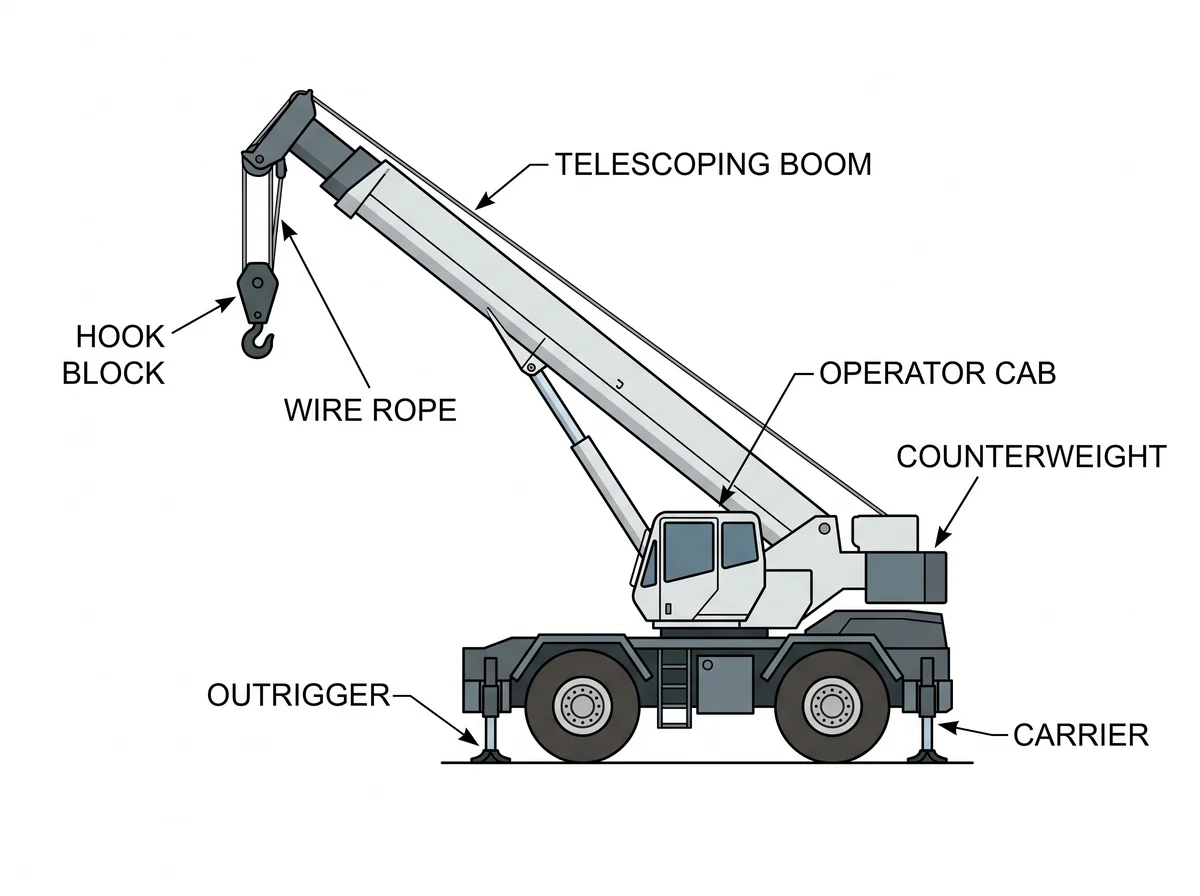
A truck crane is two machines in one: a highway-capable carrier that gets the equipment to the jobsite, and a full rotating crane that does the lifting once it arrives. Understanding how those two halves connect — and how outriggers transform a moving vehicle into a stable lifting platform — is the foundation of safe truck crane operation. This session covers the major systems from the ground up, explains why outrigger setup is the most capacity-critical decision you make before a lift, and walks through the safety devices OSHA requires to be working before the hook leaves the ground.
Carrier, Upperstructure, and the Slew Ring
The carrier is the lower half — a heavy-duty truck chassis with engine, drivetrain, axles, and steering built for highway travel and positioning. The upperstructure, or superstructure, sits on top: this is the revolving crane body containing its own power source, the operator's cab, the hoist drums, and the boom. The connection between the two is the slew ring, a large precision bearing that allows the upperstructure to rotate a full 360 degrees on the carrier.
When traveling, the swing lock engages to prevent the superstructure from shifting freely in transit. Before any lift begins, that lock must be released. Forgetting to engage it before travel — or forgetting to release it before lifting — is a common exam scenario, and a genuine hazard in the field.
Friction Drums, Lattice Boom, and Jib
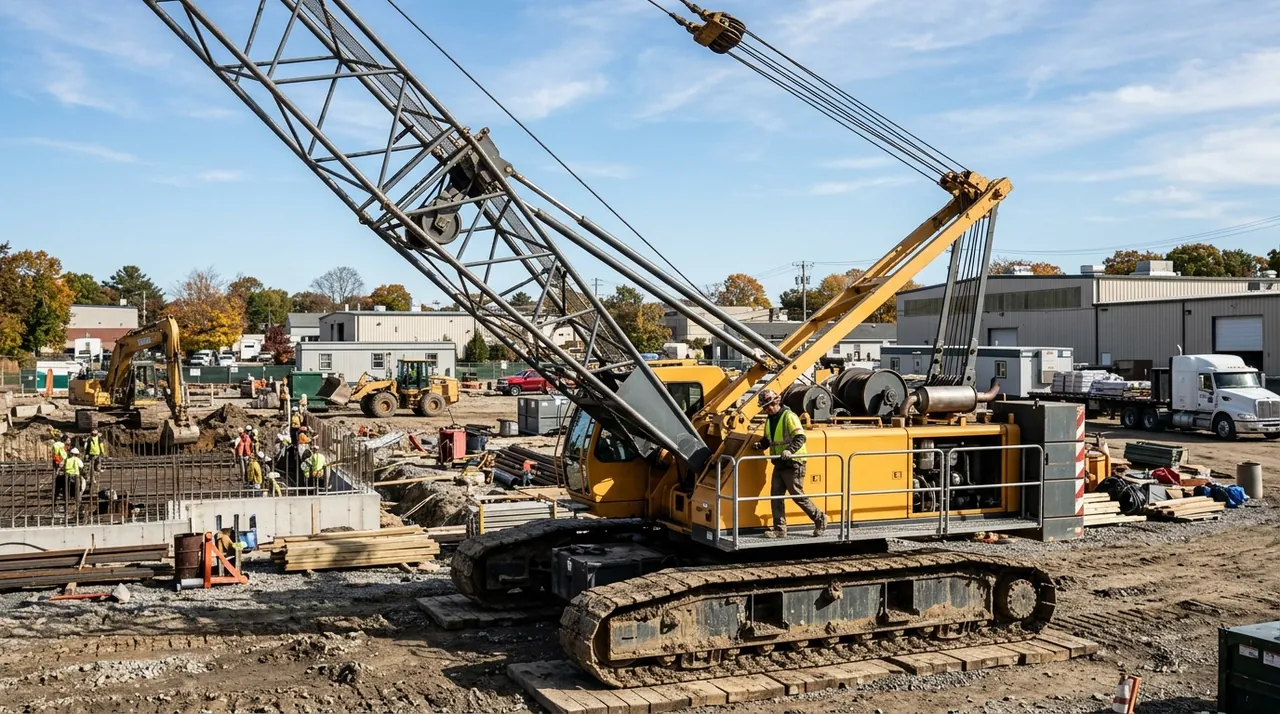
The lifting power comes from friction hoist drums: a main hoist for the primary line and an auxiliary drum for the whip line on lighter picks. These drums use a mechanical friction clutch to engage and a band brake to hold the load. Developing feel for the clutch is the core 1A operating skill; it is not the self-regulating system you find on modern hydraulic machines.
The boom is a lattice structure — boom butt, interchangeable standard inserts, and a boom top — assembled to the length the job requires. A jib, or fly, can be pinned to the boom top for additional horizontal reach. The jib has its own separate ratings on the load chart and must never be read against the main boom column.
Outriggers: Configuration Determines Capacity
Outrigger beams extend horizontally from the carrier sides, and the outrigger jacks — vertical hydraulic cylinders at the end of each beam — push down to lift the carrier off its tires. This widens the effective base and dramatically increases rated capacity and stability compared to on-rubber operation.
The load chart gives different capacity columns for fully extended, partially extended, and on-rubber configurations. The column you must use is the one that matches your actual setup. Using the fully extended numbers when you are mid-extension is not conservative — it is an unsafe lift. Under each jack sits a float, and under the float goes pads and cribbing. Their job is to spread the concentrated point load from the jack across enough soil surface area to prevent the outrigger from sinking mid-lift.
Required Safety Devices Under OSHA 1926.1415 and 1926.1416
OSHA separates truck crane safety equipment into two groups. Under 1926.1415, the required safety devices are a crane level indicator, boom stops, jib stops, foot pedal brake locks, and a horn. These are go/no-go items — any one inoperable takes the machine out of service.
Under 1926.1416, the required operational aids include a boom angle and radius indicator, and a load moment indicator (LMI) for cranes with a rated capacity greater than 6,000 lb manufactured after March 2003. The LMI monitors the relationship between the suspended load and the crane's rated capacity and warns the operator as that limit is approached. Lattice boom cranes manufactured after November 8, 2011 must also be equipped with an anti-two-block device, which prevents the hook block from being hoisted into the boom sheaves — a failure mode that can drop a load without warning.
Key Takeaways
- •The carrier travels; the upperstructure lifts. The slew ring connects them for 360-degree rotation. Engage the swing lock before travel; release it before lifting.
- •Friction hoist drums use mechanical clutch and band brake — developing feel for the clutch is the defining 1A operator skill.
- •The outrigger configuration you actually set up (fully extended, partial, or on rubber) determines which load chart column applies. Never use a higher-capacity column than your real setup.
- •Pads and cribbing under outrigger floats distribute the jack's concentrated point load across soil — skipping them risks the outrigger sinking mid-lift.
- •OSHA 1926.1415 requires level indicator, boom/jib stops, pedal brake locks, and horn. OSHA 1926.1416 adds boom angle/radius indicator, LMI for qualifying cranes, and anti-two-block on lattice boom cranes built after November 8, 2011.