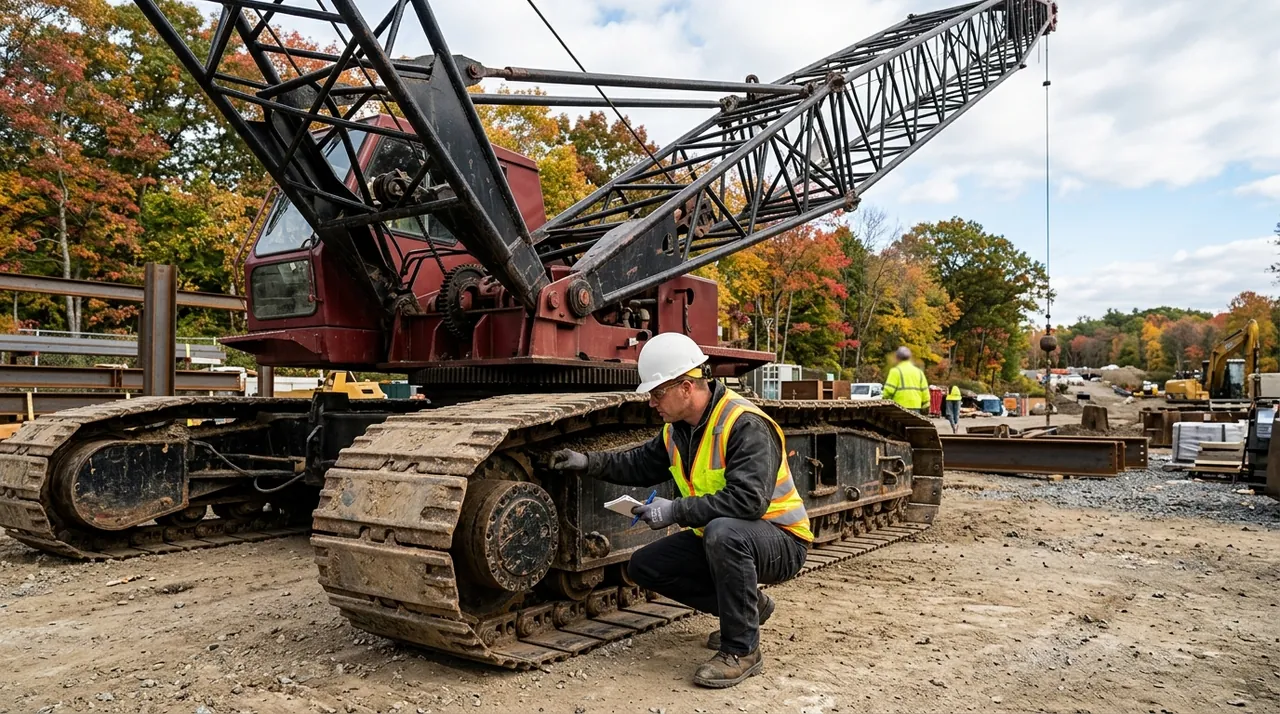
A crane accident rarely starts at the moment of failure. It starts earlier, when someone skipped the inspection, guessed at the load weight, or ignored a soft spot in the ground. Pre-lift planning and pre-shift inspections exist to close those gaps before the hook ever leaves the ground. This lesson covers the inspection regime required by OSHA 1926.1412 and the lift planning sequence that ensures your configuration is matched to the load, the radius, and the ground beneath you.
The inspection regime: pre-shift, monthly, and annual
OSHA 1926.1412 requires a competent person to inspect the crane before each shift. The pre-shift checklist is broad: control mechanisms, drive mechanisms, pressurized lines, hydraulic fluid, hooks and latches, wire ropes, electrical apparatus, ground conditions, equipment levelness, cab windows, and all safety devices. The goal is to catch slow deterioration — a rope that has developed a kink, a hook latch that no longer snaps shut — before it becomes a drop.
Monthly inspections cover the same items but add a documentation requirement: the inspector's name, signature, and date, with records retained for three months. Annual inspections go deeper and must be performed by a qualified person who can evaluate structural members, bolts, fasteners, welds, sheaves, and brake and clutch components. These parts wear slowly and can look acceptable to an untrained eye long after they have degraded below safe operating limits.
Building the lift plan in the right sequence
A lift plan has a required sequence you cannot shortcut. First, determine the exact load weight — not an estimate. If you do not know the weight, you do not proceed. Next, determine the load radius: the horizontal distance from the crane's centerline of rotation to the center of the load. With those two numbers, select a boom configuration, then consult the load chart for that configuration. Your actual load must stay within the rated capacity at your radius. Finally, verify ground conditions and determine your rigging. Rigging comes last because you size the crane to the lift first.
Wind belongs in every lift plan even when the morning feels calm. Manufacturer load charts include wind speed restrictions because lateral wind loads on the boom add stress the capacity numbers do not account for, and wind on a large surface load creates swing that can drive a crane toward tip-over.
Ground conditions and outrigger support
OSHA 1926.1402 requires that ground conditions be firm, drained, and graded before a crane is assembled or used. When native soil cannot meet that standard, you supplement with blocking, mats, or cribbing. The controlling entity must inform the operator of any known subsurface hazards — voids, tanks, utilities — because you cannot design outrigger support for ground you do not understand.
Outrigger pad sizing follows a direct calculation: pad area equals the maximum outrigger load divided by the allowable soil bearing pressure. Bigger pads spread the load over more area and keep the soil from failing underneath you. Crane levelness matters for the same reason: a crane sitting out of level shifts its center of gravity, invalidates the load chart, and increases tipping risk. Manufacturer tolerance is typically plus or minus one percent of level.
Critical lifts: when the plan must go further
Under OSHA 1926.1432, any lift involving multiple cranes is a critical lift, as is any lift the operator or lift director determines requires special procedures. A critical lift plan must be developed by a qualified person and reviewed by a competent person. Before the lift begins, a pre-lift meeting is required with all workers involved so everyone understands the plan and their role in it.
An exclusion zone must be established around the crane equal to the maximum radius plus the load's swing potential. No unauthorized personnel enter that zone during the lift. The exclusion zone is what keeps a load shift or dropped rigging from becoming a fatality — and the pre-lift meeting is what ensures everyone on site knows where that boundary is.
Key Takeaways
- •OSHA 1926.1412 requires a competent person to inspect before every shift; monthly records are retained three months; annual inspections require a qualified person.
- •Lift planning sequence is fixed: load weight, load radius, boom configuration, load chart, ground conditions, rigging — in that order.
- •Under 1926.1402, ground must be firm, drained, and graded; outrigger pad area equals maximum outrigger load divided by allowable soil bearing pressure.
- •A crane out of level has reduced rated capacity and increased tipping risk; confirm levelness within manufacturer tolerance before every lift.
- •Critical lifts under 1926.1432 require a qualified person to write the plan, a competent person to review it, and a pre-lift meeting before the hook moves.