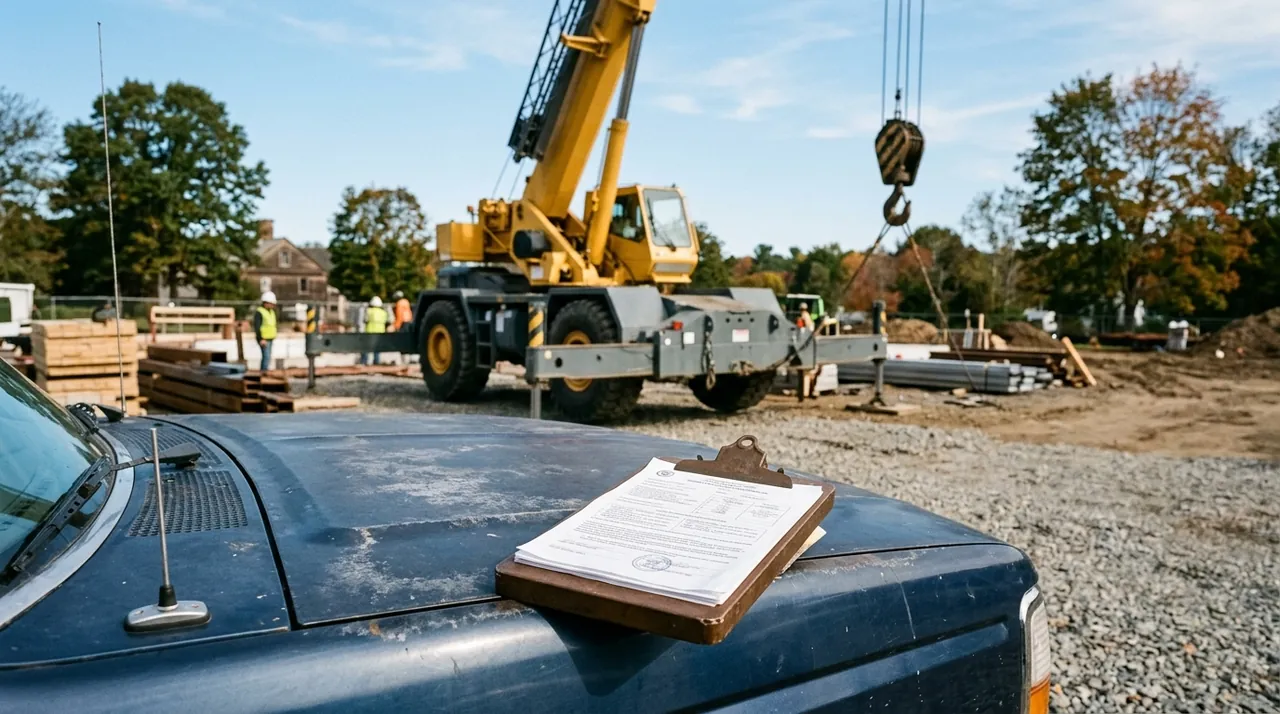
Before you climb into the cab of a hydraulic truck crane or a rough-terrain crane, Massachusetts law has already decided something about you: you need a license. This session covers the legal foundation that makes that true — the statute, the regulation, and the agency that enforces both — and walks through exactly what a 1B license covers, what it does not, and the administrative requirements you need to meet to get it and keep it. Understanding the licensing framework is not background noise. It tells you what equipment you can legally operate, under whose authority, and what happens to your livelihood if the paperwork lapses.
The law and the regulation: what governs your license
Two documents sit at the top of the licensing framework. The first is Massachusetts General Laws Chapter 146, sections 53 through 54A, along with sections 65 through 67. Chapter 146 is the statute — the legislative act that says who must hold a hoisting license and what the consequences are for working without one. It also establishes the requirement that an operator pass an examination covering the working parts of the machinery, safety practices, hand signals, and inspection.
The second document is 230 CMR 6.00, titled Hoisting Machinery. This is the implementing regulation — the detailed rulebook that the statute authorizes the agency to write. It was previously numbered 520 CMR 6.00, so if you see that citation in older materials, know it describes the same regulation. On the exam, always cite 230 CMR 6.00.
The agency that issues your license is the Division of Occupational Licensure, through its Office of Public Safety and Inspections. A common exam distractor names the Department of Public Safety — that was the former name. The correct answer is DOL/OPSI.
What the 1B restriction means and how it fits among other classes
The 1B restriction covers equipment that combines two specific features: a telescoping boom and a wire-rope hoist line that runs over a drum. Hydraulic truck cranes and rough-terrain cranes are the machines this describes. The wire rope is what sets 1B apart from its close neighbor, 1C. A 1C machine operates with a hydraulic cylinder to lift the load directly, with no wire rope over a drum. If the machine has a drum and a wire rope, it is 1B, not 1C.
The 1A restriction sits above 1B in authority. A 1A license — issued for friction-clutch machines, lattice-boom cranes, and derricks — automatically includes 1B authority. A licensed 1A operator can legally run 1B equipment, but a 1B operator cannot run a 1A machine. Understanding where 1B fits in this hierarchy matters for the exam and for daily decisions about who may legally operate a given piece of equipment.
Age, fees, and the license term
The minimum age to hold any Massachusetts hoisting license, including 1B, is 18 years old. The application fee is $75 per restriction class, and it is nonrefundable regardless of whether you pass the exam or not. These numbers appear directly on the exam, so fix them in memory.
Once issued, the license is valid for two years. You may apply for renewal up to 60 days before the expiration date. An expired license is an invalid license — do not let it lapse and assume you can continue working. Renewal is not simply a matter of paying a fee; 230 CMR 6.04 requires continuing education before a 1B license can be renewed. Make sure your CE hours are completed before you submit your renewal application, not after.
Who is exempt and what the exam tests
The licensing requirement is broad, but MGL Chapter 146 carves out specific exemptions. Agricultural operators working on their own land do not need a hoisting license for equipment used in farming operations. Certain supervised programs also qualify: public utility workers in approved training programs, vocational school students, and participants in approved apprenticeship programs under direct supervision. These exemptions are narrow and conditional — they do not cover general construction work, and the supervision requirement is not optional.
The exam tests what the statute requires: working parts of the machinery, safety practices, hand signals, and inspection. Knowing the statute, the regulation, the agency, and the scope of your restriction is how you avoid violations — and how you pass the first section of the exam.
Key Takeaways
- •MGL c. 146 §§ 53–54A is the governing statute; 230 CMR 6.00 (not the former 520 CMR) is the implementing regulation; the issuing agency is DOL/OPSI.
- •A 1B license covers telescoping-boom cranes with a wire-rope hoist line over a drum — hydraulic truck cranes and rough-terrain cranes. No wire rope means 1C, not 1B.
- •A 1A license includes 1B authority; a 1B license does not authorize 1A equipment.
- •Minimum age is 18; the application fee is $75 per restriction class and nonrefundable; the license is valid for two years.
- •Renewal requires completing continuing education under 230 CMR 6.04 before the license expires; an expired license is invalid, so do not let it lapse.