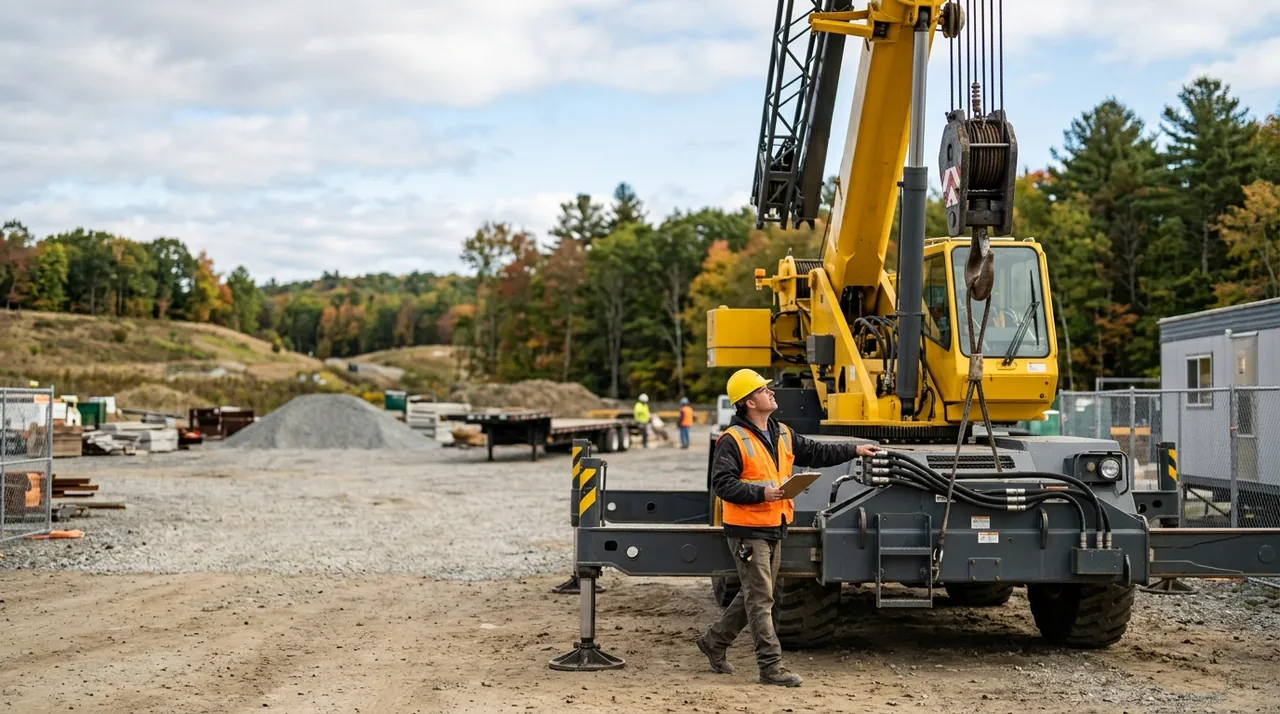
A telescoping-boom crane is only as reliable as the wire rope holding the load. That rope bends around sheaves under tension, cycles thousands of times over a season, and absorbs the shock of every pick and set. Knowing how to read it — and when to pull it from service — is a core competency for the 1B license. This session covers wire-rope construction, the inspection criteria that govern mobile cranes under ASME B30.5, and the components the rope passes through: sheaves, the hoist drum, and end connections.
How wire rope is built
A wire rope is an assembly of individual wires twisted into strands, with those strands laid around a central core. The core is either a fiber core or an independent wire rope core (IWRC). An IWRC is stiffer and more resistant to crushing under the pressure of a loaded hoist drum — that is the preferred construction for running rope on cranes. Lay direction describes how the strands are wound around the core (right-hand or left-hand lay) and how the wires are twisted within each strand (regular or Lang lay); this matters during reeving and inspection because it affects how the rope contacts sheave grooves.
Running rope is the hoist line that moves over sheaves and spools onto the drum; it is built for flexibility and fatigue resistance. Standing rope is used in static pendant applications and is built for abrasion resistance. ASME B30.5 applies different removal criteria to each type because the failure modes differ — running rope fails from bending fatigue, standing rope from surface wear and corrosion.
Defects and removal criteria under ASME B30.5
ASME B30.5 is the governing inspection standard for mobile and locomotive cranes and defines precisely when a rope must come out of service. Broken wires are the most common finding. ASME B30.5 sets a broken-wire threshold counted within one rope lay — the distance it takes one strand to complete one full turn around the core. Breaks clustered in a single strand are treated more seriously than the same number distributed across all strands, because clustering signals a localized stress point rather than general fatigue.
Beyond broken wires, these conditions all require immediate removal: reduction in diameter from external abrasion; corrosion, including internal corrosion you detect as stiffness or reddish powder working out of the strands; kinks (permanent bends that destroy the wire geometry at that point); birdcaging, where strands have expanded outward after a shock load; crushing, where the rope has been flattened by an overloaded drum or improper fleet angle; core protrusion; and any heat damage or electrical arc contact. A rope that has touched an energized line comes out regardless of appearance — arc damage to interior wires is invisible.
Sheaves, the drum, end connections, and inspection intervals
The rope's condition is inseparable from the condition of the components it runs through. A sheave groove worn too narrow pinches the rope and accelerates wire breakage; a groove too wide lets the rope flatten under load. Use a sheave gauge to verify groove profile. Check sheave flanges for cracks. On the hoist drum, inspect groove condition and flange integrity — a corroded or damaged drum surface abrades the rope on every wrap.
End connections deserve close attention. The wedge socket is the most common connection on telescoping-boom hoist lines. The tail must extend past the wedge and be secured with a keeper; the wedge and socket must match the rope diameter. The becket — the dead-end anchor at the drum or on the reeving — must also be checked for proper seating and wear. Swaged fittings must be free of cracks at the swage boundary and must not move relative to the rope — rotation or pull-out indicates failure.
ASME B30.5 sets two inspection intervals: frequent (daily or each shift, by the operator) and periodic (less frequent, by a qualified person, including end-connection disassembly where warranted). Periodic inspections must be documented and the records retained. When either inspection surfaces a removal condition, the rope gets tagged out and replaced before the crane works again. Production pressure does not change that equation.
Key Takeaways
- •Wire rope is built from wires, strands, and a core; IWRC is preferred for crane hoist lines because it resists crushing on the drum.
- •ASME B30.5 governs mobile-crane wire-rope inspection; removal conditions include broken wires beyond the threshold in one lay, reduced diameter, kinks, birdcaging, crushing, core protrusion, corrosion, and electrical arc or heat damage.
- •Sheaves and the hoist drum must be inspected alongside the rope — worn grooves damage the rope on every cycle and are independent out-of-service findings.
- •End connections (wedge sockets, swaged fittings, and the becket) must be correctly sized, secured, and free of movement; a rotating or pulling fitting is an immediate out-of-service condition.
- •Frequent inspections happen each shift; periodic inspections are done by a qualified person and must be documented; either finding a removal condition takes the crane out of service until the rope is replaced.