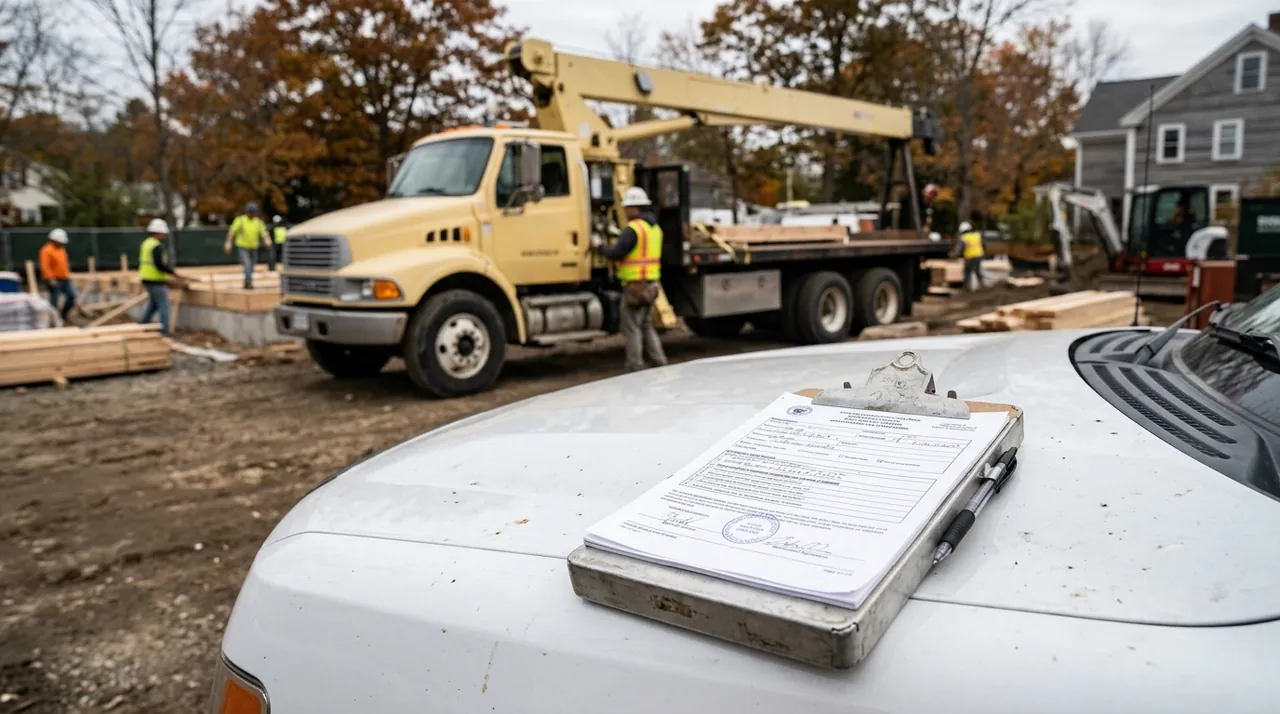
Before you can legally operate a boom truck or knuckle-boom crane in Massachusetts, you need a 1C hoisting engineer license issued by the state. That license is not just a card in your wallet — it is proof that you understand the law, the machine, and your responsibility to everyone on the job site. This lesson covers the statute that created the requirement, the agency that enforces it, the basic license terms you need to know cold for the exam, and the exemptions that are just as important to recognize as the rule itself.
The statute and the agency behind your license
Massachusetts hoisting law starts with M.G.L. c. 146, §§ 53 through 54A. Section 53 is the core provision: it defines who must hold a license and what triggers the requirement. The additional sections within that range address examinations and related licensing matters. Section 53A delegates rulemaking authority to the Division of Occupational Licensure, which is why there is a companion administrative regulation that fills in the technical details the statute does not spell out. Continuing education requirements before renewal fall under 230 CMR 6.04.
The agency that actually issues your license is the Division of Occupational Licensure, commonly abbreviated DOL. Its operational arm for hoisting matters is the Office of Public Safety and Inspections, or OPSI. You will see this distinction on the exam: OPSI is not the "Department of Public Safety." That name is a legacy of a prior reorganization and is no longer accurate. If an exam question asks which agency issues hoisting licenses, the correct answer involves DOL and OPSI — not the old DPS name.
License terms, fees, and what the exam tests
A Massachusetts hoisting license is valid for two years from the date of issue. You can begin the renewal process up to sixty days before expiration, and continuing education is required before renewal under 230 CMR 6.04. The minimum age to be licensed is eighteen years old — there is no path to a 1C license if you are younger, regardless of experience.
The application fee is $75 per restriction class, and it is nonrefundable. That means if you apply for a 1C restriction and later decide you also want a 1B, you pay a separate $75 for the second restriction. Knowing that the fee is per restriction and not per license document catches exam candidates off guard.
The licensing exam covers the working components of the machine, safe operating procedures, hand signals, and inspection requirements. This course is structured around those four areas.
Why a boom-truck operator needs this license
The practical question that drives the whole statute is simple: when does moving material with a boom cross the line into hoisting equipment that requires a license? Under § 53, the requirement kicks in when you are operating hoisting machinery on a public way or on a construction site accessible to the public. A driver delivering lumber who uses the truck's hydraulic boom to unload materials on a public street is operating hoisting equipment under the statute. That operator needs a 1C license.
This connection matters because boom trucks and knuckle-boom cranes look like delivery equipment to the uninitiated. The fact that the boom is hydraulic and the truck is licensed for the road does not exempt the lifting operation from the hoisting-license requirement. The machine and the task determine whether the statute applies, not the vehicle registration.
Exemptions — who does not need a license
Section 53 includes several statutory exemptions, and the exam tests these carefully because they are easy to confuse with the general rule. Agricultural operators working on their own land are exempt — a farmer running a hay baler with a loader on private property does not need a hoisting license. Certain supervised programs are also exempt: public utility employees in approved training programs, participants in approved apprenticeship programs, and students in vocational school programs operating under direct instructor supervision.
The common thread in these exemptions is controlled context. Either the operator is on private property doing agricultural work, or they are under active supervision in a recognized training structure. A worker who completed an apprenticeship program but is now working independently no longer qualifies for the apprenticeship exemption. Once you are on a job site running equipment on your own, you need the license.
Key Takeaways
- •M.G.L. c. 146, §§ 53–54A is the governing statute; Section 53A delegates rulemaking authority to DOL, and 230 CMR 6.04 sets continuing-education requirements for renewal.
- •Licenses are issued by the Division of Occupational Licensure (DOL) through OPSI — not the former Department of Public Safety.
- •Minimum age is 18; the license is valid for 2 years; the application fee is $75 per restriction class and is nonrefundable.
- •A boom-truck or knuckle-boom operator unloading on a public way needs a 1C license — the hydraulic boom is hoisting equipment under the statute.
- •Exemptions cover agricultural operators on their own land and participants in approved supervised utility, apprenticeship, or vocational programs — not independent workers.