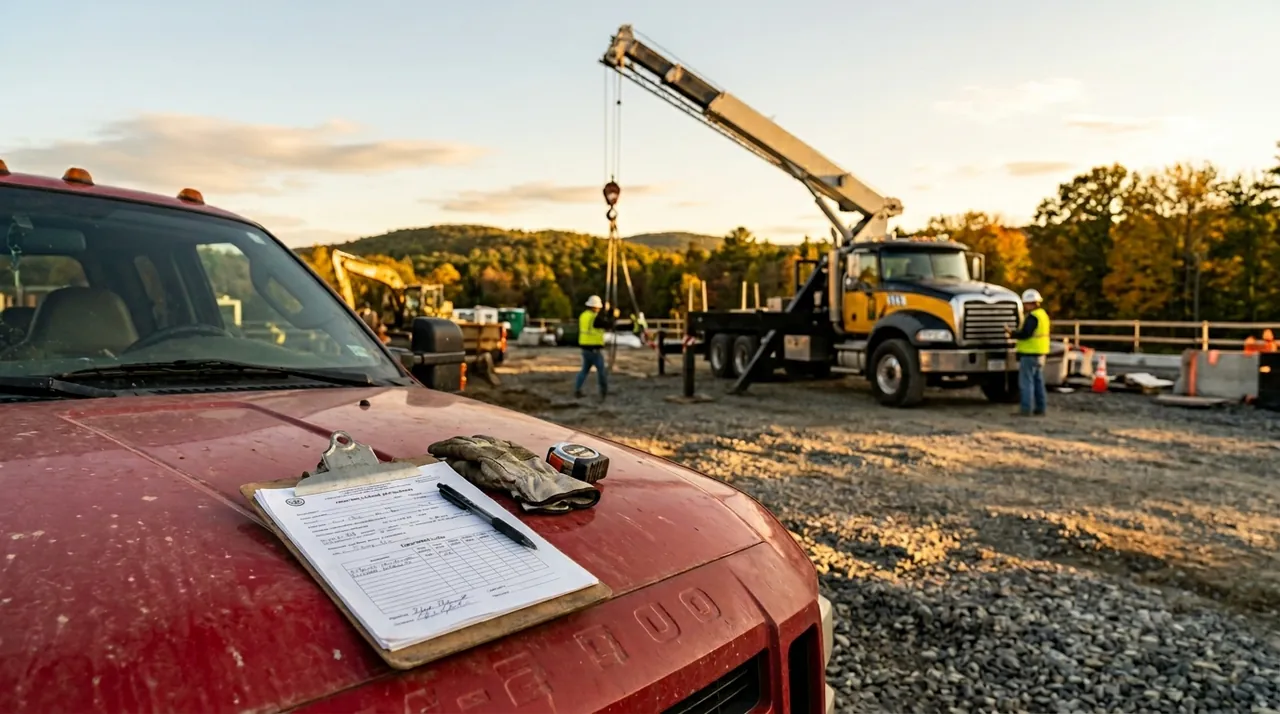
Before you can operate legally or answer a single exam question with confidence, you need to know exactly what law governs you, what code it lives in today, and what the 1C restriction actually authorizes. Those are not the same question, and confusing them is one of the most common mistakes candidates make. This session locks in the regulatory framework and draws the precise boundary lines of the 1C restriction so you never misidentify a machine or cite the wrong code.
The statute, the regulation, and the recodification you must know
Massachusetts hoisting-license law flows from M.G.L. c. 146, the state's boiler and pressure vessel statute that was extended to cover hoisting machinery. The regulation implementing that statute is 230 CMR 6.00, titled "Hoisting Machinery." That is the document that defines license classes, equipment categories, continuing-education requirements, and the rules operators must follow on the job.
Here is where candidates trip up: for years this regulation was codified as 520 CMR 6.00. It was moved to Title 230, now under the Division of Occupational Licensure (DOL), and the old citation no longer applies. The exam will test this directly. If you write or say 520 CMR 6.00, you are citing a dead address. The correct current citation is 230 CMR 6.00, full stop. Continuing-education requirements specifically live at 230 CMR 6.04, which is useful to know when a question asks where to look for CE obligations.
What the 1C restriction actually covers — and what it does not
The 1C restriction authorizes the operation of hydraulic telescoping booms and other hydraulic hoisting equipment. The defining concept is that the hydraulic boom itself lifts the load. The boom extends and retracts, raises and lowers, and transmits the lifting force through its own structure — no wire-rope hoist line is involved in delivering that force.
That last point is the single most important boundary to memorize: the 1C restriction does not cover machines equipped with wire-rope hoist lines. Add a wire-rope drum and hook to a telescoping boom and you have moved out of 1C territory. This exclusion is the core of the restriction's definition, and it is exactly what the exam will probe when it describes a machine and asks you to classify it.
The machines you will actually run under a 1C license
Two machine types are the textbook examples of 1C equipment. The first is the truck-mounted hydraulic telescoping boom crane, commonly called a boom truck. The boom sections nest inside one another and extend hydraulically; when the boom raises and swings the load, hydraulic cylinders do all of the work. The second is the articulating knuckle-boom loader crane. Instead of a single straight boom, the knuckle boom uses two or more boom sections pinned together like a folding arm, each section driven by its own hydraulic cylinder. Both machines share the same defining characteristic: no wire rope, hydraulic force from tip to heel.
A common misconception worth clearing up now is that loaders and backhoes belong in this class. They do not. Loaders and backhoes are Class 2 machines, a separate licensing category. However, if you hold a 1C license, it also covers 1D — indoor warehouse forklifts — because 1D is nested under 1C in the licensing structure.
How 1C fits in the broader restriction family
Understanding the 1C restriction means understanding what sits on either side of it. The 1B restriction is the closest neighbor and the most important to distinguish. A 1B license covers telescoping boom cranes that include a wire-rope hoist line — the combination of hydraulic boom extension and a drum-and-line lifting system. If 1C is the hydraulic-only world, 1B is what you hold when the machine adds wire rope to that world. A 1B operator can run a 1C machine; a 1C operator cannot run a 1B machine.
Above both sits the 1A restriction, which is the broadest class-one license. It covers friction-clutch machines, derricks, lattice-boom cranes, and everything beneath it — including all 1C equipment. Think of the restriction classes as concentric rings: 1A contains everything; 1C is a defined inner ring covering hydraulic equipment without wire rope; 1D sits inside 1C. Knowing the nesting order tells you immediately who can legally operate a given machine and who cannot.
Key Takeaways
- •The correct current citation is 230 CMR 6.00 — not 520 CMR 6.00, which is an outdated address. Continuing-education requirements live at 230 CMR 6.04.
- •The 1C restriction covers hydraulic telescoping and articulating boom cranes where the hydraulic boom itself lifts the load.
- •The defining exclusion: 1C does not authorize machines that use a wire-rope hoist line. That line pushes the machine into 1B territory.
- •Textbook 1C machines are boom trucks and knuckle-boom loader cranes. Loaders and backhoes are Class 2, not 1C.
- •1A contains 1C; 1C contains 1D. A higher restriction covers everything below it; the reverse is not true.