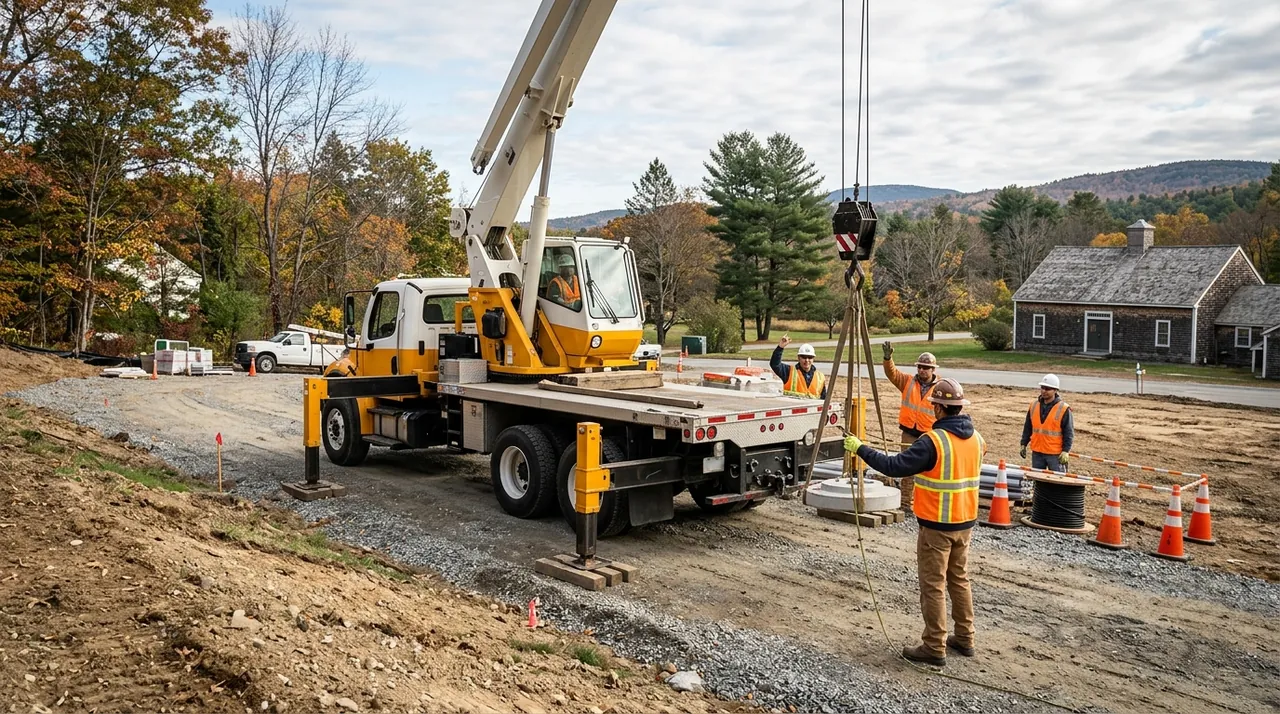
Your Massachusetts 1C license gives you the legal authority to operate hydraulic telescoping and articulating boom cranes in the Commonwealth. But the license is only one layer of the framework you work inside every day. Two additional bodies of rules — federal OSHA standards and ASME consensus standards — define how that work must be conducted and what the equipment must be capable of doing. Understanding how these three layers fit together is not an academic exercise. A crane operator who cannot navigate a Subpart CC requirement or locate a machine's B30 operating limits is not actually prepared to work safely.
OSHA 29 CFR 1926 Subpart CC — the federal floor for construction crane work
Whenever a crane is used on a construction site — hoisting steel, placing concrete forms, or moving suspended loads — federal OSHA's 29 CFR 1926 Subpart CC applies. Subpart CC covers power-operated equipment that hoists, lowers, and horizontally moves a suspended load, which captures the hydraulic boom trucks and articulating cranes that 1C operators run.
Subpart CC establishes minimum requirements for ground conditions, power line clearances, pre-use inspections, and the qualification of signal persons and riggers who work alongside you. Articulating cranes — knuckle-booms — receive specific provisions within Subpart CC because their motion envelope and tipping mechanics differ from a conventional boom truck. Two other OSHA sections, 29 CFR 1926.602 and 1910.178, address material-handling situations where equipment moves loads without suspending them in the traditional crane sense, so knowing where that boundary falls helps you recognize which standard governs a given task.
ASME B30.5 and B30.22 — the consensus standards behind the machines
The American Society of Mechanical Engineers publishes the B30 series of consensus standards, which cover the design, operation, and maintenance of cranes. OSHA references these as authoritative, and the industry treats them as the technical foundation that backs up federal requirements.
For 1C operators, two volumes matter. ASME B30.5 covers mobile and locomotive cranes, including the hydraulic telescoping boom trucks that make up most of the 1C machine class — it defines operating limits, required load charts, and operator responsibilities. ASME B30.22 covers articulating boom cranes specifically, the knuckle-boom loader cranes used in construction and utilities. If you run a knuckle-boom, B30.22 governs how that machine must be operated to stay within safe limits.
How the three layers work together — and why the manual still governs
Think of the framework as a stack. Your Massachusetts 1C license is the legal credential that authorizes you to operate these machines in the Commonwealth. OSHA Subpart CC sets the federal safety floor for every construction site in the country. The ASME B30 standards provide the technical foundation beneath both, defining what the machines are designed to do and how they must be used.
None of these layers replaces the others. Your license does not exempt you from OSHA. OSHA compliance does not qualify you to operate a machine you have never trained on. And beneath all three, the manufacturer's operating manual for each individual machine is the controlling authority for that specific unit — its load chart and operating limits govern whenever they are more restrictive than the general standard.
Operator competency under Subpart CC means being trained on and familiar with the specific machine you are assigned — its load chart, its controls, and the limits the manufacturer has established. Qualified signal persons and riggers working with you also have defined competency requirements. Knowing where each body of rules applies, and being able to move between them on the job, is what separates a competent operator from one who is simply licensed.
Key Takeaways
- •OSHA 29 CFR 1926 Subpart CC is the federal standard governing crane use on construction sites — it applies to hydraulic boom trucks and articulating cranes and sets requirements for inspections, ground conditions, power line clearances, and crew qualifications.
- •ASME B30.5 applies to mobile and locomotive cranes including hydraulic telescoping boom trucks; ASME B30.22 applies specifically to articulating (knuckle-boom) cranes.
- •The MA 1C license, OSHA Subpart CC, and ASME B30 standards each serve a distinct role and all three apply simultaneously on a construction site — none replaces the others.
- •The manufacturer's operating manual is the controlling document for any specific machine; its load chart and limits govern over the general standard when more restrictive.
- •Operator competency under Subpart CC means training on the specific machine assigned, not just holding a license — qualified signal persons and riggers on your crew have their own competency requirements too.