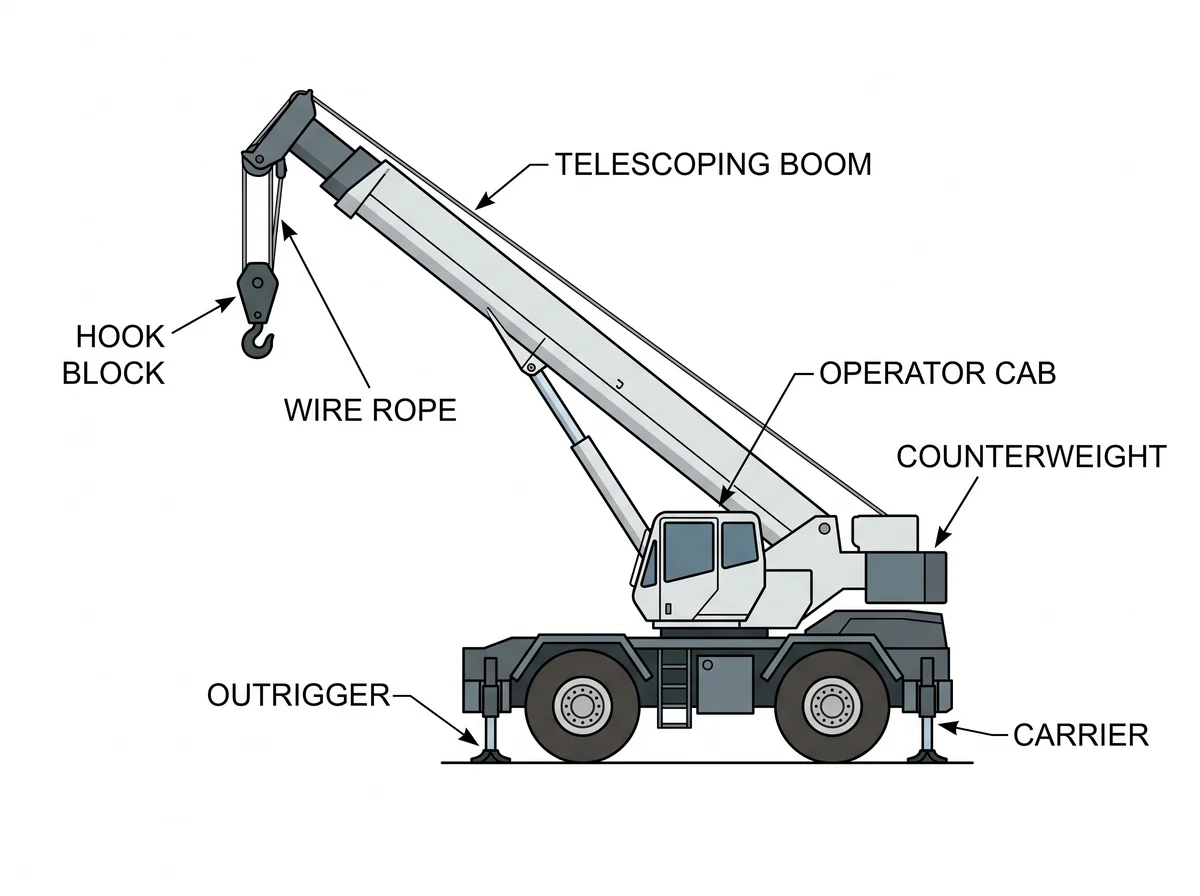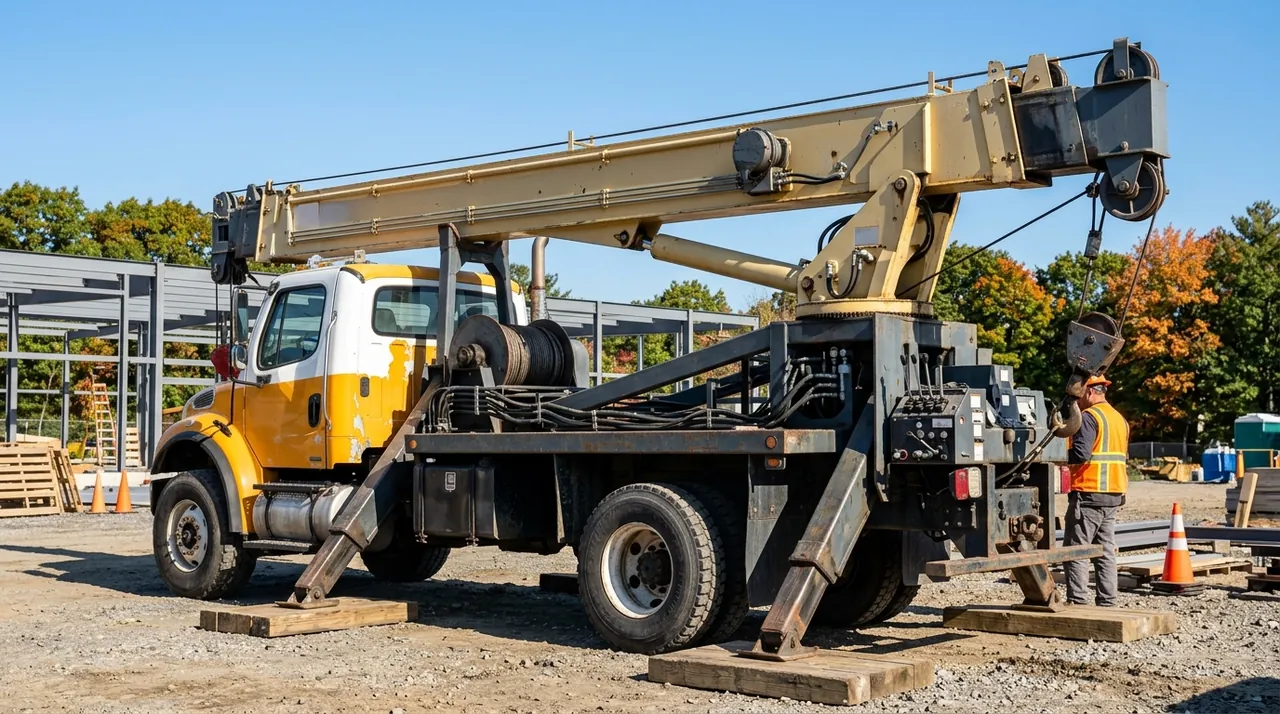
Every movement a hydraulic boom crane makes — lifting the boom, telescoping out, swinging, setting an outrigger — is powered by pressurized fluid. If you understand where that pressure comes from, where it goes, and what stands between you and a runaway load when something fails, you understand the machine. This lesson traces the hydraulic power path from the engine to the actuators, explains the safety components built into that system, and covers the hazards high-pressure hydraulics create on the job site.
Where the Power Comes From
A truck-mounted boom crane draws its hydraulic power from the vehicle's drive engine through a power take-off, the PTO. The PTO spins a hydraulic pump that converts engine rotation into pressurized fluid flow. That fluid comes from the hydraulic reservoir — a tank that stores, cools, and filters the working fluid before it reaches the pump.
From the pump, fluid moves through control valves that direct flow to whichever actuator the operator commands: the boom lift cylinder, the telescope cylinder, the swing motor, or the outrigger cylinders. Pressure relief valves protect the system by routing fluid back to the reservoir if pressure climbs beyond the designed limit. A problem anywhere on this path — a worn pump, a clogged filter, a stuck relief valve — shows up as sluggish response, unexpected drift, or no movement at all.
The Cylinders That Move the Boom
Three cylinder groups do the structural work on a hydraulic telescoping boom crane. The lift cylinder raises and lowers the boom angle. The telescope cylinder lives inside the boom and pushes the nested sections in and out, changing your working radius. On multi-section booms a sequencing system extends each section in order.
The outrigger cylinders are a separate circuit but equally critical. They extend the beams outward and drive the outrigger pads — the floats — down to the ground, lifting the vehicle's tires clear of the surface. Those cylinders must hold position under sustained load for the entire lift, which is why their condition on a pre-shift inspection matters as much as the lift cylinder's.
Swing is handled by a hydraulic motor that drives a gearbox to rotate the upperstructure on the slew ring. The inertia of a loaded boom means you always stop the swing gradually — abrupt stops load the structure and can cause the load to pendulum.
Holding Valves: What Keeps the Load from Dropping
The most important safety component in the hydraulic circuit is the counterbalance valve, also called a holding valve or load-holding check valve. It sits directly at the cylinder port and holds the oil captive inside the cylinder. If a hose ruptures between the control valve and the cylinder, the oil inside cannot escape because the holding valve stays closed — the boom and its load remain in position rather than crashing down.
Load-holding check valves serve the same function on the outrigger circuit: if an outrigger hose fails during a lift, the pad stays planted. These components are the reason a single hose failure does not automatically cause a catastrophic drop. They are also why you depressurize the system before disconnecting any line for service — a valve holding load pressure will violently release that energy if the circuit is opened carelessly.
High-Pressure Hazards and Fluid Condition
Hydraulic systems on boom cranes operate at very high pressures. At those pressures, a pinhole leak in a hose or fitting can inject fluid through unbroken skin. Hydraulic injection injuries look minor on the surface but are medical emergencies — the fluid spreads under the skin and causes severe tissue damage. Never run your hand along a hose to feel for a leak. Use a piece of cardboard held near the suspected area, or a mirror. If you find a leak, depressurize the line before loosening any connection.
Fluid condition tells you about system health. Hydraulic fluid should be clear amber. Milky or cloudy fluid means water has entered the system, which causes cavitation and accelerated wear inside the pump and valves. Dark or burnt-smelling fluid means the system has been overheating, which breaks down the fluid's viscosity and lubrication. Either condition warrants investigation before you operate. Hoses fail visibly too: bulges in the outer cover, abrasion wear-through, cracked rubber, and weeping fittings are all removal-from-service conditions.
Key Takeaways
- •Hydraulic power on a truck-mounted boom crane comes from the engine via a PTO-driven pump; filters, relief valves, and control valves sit between the pump and the actuators.
- •Three cylinders do the core structural work: the lift cylinder controls boom angle, the telescope cylinder controls reach, and the outrigger cylinders set the crane's foundation.
- •Holding valves (counterbalance valves) trap oil inside the cylinder if a hose fails, preventing the boom or outrigger from dropping uncontrolled.
- •Never touch a pressurized hose to find a leak — hydraulic injection through the skin is a medical emergency; use cardboard or a mirror and depressurize before disconnecting.
- •Fluid color is a health indicator: amber is good, milky means water contamination, dark or burnt means overheating — investigate before operating.