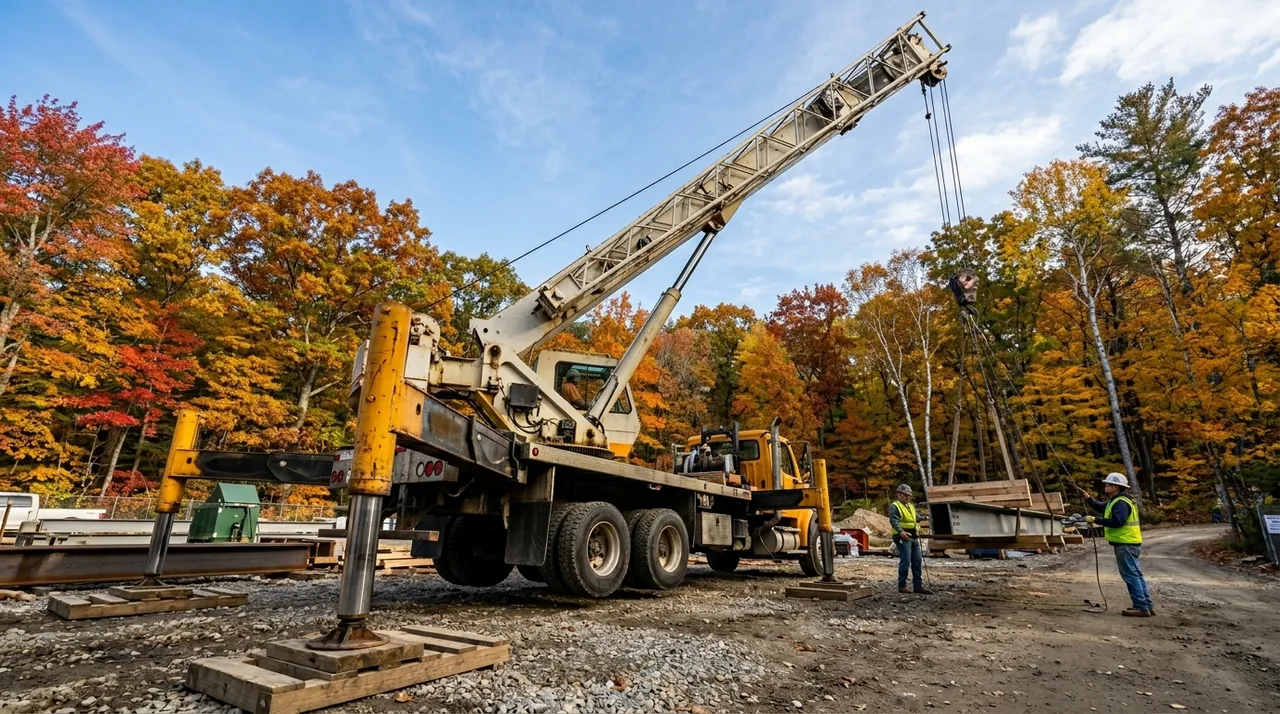
Of all the things that can go wrong with a hydraulic boom crane, the most preventable ones happen before the first pick leaves the ground. Outrigger setup is the foundation everything else rests on. Get it right and the machine is stable for the entire lift. Get it wrong and no amount of skill at the controls will keep the crane from tipping when the load swings to radius. This lesson covers the mechanics of outrigger stability, how ground bearing pressure works, what partial deployment means for the load chart, and how to spot the ground conditions that can drop a crane even when the setup looks correct.
What outriggers do and why full deployment matters
A hydraulic boom crane on its tires has a narrow footprint. The moment you extend a load to any real radius, the crane wants to rotate about the front axle or side tires. Outriggers solve this by deploying horizontal beams outward from the carrier frame and then driving vertical jacks down until the tires lift clear of the ground. The result is a much wider base that shifts the tipping axis out to the outrigger pads instead of the tire contact patch.
That wider base is why fully deployed outriggers unlock the highest load chart ratings. The manufacturer engineered the rated capacity numbers around a specific geometry — beams at full extension, tires off the ground, pads firmly set. If the tires are still touching or one beam is partly retracted, you are not in that configuration and cannot use those numbers.
Ground bearing pressure and why pads and cribbing matter
Deploying the outriggers concentrates the crane's entire weight plus the load into four small areas where the outrigger floats contact the ground. Pressure at any point equals force divided by area. A small float on soft ground creates high pressure and punches through. A larger pad or cribbing stack spreads the same force over more area and prevents sinking.
Ground hazards invisible from above are a leading cause of tip-overs. Recently backfilled trenches are never as solid as undisturbed soil. Underground utilities create voids. Frost heave can destabilize pads mid-lift. Slopes shift weight unevenly across the four pads. On paved surfaces, asphalt or concrete slabs over parking structures have their own limits — a large outrigger force can crack a slab or collapse what is below it. Verify ground conditions before setup, use adequate padding, and keep outriggers clear of excavation edges where edge collapse is a real risk.
Partial deployment and the load chart
Full outrigger deployment is the default because it gives maximum stability and the highest rated capacity. Partial deployment — beams extended less than fully due to an obstruction — is sometimes unavoidable, but it is not a shortcut. It is a reduced-capacity configuration with its own separate load chart column or table.
If you must use partial deployment, switch to the chart that matches that specific extension. Using the full-extension chart with partially deployed outriggers means your numbers do not reflect the machine's actual geometry. If the partial-deployment chart shows no rating for your radius and boom length, the lift cannot be made in that configuration.
Leveling and monitoring after the first pick
The load chart ratings assume the crane is level within the manufacturer's tolerance. Even a small tilt shifts the center of gravity toward the downhill side, moving the tipping axis closer to the load and reducing the actual margin before tip-over. Level the crane using the cab indicator before any pick.
Once lifting begins, watch the pads. Ground that appeared solid can compress under the sudden addition of load. After the first pick, verify no pad has settled or shifted. If a float is no longer firmly seated, set the load down and correct the setup before continuing. Inspect the outrigger system itself at pre-shift as well — cylinders for leaks or slow drift, beams for cracks, pins and retaining clips for security. An outrigger failure mid-lift is almost always traceable to a condition that was present and missed at inspection.
Key Takeaways
- •Outriggers widen the stability base and lift the tires clear — rated capacity is only valid when the setup matches the chart's exact configuration.
- •Ground bearing pressure equals force divided by area — pads and cribbing spread load and prevent punch-through on soft, paved, or compromised surfaces.
- •Partial outrigger deployment requires a separate, lower-capacity load chart; never apply full-extension numbers to a partially deployed setup.
- •A crane out of level has reduced rated capacity — level within manufacturer tolerance before any pick.
- •Re-check pad seating after the first lift; settling can occur even when initial ground conditions appeared solid.