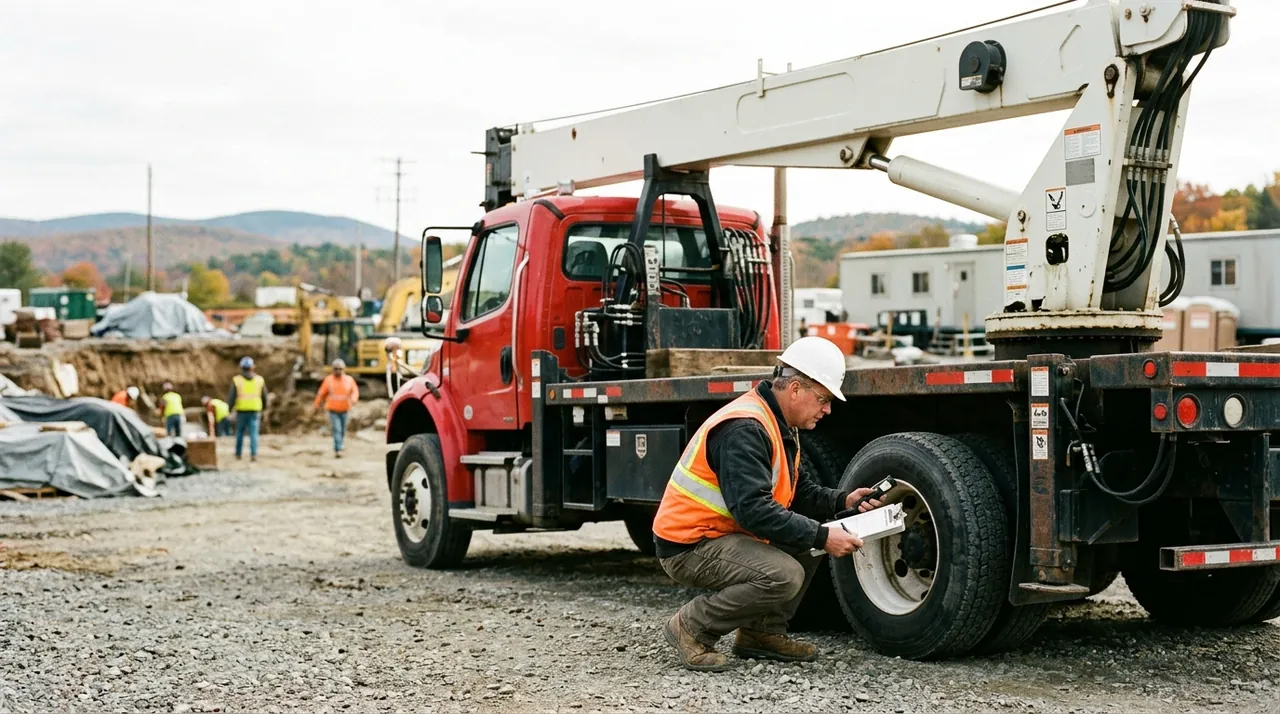
Getting your 1C license is the starting line, not the finish line. The operators who stay safe and stay employed treat the machine as a system that needs routine attention, keep their paperwork in order, and never let their license slip. This session covers operator-level maintenance habits, the recordkeeping OSHA and the state require, and the Massachusetts renewal rules that determine whether you are legally allowed on the controls any given workday.
Operator-level maintenance: what you own every shift
Hydraulic boom cranes depend on lubrication and clean fluid to function reliably. You are not a mechanic, but you are responsible for the first line of maintenance. Before each shift, check engine oil, hydraulic fluid level and condition, coolant, and fuel. Milky hydraulic fluid means water contamination; burnt-smelling fluid means overheating. Either condition means the machine needs attention before it works again.
Greasing is the other daily discipline. Pins and bushings at the boom pivots, knuckle joints on articulating cranes, the swing bearing, and outrigger pivot points all have grease fittings that must be serviced on the manufacturer's schedule. A dry pivot accelerates wear and eventually affects load geometry and safe capacity. Wear pads on the boom sections deserve periodic inspection too — they keep the inner boom sliding smoothly inside the outer sleeve, and when they wear down the boom racks and binds.
The manufacturer's maintenance manual is the controlling document. Those service intervals, not a general rule of thumb, determine when hydraulic fluid and filters get changed.
Reporting defects and tagging out unsafe equipment
Maintenance discipline only works if problems get reported when they are found. When your inspection turns up a defect — a weeping hydraulic fitting, a cracked wear pad, a slow outrigger cylinder — report it promptly and, if the condition makes the machine unsafe, tag it out of service before anyone else uses it. That tag-out is not optional. Operating a machine with a known defect you did not report exposes you, your employer, and everyone on site to serious risk.
OSHA Subpart CC requires that inspection findings be documented and that records from shift, monthly, and annual inspections be retained on the standard's schedule. These records protect everyone if questions ever arise about whether the machine was properly maintained before an incident.
Massachusetts continuing education and renewal requirements
Your 1C hoisting license is valid for two years. Massachusetts law, through 230 CMR 6.04, requires you to complete continuing education before you can renew it. The CE requirement exists because equipment, regulations, and safety practices evolve, and the state wants to ensure licensed operators stay current rather than coasting on knowledge from their original exam.
The renewal window opens up to 60 days before your expiration date. The process is: complete your CE first, then submit your renewal application with the required nonrefundable fee per restriction class (confirm the current renewal amount on mass.gov). Do not wait until the last week. If your license expires before your renewal processes, you are in lapsed status.
An expired license is an invalid license. There is no grace period under Massachusetts law that allows you to keep operating while your paperwork catches up. If your license lapses, you must stop operating hoisting equipment immediately. Depending on how long the lapse runs, re-examination may be required before reinstatement. The safest habit is to set a calendar reminder six weeks before your expiration date, complete your CE, and submit the renewal with time to spare. Keep a copy of your current license and your CE completion record on the job site, because an employer or inspector may ask to see them.
Why these habits connect to each other
Maintenance, recordkeeping, and license renewal are not three separate administrative chores. They all express the same principle: professional accountability. A crane greased on schedule and inspected thoroughly performs predictably within its load chart. Documented maintenance shows the operator and employer met their obligations. A current license confirms the operator meets the state's competency standard.
On the exam, these topics appear as scenarios: your license expired — can you operate? Monthly records are missing — what happens? The answer to the first is always no. The answer to the second is that OSHA requires those records and their absence is a violation. Understanding why the requirements exist makes the right answer clear in any question.
Key Takeaways
- •Daily operator maintenance — checking fluid levels, greasing pins and bushings, and inspecting wear pads — follows the manufacturer's maintenance manual as the controlling document.
- •Defects found during inspection must be reported promptly; unsafe machines must be tagged out before anyone operates them.
- •OSHA Subpart CC requires documented shift, monthly, and annual inspection records retained on the required schedule.
- •Massachusetts 230 CMR 6.04 requires continuing education before each 1C license renewal; complete CE first, then submit the renewal application.
- •An expired license is immediately invalid — there is no grace period — and depending on the length of the lapse, re-examination may be required to reinstate it.