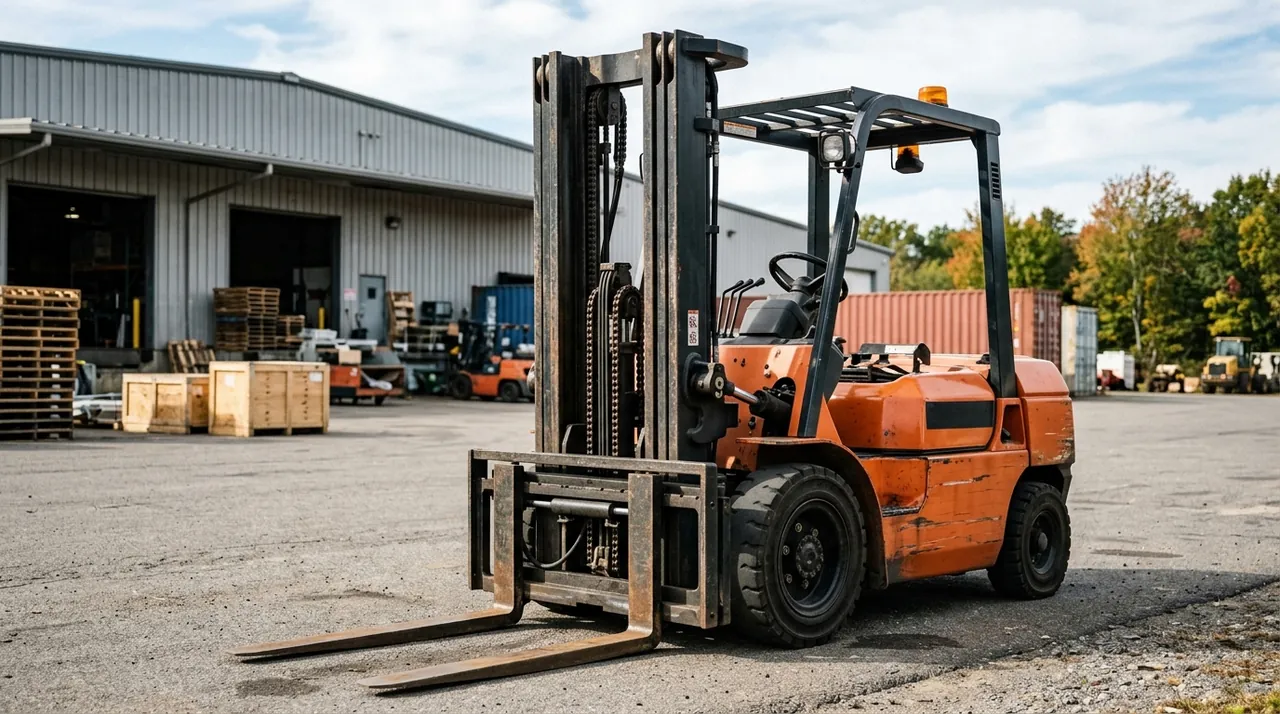
Before you can operate a forklift safely — or pass the Massachusetts 1D exam — you need to name what you are sitting on and explain why each part exists. A forklift is not a complicated machine, but every major component has a specific job, and when one is compromised the whole system can fail. This lesson walks through the anatomy of the counterbalanced forklift piece by piece, then introduces two close relatives — the reach truck and the telehandler — that appear on real job sites and on the exam.
How the counterbalanced forklift stays upright
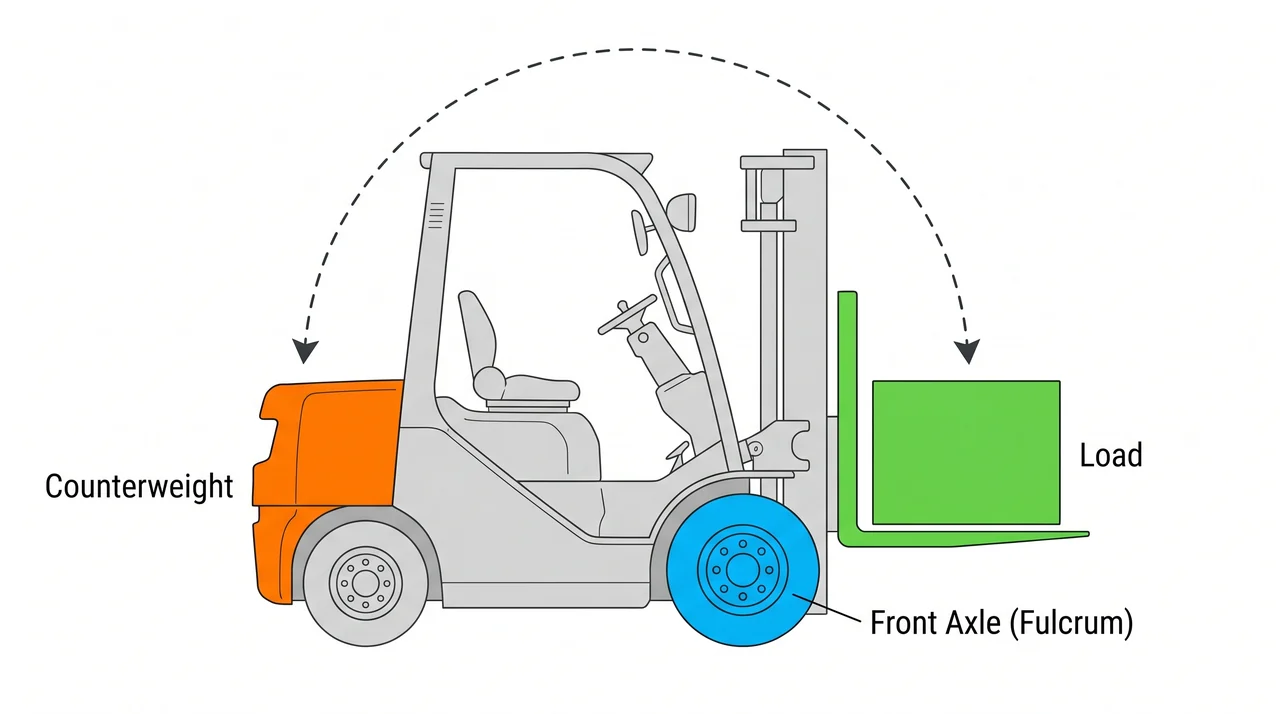
The counterbalanced forklift is built around one principle: forks projecting past the front axle create a tilting force, so a heavy cast counterweight at the rear cancels that force out. The front axle is the fulcrum. The load on the forks is one side of the lever; the counterweight is the other. That balance is why there are no outriggers — the machine itself provides the stability.
The counterweight is precisely calculated for the truck's rated capacity. Welding on extra ballast, bolting on improvised weight, or removing any portion of it without manufacturer approval destroys that calculation and can tip the truck even with a load inside the nameplate rating. The counterweight is not field-adjustable.
Mast, carriage, and forks: the lifting assembly
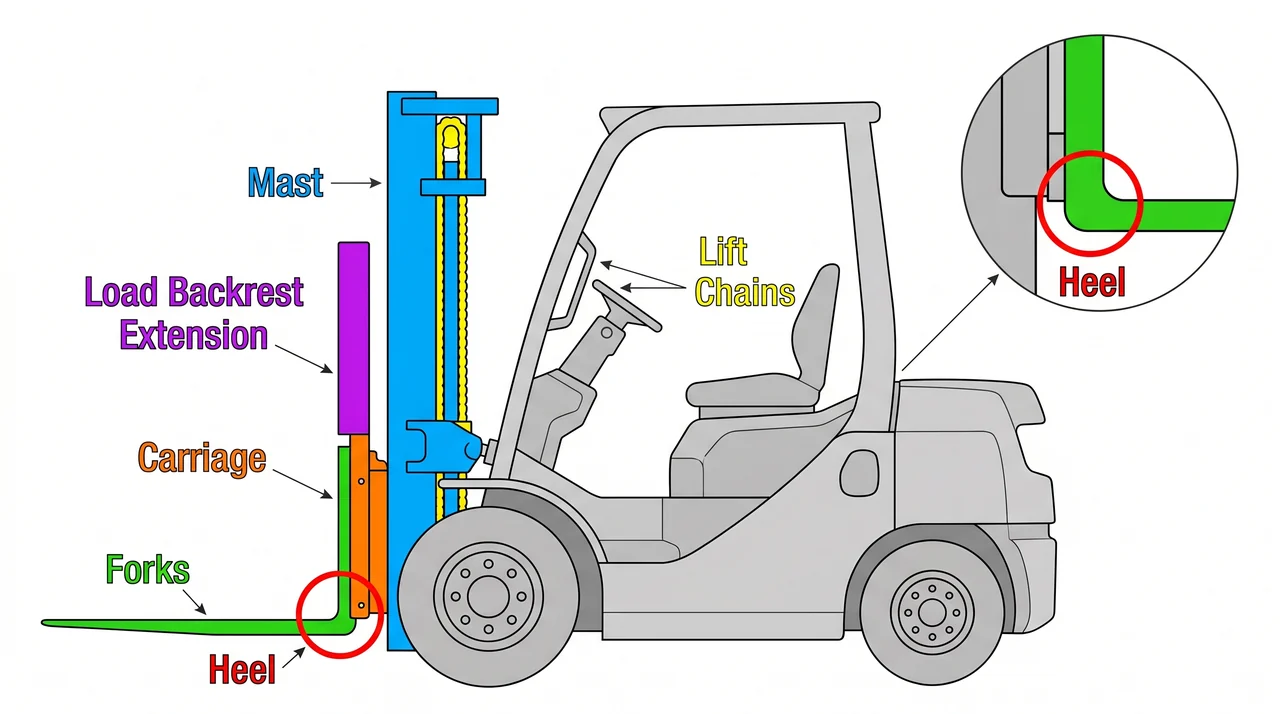
The mast is the vertical steel framework at the front of the truck. Nested channels ride on rollers and telescope upward when lift chains — running over pulleys at the mast top — are pulled by the lift cylinder. Tilting the mast back rotates the entire assembly rearward, shifting the load's center of gravity toward the truck for safer travel.
The carriage rides up and down inside the mast channels. The forks pin onto the carriage and can be repositioned for different pallet widths. Forks are rated as a matched set, and the heel — where the horizontal blade meets the vertical shank — is the highest-stress point. Cracks at the heel or wear below the manufacturer's thickness limit are removal-from-service conditions, not a slow-it-down situation.
The load backrest extension stands behind the load on the carriage. Its job is to keep the load from sliding rearward toward the mast and the operator when the mast is tilted back — a direct line of protection for the person in the seat.
Overhead guard and operator restraint
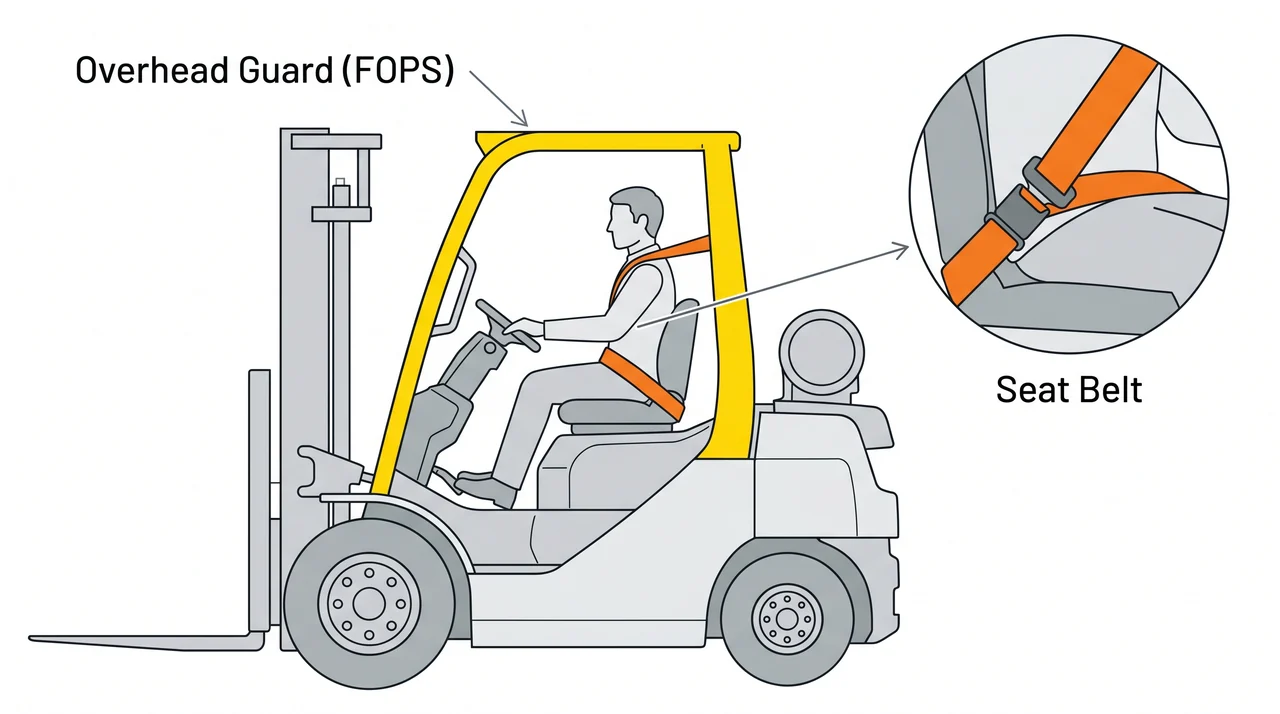
The overhead guard — formally a Falling Object Protective Structure (FOPS) — is the steel framework over the operator's compartment. It deflects small objects that fall from racking or a load above. It must be in place and undamaged during all operation.
The seat belt keeps the operator inside the guard during a tip-over. The instinct to jump clear almost always puts the operator in a worse position than staying belted inside the structure. The two work together: one without the other significantly reduces protection.
Reach trucks and telehandlers: when the standard design does not fit
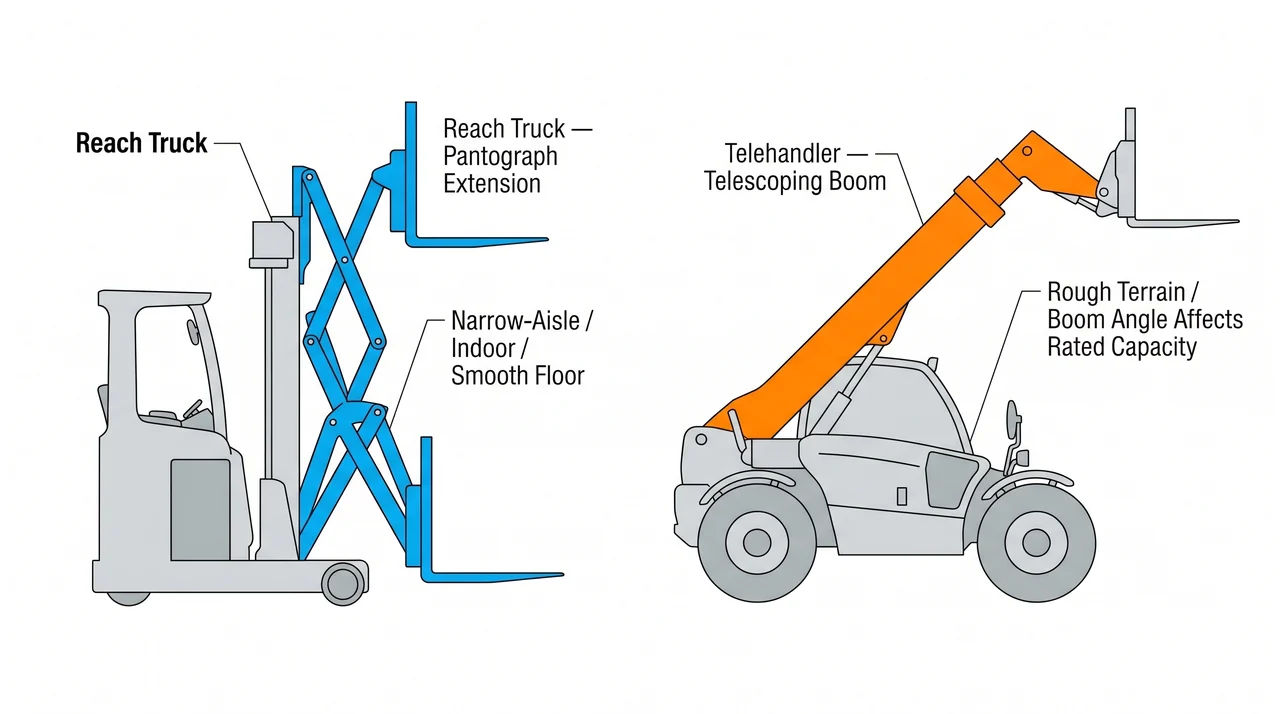
A reach truck is a narrow-aisle warehouse machine. Instead of carrying the load cantilevered past the front axle, it extends its forks forward on a pantograph or scissor mechanism, then retracts them back over the wheelbase before lifting. This keeps the load centered over the chassis, allowing a smaller footprint and tighter aisle work. Reach trucks are designed for smooth indoor floors only.
The telehandler — also called a variable-reach rough-terrain forklift — replaces the vertical mast with a telescoping boom that extends forward and upward. This gives reach and lift height that a mast-style truck cannot match, and large tires allow it to work on uneven ground. Many telehandlers deploy outriggers for high or extended lifts. The critical difference for operators: rated capacity changes with both boom angle and extension length, so the load chart must be consulted before every non-standard lift.
Key Takeaways
- •A counterbalanced forklift balances the load on the forks against a rear counterweight — the front axle is the fulcrum, and the counterweight must never be altered without manufacturer approval.
- •The mast raises and lowers the carriage via lift chains; forks are rated as a set and must be tagged out if cracked or worn, especially at the heel.
- •The load backrest extension prevents the load from sliding back toward the operator when the mast is tilted.
- •The overhead guard (FOPS) deflects falling objects; the seat belt keeps the operator inside it during a tip-over — both must be present and functional.
- •Reach trucks use an extending pantograph for narrow-aisle indoor work; telehandlers use a telescoping boom for rough-terrain lifts, with a load chart that varies by boom angle and extension.