Free MA Hoist

Daily Inspections

2 hours

1D — Daily Inspections (Industrial lift trucks).
1Dindustrial lift trucks.

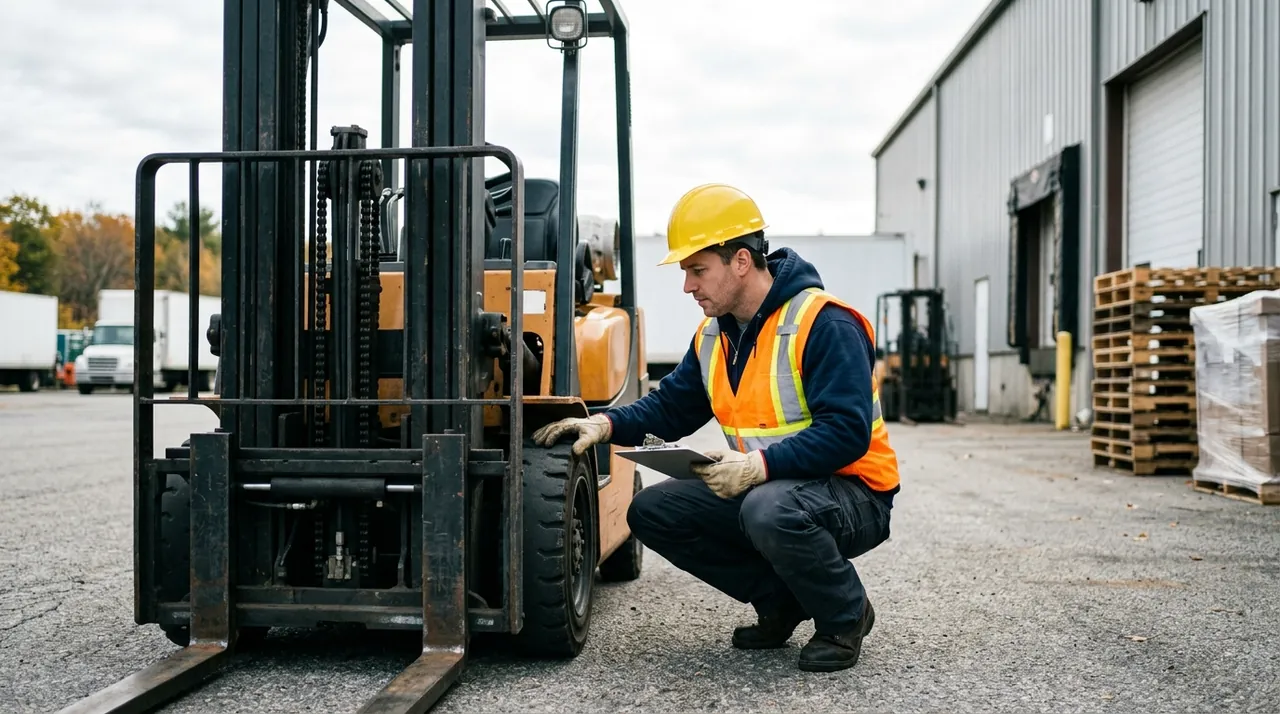
Every forklift shift starts the same way: before you touch the key, you walk the truck. OSHA's standard for industrial trucks requires that a forklift be examined before it is placed in service each shift — and for trucks running around the clock, that means after each shift ends, not just once at the top of the day. The habit takes less than ten minutes, and it is the most reliable tool you have for catching a small problem before it becomes a dropped load, a hydraulic failure, or an incident report.

The OSHA requirement and who carries it out

OSHA's standard at 1910.178 places the inspection obligation on the employer, but the operator is the person who executes it. You are the one who knows what normal feels like on your truck — how much pedal the brake takes, whether that hose was already weeping yesterday. The frequency rule matters: a truck on a single shift is examined before that shift begins. A truck running non-stop across multiple shifts must be examined after each shift, because the next operator needs current information before they place it in service.

Key-off visual inspection: before the engine starts

Start with the engine off and the key out. Work around the truck in a fixed route. Check tires and wheels for damage and secure fasteners. Inspect the forks at the heel for cracks, wear, and bend. Look at the mast and lift chains for damage and proper lubrication, then examine every hydraulic hose and fitting for chafing or seeping fluid. Check under the truck for fresh puddles — fluid on the floor is the fastest indicator of a developing problem. Verify the data plate is legible, and confirm the overhead guard and load backrest extension are in place.

Then check your fluids: hydraulic reservoir, engine oil, coolant, and fuel or LP connection. On an electric truck, check battery condition and electrolyte water level. These checks take two minutes and are the difference between a truck that runs the full shift and one that quits mid-load.

Key-on operational check: what you verify with power on

With the engine running or power on, test lift and tilt through their full range — sluggish response or unusual noise confirms what you may have noticed on the walk-around. Apply the service brake firmly at slow speed and confirm the truck stops decisively. Set the parking brake and verify the truck will not roll. Both brakes must work independently.

Check steering responsiveness, sound the horn, confirm lights function if the truck operates in low-light areas, and verify the backup alarm activates in reverse. Scan your gauges and warning lights for temperature, fuel, and fault indicators. Finally, fasten and test the seat belt or operator restraint. The restraint keeps you inside the overhead guard during a tip-over — if the buckle sticks or the belt is frayed, the restraint is not functional and must be fixed before the truck moves.

Defects: reporting, tagging out, and returning to service

When your inspection finds a defect, report it immediately — not at end of shift, not after one more run. Any truck that is defective or unsafe must be taken out of service until qualified maintenance personnel restore it to safe operating condition. Tag it out with a written out-of-service notice on the controls so no other operator unknowingly takes it. Inspection records document what was found, when, and by whom. The truck goes back into service when maintenance clears it — not because the shift is short-handed.

Key Takeaways

  • OSHA 1910.178 requires forklift examination before each shift; trucks running continuously must be inspected after each shift.
  • The key-off visual check covers tires, forks, mast and chains, hoses and fittings, leaks under the truck, data plate, overhead guard, load backrest, and all fluid levels.
  • The key-on operational check confirms lift and tilt, both brakes, steering, horn, lights, backup alarm, gauges, and seat belt function.
  • Any defect must be reported immediately — a defective truck must be tagged out and kept out of service until cleared by maintenance.
  • Inspection records and a physical out-of-service tag protect everyone and document the machine's condition across shifts.

Learning Objectives

  • State the OSHA requirement to examine a forklift before it is placed in service each shift
  • Perform a key-off visual pre-start inspection of a forklift
  • Perform an operational check of the truck with the engine running or power on
  • Explain what to do when an inspection reveals a defect

Topics Covered

  • OSHA 1910.178: industrial trucks must be examined before being placed in service; trucks used around the clock are examined after each shift
  • Key-off visual check: tires/wheels, forks (heel cracks, wear, bend), mast and chains, hoses and fittings, leaks under the truck, data plate legible, overhead guard and load backrest in place
  • Fluid checks: hydraulic, engine oil, coolant, fuel/LP connection or battery condition and water level
  • Operational (key-on) check: lift and tilt functions, service brake and parking brake, steering, horn, lights, backup alarm, gauges and warning lights
  • Seat belt / operator restraint condition and function
  • A defect found in inspection must be reported immediately
  • A truck that is defective or in any way unsafe must be taken out of service until restored to safe operating condition
  • Inspection records and tag-out of an out-of-service truck

Resources

Self-Check Questions

Question 1: How often does OSHA require a forklift to be examined?

  1. A. Once a week
  2. B. Once a month
  3. C. Before it is placed in service each day (and after each shift if used around the clock)(correct)
  4. D. Only when a problem is suspected
Show Explanation

Explanation:

OSHA 1910.178 requires that industrial trucks be examined before being placed in service, and trucks used on a round-the-clock basis be examined after each shift. Exam tip: the pre-shift inspection is a legal requirement, not optional.

Question 2: Which of the following is checked during the KEY-OFF (visual) portion of a forklift inspection?

  1. A. Service brake feel
  2. B. Horn and backup alarm function
  3. C. Forks for heel cracks and wear, hoses for leaks, and that the data plate is legible(correct)
  4. D. Steering response
Show Explanation

Explanation:

The key-off visual check covers the things you inspect without power: forks, mast and chains, tires, hoses and fittings, leaks under the truck, fluid levels, and the condition of the data plate and guards. Brakes, horn, and steering are checked in the operational (key-on) portion.

Question 3: During your inspection you find the service brake goes nearly to the floor before engaging. What must you do?

  1. A. Use the parking brake instead and keep working
  2. B. Drive slowly and pump the brake as needed
  3. C. Take the truck out of service and report the defect — do not operate it until repaired(correct)
  4. D. Finish the current task, then report it
Show Explanation

Explanation:

A truck found defective or in any way unsafe must be taken out of service until restored to safe operating condition. Compromised brakes are an immediate out-of-service condition — there is no "finish this load first."

Question 4: When a defect is found during a pre-shift inspection, OSHA requires that it be:

  1. A. Logged at the end of the month
  2. B. Reported immediately(correct)
  3. C. Ignored if the truck still runs
  4. D. Fixed by the operator on the spot regardless of training
Show Explanation

Explanation:

OSHA requires defects to be reported immediately and corrected. The operator does not have to be the one who repairs it, but the defect must be reported and the truck kept out of service until it is fixed.

Question 5: Why should the operator check the seat belt / operator restraint during the daily inspection?

  1. A. It is only required on outdoor trucks
  2. B. The restraint is the operator's primary protection in a tipover — it keeps them in the protected zone of the cab(correct)
  3. C. It only matters if the truck has doors
  4. D. Seat belts are optional on forklifts
Show Explanation

Explanation:

In a tipover, the most dangerous thing an operator can do is jump — they can be crushed by the overhead guard. The operator restraint keeps them in the seat within the protected zone, so it must be present and functional.

Question 6: A forklift used non-stop across three shifts should be examined:

  1. A. Once at the start of the first shift only
  2. B. After each shift(correct)
  3. C. Once a week
  4. D. Only when the operator changes
Show Explanation

Explanation:

OSHA requires trucks used on a round-the-clock basis to be examined after each shift, so problems that develop during one shift are caught before the next operator takes over.