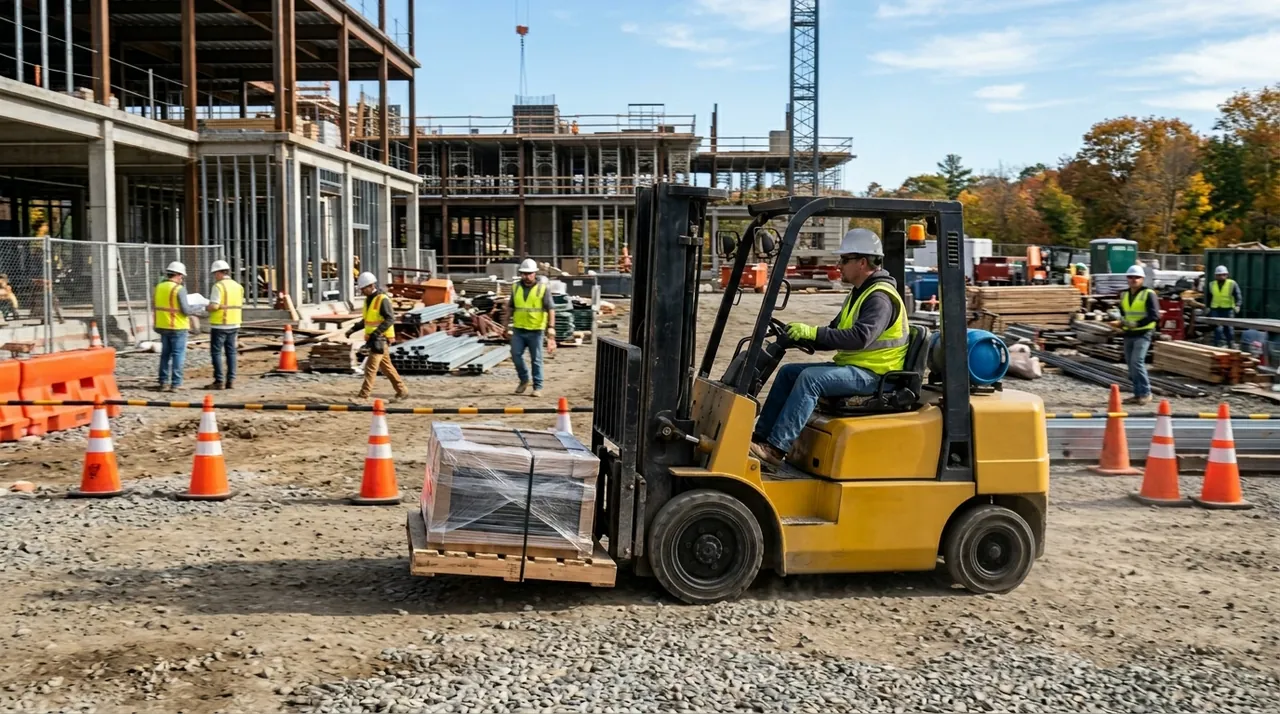
Knowing how to operate an industrial lift truck is only half the job. The other half is operating it safely around people, loads, and energy sources that can hurt you fast if you cut corners. This lesson covers the safe traveling and load-handling practices the Massachusetts 1D exam tests directly, along with the fuel and battery hazards that cause fires and injuries when operators skip the rules.
Traveling safely — loaded and unloaded
The most basic rule of forklift travel is also the one most operators violate: keep the forks low and the mast tilted back while moving. Raising the forks while traveling raises the center of gravity, which is what turns a routine turn into a tip-over. Forks should only come up when you are actually stacking or picking, then come back down immediately.
When a load blocks your forward view, travel in reverse so you can see where you are going. On grades steeper than 10 percent, the load always faces uphill, whether you are going up or coming down. The logic is the same in both directions: never let the load sit on the downhill side, because that is the condition that causes a loaded truck to lose traction and the load to shift.
Maintain roughly three truck lengths of following distance and keep your speed low enough that you can stop safely. At intersections, blind corners, and doorways, slow down and sound the horn every time — as a consistent habit, not just when you think someone might be nearby.
Pedestrian safety in shared work areas
One rule that catches people off guard on the exam: never drive a lift truck up to someone standing between the truck and a fixed object. The person has nowhere to go, and a small misjudgment leaves them pinned. Keep approaches clear before you commit.
No one walks or stands beneath elevated forks or a raised load — not to check what is on the pallet, not for any reason. Hydraulics can fail and controls can be bumped. No unauthorized riders, ever. And for the operator: keep arms, legs, and head inside the running lines of the truck at all times, and never reach through the mast. It moves, and the pinch points are serious.
Picking, placing, and stacking loads
Center the load on the forks so weight is distributed evenly side to side, and drive the forks fully under the load so the back of the forks carries as much of the load depth as possible. A load that is only partially on the forks can tip forward when you tilt the mast back.
When stacking, go square — an off-center stack is a falling hazard for anyone nearby. And never pick or stack a load that exceeds the truck's rated capacity. The nameplate capacity accounts for the specific truck, mast height, and load center. Exceeding it undermines the counterweight balance the truck was engineered around.
Fuel and battery hazards
LP (propane) forklifts must be refueled away from buildings and any ignition source, with the engine off. Propane is heavier than air and pools at floor level when it leaks, where it can ignite from a spark at a distance.
Battery charging must happen in a ventilated area because charging produces hydrogen gas, which is explosive. If you ever need to handle battery acid or mix electrolyte, always add acid into water — never water into acid — because reversing the order causes a violent reaction. Keep sparks and open flame out of the charging area, and no smoking.
For diesel and gasoline trucks: no open flame to check the fuel level, and any leak must be fixed before putting the truck back in service.
Key Takeaways
- •Keep forks low and mast tilted back while traveling; only raise the load to stack or pick.
- •Travel in reverse when the load blocks your forward view.
- •On grades over 10 percent, the load always faces uphill — going up or coming down.
- •Never approach a pedestrian pinned against a fixed object; no one stands under elevated forks; no unauthorized riders.
- •LP refueling requires engine off and distance from ignition sources; battery charging requires ventilation and no sparks; if handling acid, add acid to water, never water to acid; fuel leaks must be fixed before operating.