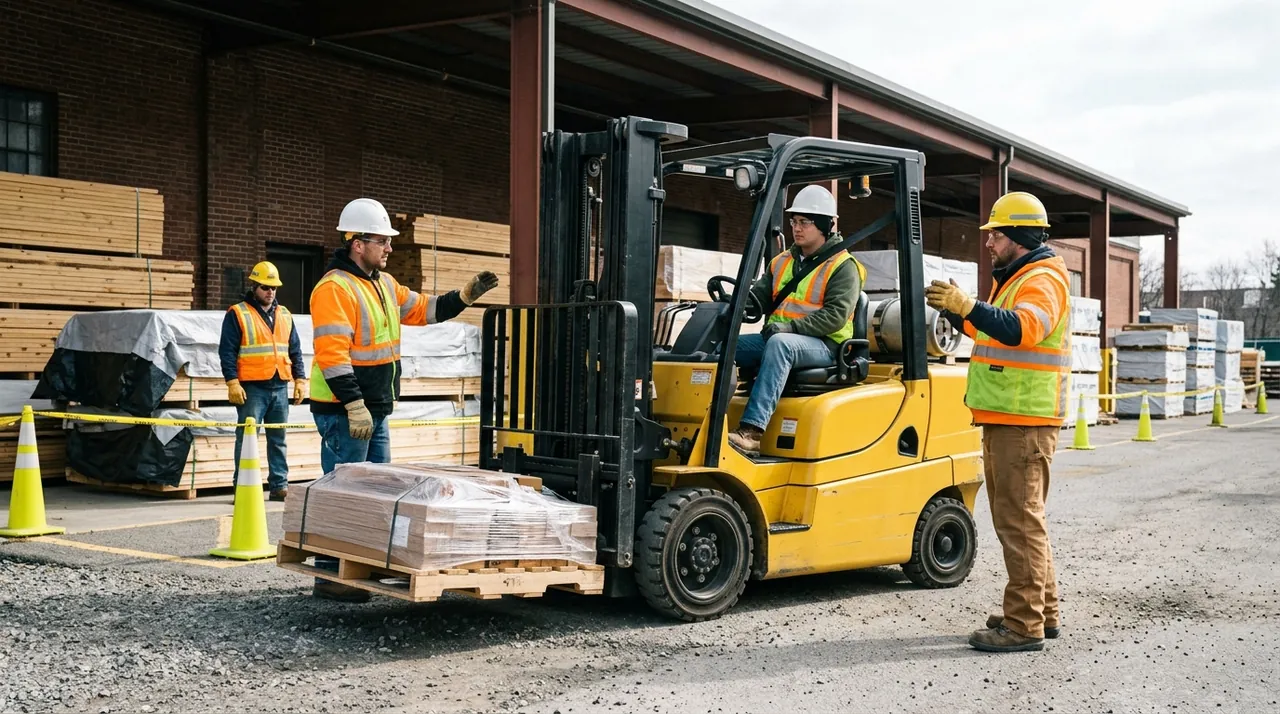
Most operators know the forklift rules on the warehouse floor come from somewhere — they just have not read the actual standard. OSHA 29 CFR 1910.178 is that standard. It sets the federal floor for how powered industrial truck operators must be trained, evaluated, and certified in general industry. Understanding 1910.178 matters for the MA 1D exam because it defines what your employer owes you in training, what you owe them in performance, and how the federal rule interacts with the separate state license Massachusetts requires.
What 1910.178 covers — and what it deliberately leaves out
The standard applies to powered industrial trucks as a class: fork trucks, tractors, platform lift trucks, motorized hand trucks, and similar equipment used in general industry. The coverage is broad because these machines share the same core hazards — tip-over, pedestrian strikes, falling loads — regardless of exact configuration.
What the standard does not cover is equally important. Compressed-air trucks, farm vehicles, and earth-moving equipment are all excluded. Outdoor rough-terrain forklifts on a construction site fall under a separate OSHA construction standard rather than 1910.178. Knowing the exclusions keeps you from applying the wrong rule to the wrong machine — exactly the kind of distinction the exam tests.
The three-part training requirement
OSHA 1910.178 does not allow training by lecture alone. It requires a combination of three elements: formal instruction such as classroom teaching or written materials, practical hands-on training, and a workplace evaluation where a qualified person observes the operator in the actual environment where the truck will be used. All three must happen before an operator is cleared to work unsupervised.
Training content must address two categories. Truck-specific topics include how the controls work, what rated capacity means and how it shifts with load center and mast tilt, stability principles, and pre-shift inspection. Workplace-specific topics cover the surface conditions in that facility, where pedestrian paths cross truck routes, ramp procedures, and any hazardous locations. A program that skips either category does not satisfy the standard.
After initial certification, operators must be re-evaluated at least once every three years — a performance evaluation, not just a quiz.
When refresher training is required
The three-year cycle is the minimum. Several specific events require refresher training and a new evaluation before that interval expires: an accident or near-miss, observed unsafe operation, a poor periodic evaluation, assignment to a different truck type, or a workplace change that affects safe operation.
The truck-type trigger deserves attention. A certification on one machine does not carry over to another. An operator trained on a sit-down counterbalanced forklift who is reassigned to a stand-up reach truck is operating a different machine with different controls, a different stability profile, and different sightlines. OSHA requires new training and evaluation before that operator works unsupervised — not a simple cross-endorsement. The exam routinely presents scenarios like this one, so know it cold.
Employer certification and the Massachusetts license
After each training and evaluation, the employer must create a written certification record that includes the operator's name, the date of training, the date of evaluation, and the identity of the trainer or evaluator. This is what OSHA inspectors look for, and an employer who cannot produce it faces citation even if the training actually happened.
The Massachusetts 1D hoisting license sits alongside 1910.178, not inside it. The federal standard is an employer-based training requirement — it governs how employers must train and certify their workers. The Massachusetts license is a separate individual credential issued by the state under Massachusetts General Law. An operator generally needs both: the employer certifies the training under OSHA, and the operator carries a valid state license. Neither replaces the other.
Key Takeaways
- •OSHA 29 CFR 1910.178 covers fork trucks, tractors, and platform lift trucks in general industry but excludes compressed-air trucks, farm vehicles, and earth-moving equipment.
- •Training must combine formal instruction, hands-on practical training, and a workplace performance evaluation — no single element is enough on its own.
- •Training content must address both truck-specific topics (controls, capacity, stability, inspection) and workplace-specific topics (surfaces, pedestrians, ramps, hazardous areas).
- •Operators must be evaluated at least every three years; refresher training and re-evaluation are also required after accidents, observed unsafe acts, poor evaluations, a new truck type assignment, or workplace changes.
- •The Massachusetts 1D hoisting license and OSHA 1910.178 certification are separate requirements — an operator generally needs both, and one does not substitute for the other.