Free MA Hoist

230 CMR 6.00 — Rules Specific to Excavating Machinery

1.5 hours

2A — 230 CMR 6.00 — Rules Specific to Excavating Machinery (Excavating Machinery).
2Aexcavating machinery.

Chapter 146 of the Massachusetts General Laws requires hoisting licenses. But a statute alone does not tell an operator how to run a machine safely on a live job site — that is the job of the implementing regulation. For 2A excavating machinery, 230 CMR 6.00 is that regulation. It translates the broad legislative requirement of safe operation into specific, enforceable rules: who gives signals, where workers may stand, who may be on the machine, and what published standards apply. Every exam question that touches job-site conduct traces back to 230 CMR 6.00, so understanding what it requires is the foundation everything else builds on.

How 230 CMR 6.00 fits into the regulatory picture

Massachusetts General Laws Chapter 146 gives the Division of Occupational Licensure (DOL), Office of Public Safety and Inspections (OPSI) authority to license hoisting operators and set safety standards. The rules that flow from that authority appear in the Code of Massachusetts Regulations under 230 CMR. Hoisting machinery is broadly governed by 230 CMR 6.00, and excavating machinery operated under a 2A license falls squarely within that regulation.

One source of confusion on the exam: older study materials may reference 520 CMR 6.00, which was the former citation before the regulation was recodified. 520 CMR 6.00 is superseded — the current, enforceable citation is 230 CMR 6.00. Think of 230 CMR 6.00 as the floor: manufacturer specifications and applicable OSHA requirements layer on top, but 230 CMR 6.00 sets the baseline every licensed 2A operator is legally held to.

Hand signals and the authority of the designated signaler

The most heavily tested rule in 230 CMR 6.00 is this: only the designated signaler may direct an operator's movements on a job site. It does not matter whether the site superintendent is more senior or a coworker is gesturing urgently — if that person is not the designated signaler, the operator does not follow their signals.

The regulation requires those signals to conform to SAE J1307-2023, the published hand-signal standard for excavating machinery. A defined standard means that a signal learned on one job site means exactly the same thing on a different crew in a different city, removing the kind of ambiguity that causes serious incidents. One rule follows directly: if the operator loses sight of the designated signaler at any point, the machine stops and stays stopped until the signaler is visible again.

Who may be on the machine and where workers must stand

230 CMR 6.00 is explicit about personnel. The licensed operator is in the cab. One apprentice working under the direct, in-person supervision of that operator may also be present. No other unauthorized persons may be on the machine during operation.

Ground workers must stay outside the full working radius of the boom and bucket during any swing movement. The working radius extends to the machine's full reach in every direction it can swing — a worker who looks clear from one angle can be inside the danger zone the moment the operator slews. The operator confirms the zone is clear before any swing begins.

One prohibition that surprises apprentices on the exam: an excavating machine may not straddle an open trench. Positioning a machine over an open excavation creates a collapse hazard for the operator and anyone working below. The rule is absolute, regardless of trench width or time pressure on the job.

Manufacturer specifications as a regulatory requirement

230 CMR 6.00 requires operators to follow all manufacturer specifications for the equipment they run. This is not a suggestion to consult the manual when something looks wrong — it is a mandate that ties the operator's conduct to the machine's engineered limits: rated capacities, approved attachments, operating angles, and any other performance boundaries the manufacturer has established. Running outside those limits is not just poor judgment; it is a regulatory violation. The operator's manual is a legal document as much as a technical one.

Key Takeaways

  • 230 CMR 6.00 is the current, enforceable regulation governing all hoisting machinery including 2A excavating equipment — 520 CMR 6.00 is the old superseded citation and should not be used.
  • Only the designated signaler may direct operator movements; all hand signals must conform to SAE J1307-2023.
  • If the operator loses sight of the designated signaler, the machine stops until the signaler is visible again.
  • No unauthorized personnel on the machine; no workers within the full working radius during boom or bucket swing.
  • Straddling an open trench is prohibited; following manufacturer specifications is a regulatory requirement, not optional guidance.
Learning Objectives

  • Explain the role of 230 CMR 6.00 relative to MGL Chapter 146
  • List the four 230 CMR 6.00 operating rules that apply to all 2A equipment
  • State the SAE hand signal standard required by 230 CMR 6.00
  • Identify who may ride on or operate the machine during a job

Topics Covered

  • 230 CMR 6.00: minimum safety standards for hoisting machinery in MA
  • SAE J1307-2023: the required hand signal standard for excavating machinery
  • Only approved signaler may direct operator movements
  • No unauthorized personnel on machine during operation
  • Crew may include operator plus one apprentice under direct supervision
  • No persons within full working radius during bucket/boom swing
  • Prohibition on straddling open trenches with excavating machinery
  • Operators must follow all manufacturer specifications
  • Differences between 230 CMR and 520 CMR references
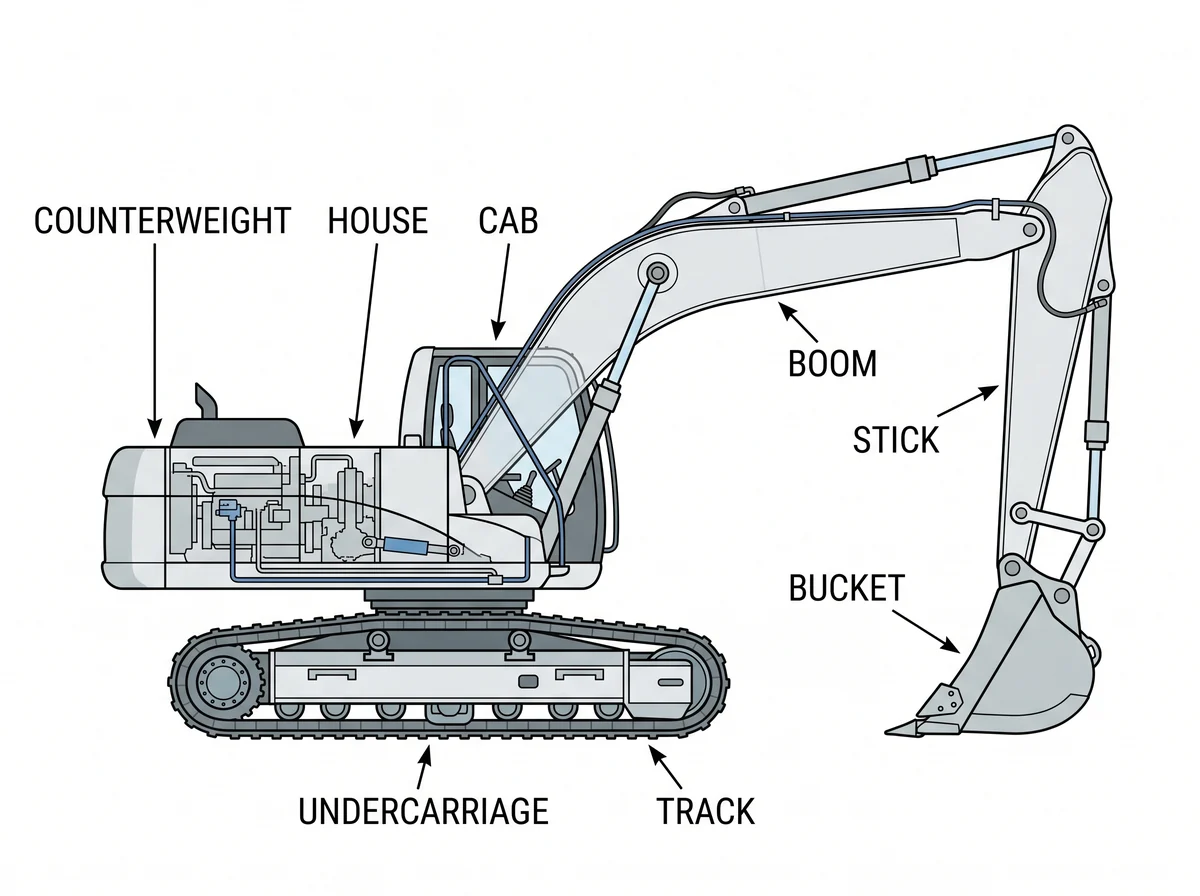
Equipment anatomy — Excavating Machinery
Labeled diagram of a hydraulic excavator: boom, stick, bucket, cab, house, counterweight, undercarriage, track.

Resources

Self-Check Questions

Question 1: Under 230 CMR 6.00, who is the ONLY person authorized to direct an excavator operator's movements on a job site?

  1. A. The general contractor's site superintendent
  2. B. Any crew member present at the job site
  3. C. The approved signaler assigned to the machine(correct)
  4. D. Either the operator or the site safety officer
Show Explanation

Explanation:

230 CMR 6.00 requires that only an approved signaler direct the operator. Taking direction from anyone else — even a supervisor — violates the regulation and creates unsafe conditions.

Question 2: You are operating an excavator and need to swing the boom. A coworker is standing within the full working radius. What must you do?

  1. A. Sound the horn and proceed carefully
  2. B. Ask the signaler to wave them off, then proceed
  3. C. Stop the swing until the worker clears the radius(correct)
  4. D. Slow your swing speed and maintain visual contact
Show Explanation

Explanation:

230 CMR 6.00 prohibits any persons within the full working radius during boom/bucket operation. The only correct action is to stop and wait until the area is clear — no exceptions.

Question 3: Under 230 CMR 6.00, is an excavator allowed to straddle an open trench?

  1. A. Yes, if the trench is less than 5 feet deep
  2. B. Yes, if a competent person approves the position
  3. C. No, straddling open trenches is prohibited(correct)
  4. D. Yes, if outriggers are deployed for stabilization
Show Explanation

Explanation:

230 CMR 6.00 explicitly prohibits excavating machinery from straddling open trenches. The weight and vibration of a machine positioned over a trench dramatically increases cave-in risk.

Question 4: Beyond the licensed operator, how many additional people may be on an excavator during operation under 230 CMR 6.00?

  1. A. No additional personnel — operator only
  2. B. One apprentice under the direct supervision of the operator(correct)
  3. C. Two helpers if the site superintendent approves
  4. D. As many as can safely fit in the cab
Show Explanation

Explanation:

230 CMR 6.00 allows one apprentice in addition to the licensed operator, but only under direct supervision. Unauthorized passengers on the machine at any time violate the regulation.

Question 5: Which SAE standard specifies the hand signals required by 230 CMR 6.00 for excavating machinery?

  1. A. SAE J386-1969
  2. B. SAE J1307-2023(correct)
  3. C. SAE J320a
  4. D. SAE J237
Show Explanation

Explanation:

SAE J1307 (most recently revised 2023) is the standard hand signal set for excavators and backhoes required by 230 CMR 6.00. SAE J386 covers seat belts, J320a covers ROPS, and J237 covers braking.

Question 6: If the operator cannot see the designated signaler during an operation, what must the operator do?

  1. A. Slow down and proceed with extra caution
  2. B. Stop all machine movement immediately(correct)
  3. C. Switch to radio communication
  4. D. Ask a nearby worker to relay signals
Show Explanation

Explanation:

If visual contact with the signaler is lost, 230 CMR 6.00 requires the operator to stop immediately. A signaler out of sight cannot safely direct the machine — no relay system or substitute is permitted.

Question 7: An excavator operator receives conflicting hand signals from the site superintendent and the designated signaler simultaneously. Which signal takes priority?

  1. A. The site superintendent's signal, as they have overall authority
  2. B. Whichever signal the operator judges to be safer
  3. C. The designated signaler's signal
  4. D. The Emergency Stop signal if either person gives it; otherwise stop until resolved(correct)
Show Explanation

Explanation:

If conflicting signals are received, the operator must stop until the conflict is resolved. However, if either person gives an Emergency Stop (crossed arms), that always takes immediate precedence over everything else.

In-depth reference for this session →

A deeper, regulation-by-regulation companion page for this lesson.