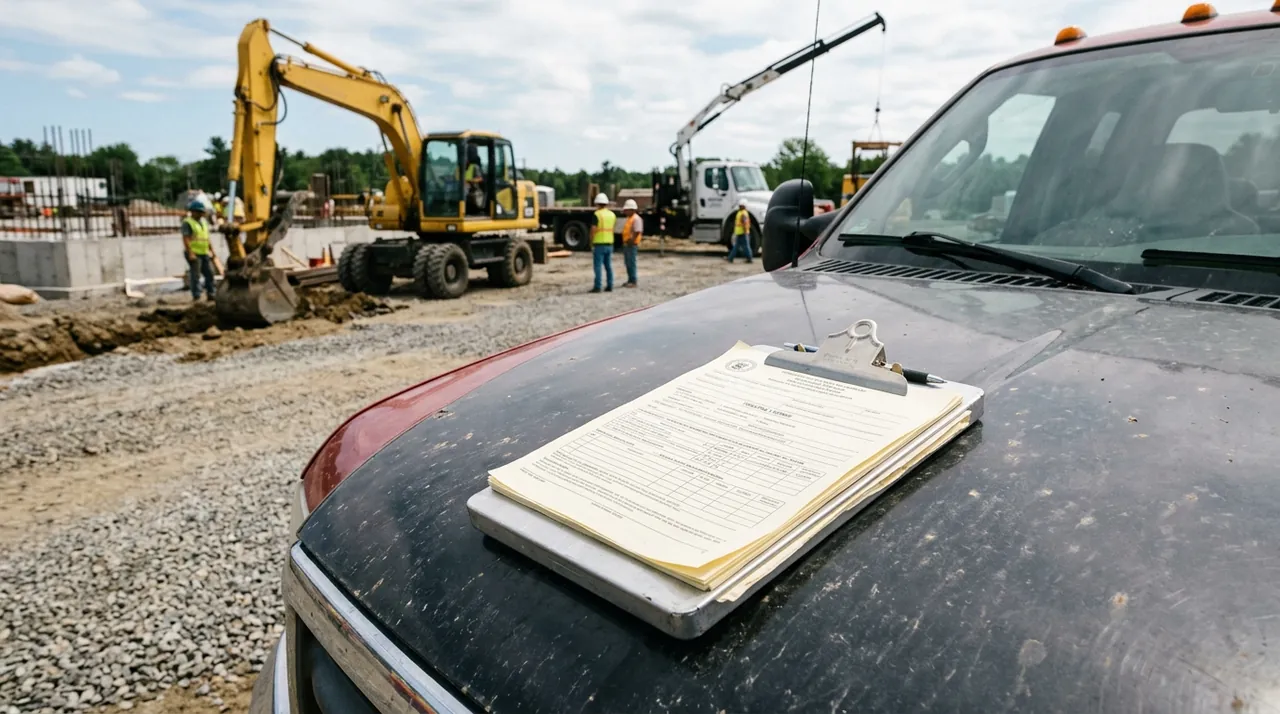
The combined 2A/1C credential covers two very different families of machines, and the Massachusetts exam expects you to keep them straight. The 2A side is the excavating family: excavators, backhoes, loaders, and compact machines. The 1C side is hydraulic boom hoisting: telescoping-boom trucks and knuckle-boom cranes that lift with the boom itself. Those two families share a license card, but they are governed by distinct scopes written into 230 CMR 6.00. Mixing them up on the job — or on the exam — has real consequences.
How 230 CMR 6.00 organizes the restriction system
The Massachusetts hoisting-license regulations under 230 CMR 6.00 establish each restriction classification and set the minimum operating standards that apply to every licensed operator. The regulation is not just an administrative list — it defines what you are legally authorized to run, what attachment and signaling requirements you must follow, and what renewal obligations apply to you under 230 CMR 6.04.
Before you can correctly classify a machine, you need to understand the framework: each restriction number identifies a category of equipment, some restrictions nest inside others (meaning a higher credential already authorizes everything a lower one covers), and the line between adjacent categories is usually drawn by a single, specific technical feature. Knowing where those lines fall is what the exam tests, and what protects you from unknowingly operating outside your license on a job site.
The 2A scope and what comes with it automatically
The 2A restriction authorizes all crawler and rubber-tired excavators and backhoes operated with manufacturer-approved attachments. If the machine digs, swings, and works within an excavating cycle — whether it is a large track excavator or a wheeled machine with a backhoe arm — it lives under 2A.
What makes 2A especially valuable is its nesting structure. A 2A license already includes the 2B restriction (combination loader/backhoe machines, the classic backhoe loader), the 2C restriction (front-end loaders and wheel loaders), and the 2D restriction (compact machines at or under 10,000 lb gross vehicle weight). You do not apply separately for those; they come with the 2A. In practice this means a licensed 2A operator can legally run the full range of common earthmoving equipment on a Massachusetts job site without any additional endorsement.
The 1C scope and the wire-rope dividing line
The 1C restriction covers hydraulic telescoping-boom equipment and other hydraulic hoisting equipment — specifically machines that lift the load directly through the boom rather than through a wire-rope hoist line. The most common 1C machines are boom trucks (truck-mounted hydraulic telescoping cranes) and articulating knuckle-boom loader cranes that pick and carry with the boom itself.
The single most important technical distinction in 1C is the wire-rope rule: if a telescoping-boom machine has a wire-rope hoist line, it is classified as 1B, not 1C. The 1C boom lifts the load directly. That one feature — wire rope versus hydraulic direct-lift — is where 1B ends and 1C begins, and the exam will probe it directly.
The 1C restriction also nests over 1D (warehouse forklifts), but it does not authorize friction cranes or lattice-boom cranes; those fall under 1A and 1B. Keeping the nesting hierarchy clear prevents you from assuming 1C is broader than it is.
The correction that trips up most candidates
The most common classification error is placing loaders and backhoes under 1C because the word "hydraulic" appears in the 1C title. This is wrong. Loaders, backhoes, and excavators are excavating-family machines and belong entirely to the 2A family, regardless of how their arms and buckets are powered. The 1C restriction is about hoisting — lifting loads off the ground with a boom — not about ground-engaging earthwork.
Drill this disambiguation until it is automatic: an excavator belongs to 2A; a backhoe loader belongs to 2A; a front-end loader belongs to 2A; a boom truck belongs to 1C; a knuckle-boom loader crane belongs to 1C; a telescoping crane with a wire-rope hoist line belongs to 1B and is outside the 2A/1C combined credential entirely. The continuing-education requirement under 230 CMR 6.04 applies separately to each restriction you hold, so understanding which machines you are responsible for is also how you manage your renewal correctly.
Key Takeaways
- •230 CMR 6.00 defines restriction classifications and minimum operating standards; 230 CMR 6.04 requires continuing education before each renewal.
- •The 2A restriction covers excavators and backhoes with approved attachments, and automatically includes 2B, 2C, and 2D — no separate endorsement needed.
- •The 1C restriction covers hydraulic telescoping-boom and knuckle-boom hoisting equipment; the machine lifts the load directly through the boom.
- •The wire-rope rule is the 1B/1C dividing line: a telescoping boom with a wire-rope hoist line is 1B, not 1C.
- •Loaders and backhoes are 2A machines, not 1C — the word 'hydraulic' in the 1C title refers to hoisting, not earthmoving.