Free MA Hoist

Shared Job-Site Hazards — Hand Signals, Power Lines & Ground Personnel

2 hours

2A/1C — Shared Job-Site Hazards — Hand Signals, Power Lines & Ground Personnel (Excavating Machinery & Hydraulic Boom-Truck Hoisting).
2A/1Cexcavating machinery & hydraulic boom-truck hoisting.

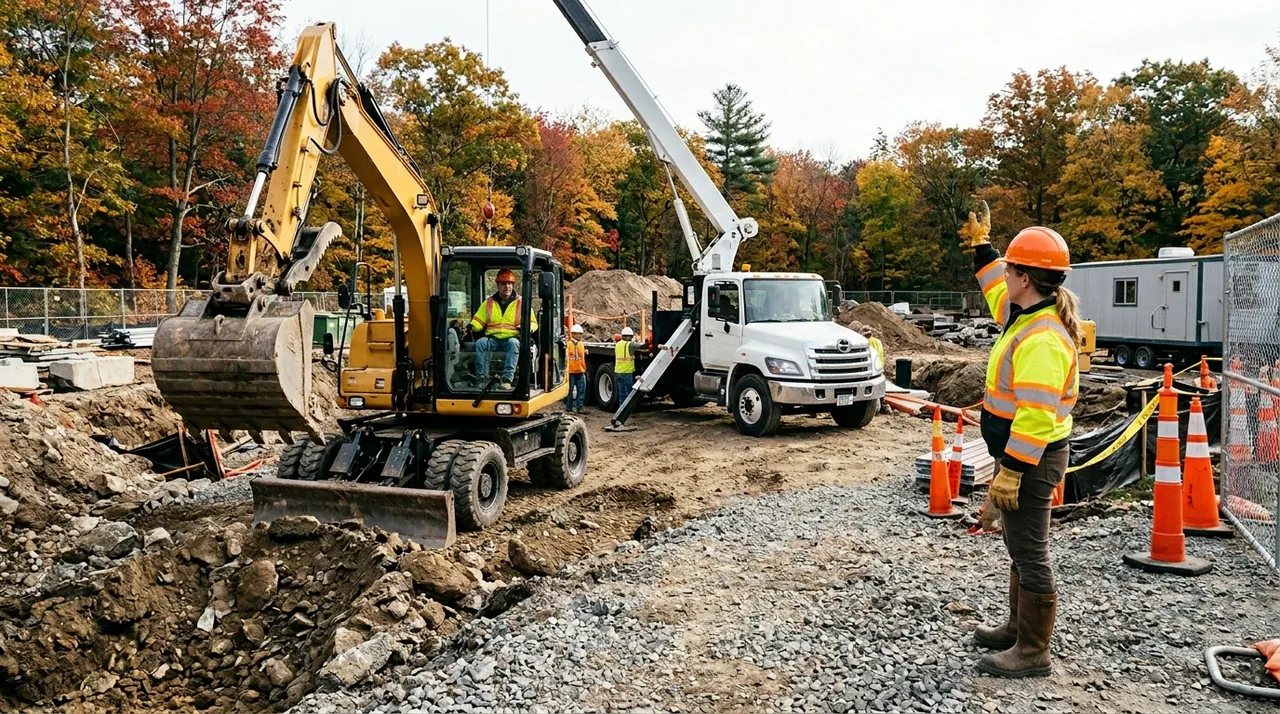
An excavator and a boom truck are powerful machines on their own. Put them on a shared job site with ground crews, signal persons, utility lines, and other trades working nearby, and the hazard picture multiplies fast. The accidents that happen most often on these sites are not mechanical failures — they are coordination failures. This session covers the communication systems, exclusion-zone discipline, and hazard awareness that keep everyone around your machine as safe as you are inside the cab.

Signal person authority and the stop signal

On any hoisting or excavating operation, a designated signal person is the operator's communication link to what is happening outside the cab. Visual contact between the signal person and the operator must be maintained at all times — if it breaks, the operator stops. That is the correct response, not a guideline. An operator who continues moving because they assume nothing changed is gambling with other people's lives.

Hand signals are standardized to remove ambiguity when engine noise, distance, or weather make verbal communication impossible. The 2A1C exam expects you to recognize signals for boom up and down, swing, travel, hoist, and stop for both excavating and lifting operations. The stop signal is the most important one. Unlike every other signal, an emergency stop can be given by any person on the site — a laborer, a rigger, an inspector, anyone — and the operator must respond immediately without waiting to understand why. That rule exists because the person giving it may be the only one who can see the hazard.

Swing radius and load-path exclusion zones

The counterweight on an excavator and the turret on a boom truck rotate through a wide arc. Ground personnel who drift into that arc have been struck and killed by equipment the operator never knew was close. Keep all personnel outside the full working radius while the machine is operating. The tail-swing behind the machine is where many struck-by incidents originate, because it moves opposite the direction most people are watching. Spotters and physical barriers — cones, tape, exclusion fencing — enforce what a posted rule alone cannot.

For 1C lift operations, the load path adds another dimension. Once a load is suspended, no worker should be beneath it or anywhere in its travel arc. Plan the lift before it begins: where does the load travel, where does it set down, and is anyone in that path? Identifying and clearing the load path in advance is the only reliable protection against a shifting or dropped load.

Power lines and underground utilities

Electrocution bridges both license classes. For boom-truck operations, energized overhead lines require maintained clearance distances from any part of the machine, the load, or the rigging. Assume every overhead line is energized until the utility owner provides written confirmation otherwise. Working within the required clearance requires specific protective measures — not just a spotter watching.

For 2A excavating work, the hazard shifts underground. Massachusetts Dig Safe law requires notification before any digging. Marking tolerances mean a buried line could be off from its marked position, so hand-dig to expose and confirm a utility before bringing machine teeth near it. Treat any buried gas line, conduit, or cable as a hazard until you can see it and know exactly where it runs.

Pre-shift coordination and caught-in hazards

Caught-in hazards look different depending on which machine you are running. For excavator work, trench walls can fail without warning, and nearby machine vibration can destabilize soil even outside the cut. For boom-truck work, a rigger or signal person can be caught between a swinging load and a fixed structure when they move into a position that looks clear until the boom rotates.

Both situations are prevented the same way: a pre-shift coordination conversation before the first movement of the day. The team agrees on who signals, where exclusion zones are, and what the emergency-stop plan looks like. That brief conversation is what prevents a worker from being in the wrong place when the machine swings — and gives the operator a shared picture of the site before the work begins.

Key Takeaways

  • Visual contact with the designated signal person must be maintained at all times — loss of contact means stop immediately.
  • Any person on the site can give an emergency-stop signal; the operator must comply without delay or question.
  • The full swing radius and tail-swing are exclusion zones; spotters and physical barriers enforce what rules alone cannot.
  • Never carry or swing a suspended load over workers — plan and clear the load path before lifting.
  • Assume every overhead line is energized; call Dig Safe before excavating and hand-dig to expose buried utilities before machine work begins.

Learning Objectives

  • Apply standard hand signals and stop signals for both excavating and lifting operations
  • Maintain required clearance from energized overhead and underground power sources
  • Establish and enforce swing-radius and load-path exclusion zones
  • Coordinate safely with signal persons, riggers, and ground crew
  • Identify struck-by, caught-in, crush, and electrocution hazards common to 2A and 1C work

Topics Covered

  • Communication: a designated signal person directs the operator; visual contact must be maintained at all times
  • Stop and emergency-stop signals: any person may give an emergency stop, and the operator must respond immediately
  • Hand signals for excavating (boom/stick/bucket/swing/travel) and for lifting (hoist via boom, swing, boom up/down, stop)
  • Swing-radius hazard: keep personnel out of the full working/swing radius of an excavator or a boom-truck turret
  • Load path: never carry or swing a suspended load over workers; plan the lift path in advance
  • Power-line clearance: maintain required clearance from energized overhead lines (Subpart CC for lifts; site rules for digging)
  • Underground utilities: Dig Safe locating before excavation; assume marked lines may be off by tolerance
  • Struck-by and crush hazards: counterweight swing, tail-swing, moving loads, and pinch points between equipment and structures
  • Caught-in/between: trench cave-ins (2A) and being trapped between a swinging load or boom and a fixed object (1C)
  • Ground conditions and spotters: blind swings, backing, and congested sites require spotters and exclusion barriers
  • Riggers and the lift team: only qualified personnel rig loads; the operator confirms the rig and the path before lifting
  • Pre-shift coordination: who signals, where exclusion zones are, and the emergency-stop plan agreed before work starts

Resources

Self-Check Questions

Question 1: Who may give an emergency-stop signal to a hoisting or excavating operator?

  1. A. Only the designated signal person
  2. B. Only the site superintendent
  3. C. Any person who observes a hazard — and the operator must respond immediately(correct)
  4. D. Only the equipment owner
Show Explanation

Explanation:

While routine signals come from one designated signal person, an emergency stop may be given by anyone who sees a hazard, and the operator must stop immediately. Safety overrides the single-signaler rule for emergencies.

Question 2: What must the operator do if visual contact with the designated signal person is lost during an operation?

  1. A. Continue slowly and carefully
  2. B. Stop all machine movement until contact is re-established(correct)
  3. C. Have any nearby worker relay signals
  4. D. Finish the current motion, then stop
Show Explanation

Explanation:

If the operator loses sight of the signal person, all movement must stop until contact is restored. A signaler who cannot be seen cannot safely direct the machine.

Question 3: Where should ground personnel be during an excavator swing or a boom-truck turret rotation?

  1. A. Anywhere outside the cab
  2. B. Out of the full working/swing radius, including the counterweight tail-swing area(correct)
  3. C. Directly behind the machine where the operator can see them
  4. D. Under the suspended load to steady it
Show Explanation

Explanation:

Personnel must stay clear of the full swing radius, including the rear tail-swing of the counterweight or turret, which can crush a worker against a fixed object. Loads must never be swung over people.

Question 4: Why is power-line clearance a critical concern for 1C boom-truck operations?

  1. A. Hydraulic fluid conducts electricity through the hoses
  2. B. Contact between the boom and an energized line can electrocute the operator, rigger, and ground crew(correct)
  3. C. Power lines reduce the truck's fuel economy
  4. D. It only matters for wire-rope cranes
Show Explanation

Explanation:

If the boom or load contacts an energized overhead line, the entire machine and anyone touching it or the load can be electrocuted. Required clearances must be maintained, and a dedicated spotter is used when working near lines.

Question 5: What is a caught-in/between hazard for these operations?

  1. A. Hydraulic fluid overheating
  2. B. A trench cave-in burying a worker, or a person pinned between a swinging load/boom and a fixed object(correct)
  3. C. An overloaded load chart
  4. D. A discharged fire extinguisher
Show Explanation

Explanation:

Caught-in/between hazards include trench cave-ins on the 2A side and being pinned between a swinging boom or suspended load and a wall, truck, or structure on the 1C side. Exclusion zones and spotters control both.

In-depth reference for this session →

A deeper, regulation-by-regulation companion page for this lesson.