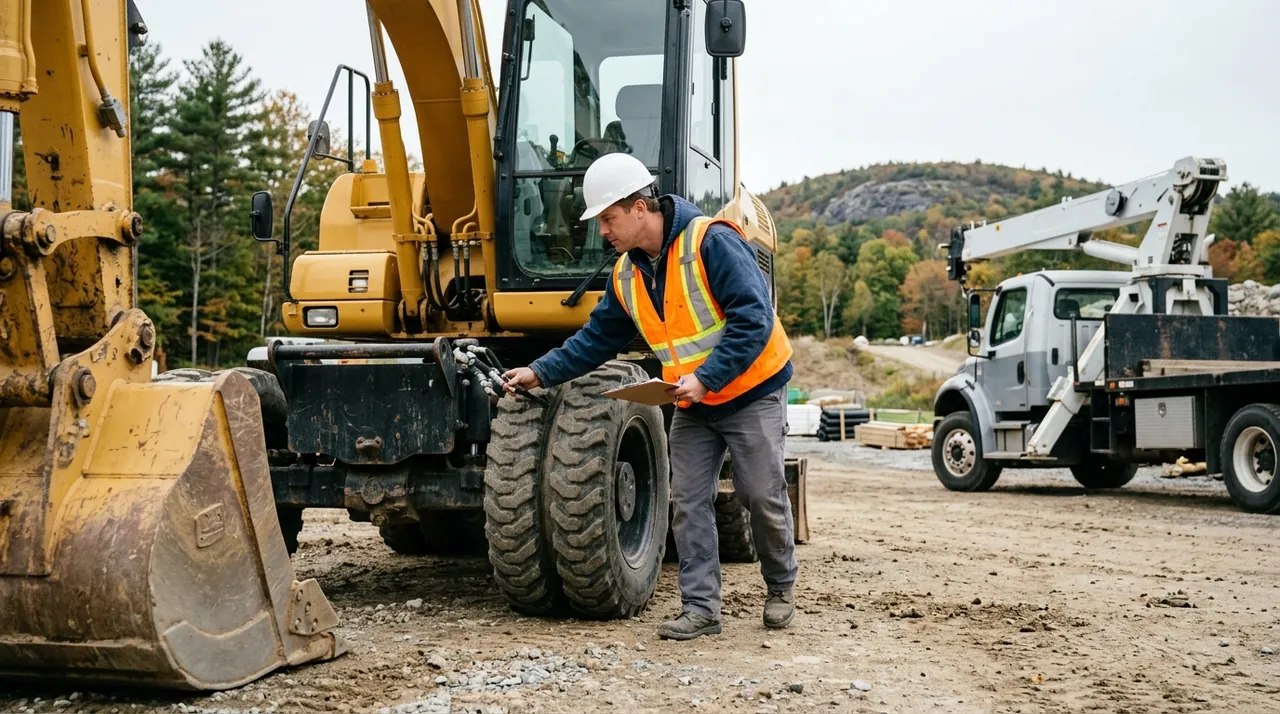
Before either machine moves — whether you are in an excavator cab or behind the controls of a hydraulic boom truck — the inspection comes first. It is a regulatory requirement and the single most reliable way to catch the defect that would otherwise show up mid-shift as a hydraulic failure, a dropped load, or an outrigger that never fully extended. This lesson builds the inspection habit for both machine types, covers what the regulations require and why, and draws a clear line between findings you log and findings that take the machine out of service.
The regulatory basis and who is responsible
OSHA requires pre-operation inspections for both machine categories covered by the 2A/1C license. For excavators, OSHA 1926.602 applies. For hydraulic boom trucks used as cranes, Subpart CC governs, and it requires inspection before use by a qualified or competent person. A competent person can identify a hazard and has the authority to pull a machine from service — in the field, that is almost always the operator.
Timing matters as much as who does it. Inspect before each shift, after relocation to a new position, and before each series of lifts on a boom truck. Ground conditions change, transport can loosen fittings, and a machine that was sound at the end of yesterday's shift may have developed an overnight hydraulic weep. The inspection resets the baseline every time.
The walk-around method: consistency over speed
A good inspection is systematic. Choose a fixed starting point — the cab door is natural — and move around the machine in one consistent direction every time. A random walk invites gaps, and gaps are where missed defects live.
On an excavator, start with fluids: engine oil, hydraulic fluid, coolant, and fuel. Hydraulic fluid color is diagnostic — milky means water contamination, dark or burnt means overheating. Trace every hose and fitting for chafing, kinks, and weeping. Then check the undercarriage: track tension, rollers, sprockets, and pins. Walk the boom, stick, and bucket for cracks, worn mounting ears, and loose pivot pins. Finish at the cab: ROPS and FOPS condition, seat belt, horn, backup alarm, and glass.
A boom truck adds crane-specific items. Inspect boom sections and any telescoping or knuckle joints for cracks and scoring. Confirm holding valves are present and undamaged — they keep a loaded boom from drifting if a hose ruptures. Inspect the hook, hook latch, and swivel, and confirm the load-moment indicator is installed and functioning.
Outrigger and load-chart verification on the boom truck
Outriggers deserve a focused check because they are the foundation of every lift. Inspect the beams, pins, jacks, and pads or floats for damage and security. Once extended, verify that the leveling indicator confirms the machine is within tolerance — a boom truck out of level operates outside its rated capacity, and a cracked or undersized pad can punch through soft ground mid-lift.
Before any lift, the capacity plate and load chart must be present and legible. The load chart defines what the machine can safely lift at a given radius and boom angle — without it, you cannot determine whether a lift is within capacity, and that alone is a removal-from-service condition. If the chart is missing or unreadable, the machine stays down until it is replaced.
Operational checks after the walk-around
The walk-around covers the static condition of the machine. The operational check covers the dynamic condition — you start the engine and verify that everything functions as it should before any work begins. On both machine types, confirm that all controls respond correctly and return to neutral, that brakes hold under load, and that there are no abnormal noises from the engine, hydraulics, or drivetrain. Warning devices must activate: horn, backup alarm, and any load-moment or anti-two-block alarms on the boom truck. On an excavator, cycle the boom, stick, and bucket through their full range while watching for hesitation, drift, or unusual sounds that signal a hydraulic or mechanical problem. On a boom truck, extend and retract the outriggers under power and confirm that each jack locks in position. Any failure discovered during the operational check is treated the same as one discovered during the walk-around — the machine does not go to work until the problem is resolved.
Removal from service, tagging out, and the inspection record
Some findings are notes in a log. Others are immediate stop-work conditions. On either machine, active hydraulic leaks, structural cracks, a damaged ROPS or FOPS, and non-functional seat belts, horns, or backup alarms require the machine to come out of service on the spot. On a boom truck, add defective outriggers, defective holding valves, and a missing or illegible load chart to that list. There is no 'finish the shift and report it' option for these conditions.
Tagging out means attaching a tag to the controls so no one else starts the machine, then reporting to a supervisor so qualified maintenance personnel can make the repair. The operator identifies the problem; someone authorized fixes it. Once the repair is complete, the tag comes off and a new inspection record starts.
The daily log is the paper trail that connects the regulatory requirement to the actual condition of the equipment. Record what you checked, what you found, and what corrective action was taken. That record protects you, documents compliance, and gives the next operator a reliable baseline.
Key Takeaways
- •OSHA 1926.602 and Subpart CC require pre-operation inspection by a qualified or competent person before each shift, after relocation, and before each lift series.
- •Use a fixed walk-around route starting at a consistent point so every item on both machine types is checked every time, then follow it with an operational check — confirm controls respond, brakes hold, and warning devices function before any work begins.
- •On a boom truck, outrigger integrity and the presence of a legible load chart and capacity plate are mandatory before any lift begins.
- •Active hydraulic leaks, structural cracks, damaged ROPS or FOPS, non-functional seat belts or warning devices, defective outriggers or holding valves, and a missing load chart are immediate removal-from-service conditions — no exceptions.
- •Tag out defective equipment, report to a supervisor, complete the daily log, and do not return the machine to service until qualified personnel complete the repair.