Free MA Hoist

Applied Scenarios — Choosing the Right Machine and the Right Restriction

2 hours

2A/1C — Applied Scenarios — Choosing the Right Machine and the Right Restriction (Excavating Machinery & Hydraulic Boom-Truck Hoisting).
2A/1Cexcavating machinery & hydraulic boom-truck hoisting.

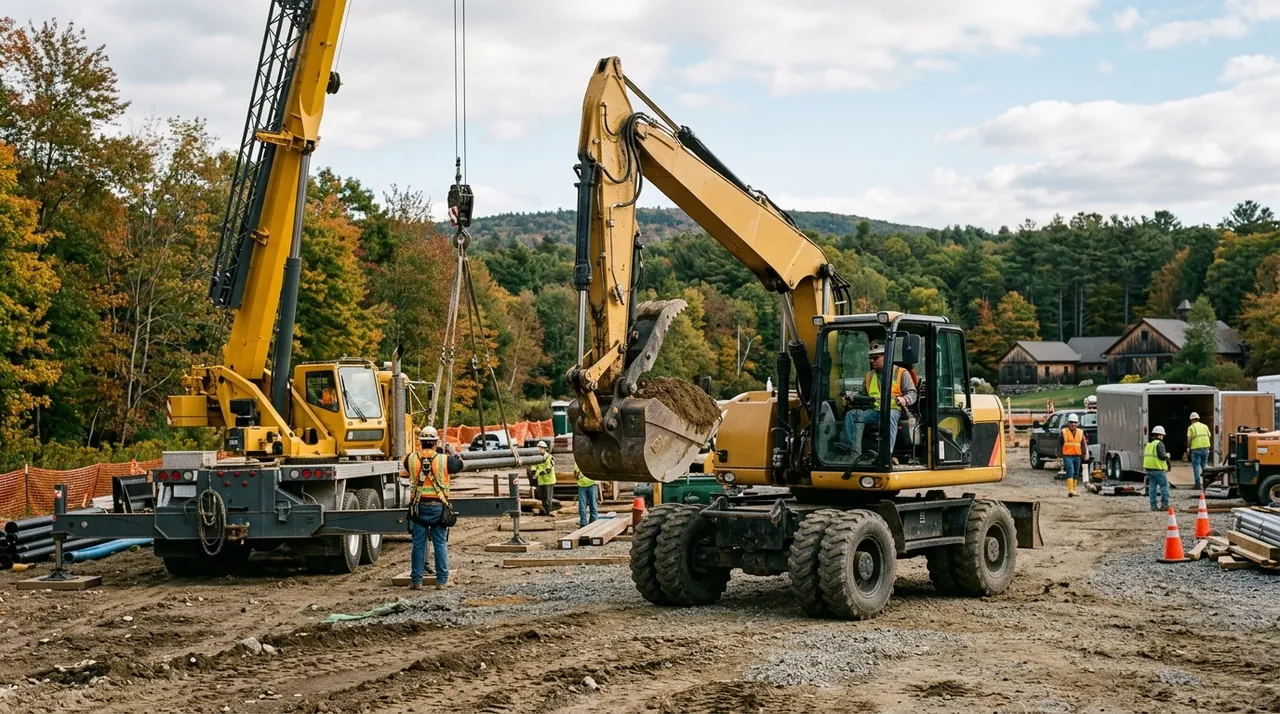
Everything you have studied — restrictions, load charts, outriggers, trench protection, inspection rules — only pays off when you apply it all at once on a real site. This session puts you in the seat for applied scenarios: a machine shows up, a task is assigned, conditions are described, and you have to decide which restriction covers the work, whether the setup is safe, and whether anything found during inspection means the job does not go today. That is exactly what the exam tests.

Machine, task, then restriction — in that order

The fastest way to classify any situation is to ask three questions in sequence: What is the machine? What is it being asked to do? Which restriction covers that combination? The machine alone does not answer the question. A backhoe digging footings is a 2A task. The same machine fitted with a hydraulic boom placing a load onto a roof becomes a 1C task. The restriction follows the task, not just the iron.

Common 2A tasks include digging trenches and footings, grading, loading trucks, and running approved attachments on excavators, backhoes, and loaders. Common 1C tasks involve a knuckle-boom or truck-mounted hydraulic boom setting trusses, placing materials on a structure, or hoisting where no wire-rope hoist line is in use. When an operator digs in the morning and runs a boom truck in the afternoon, both restrictions must appear on the license.

Recognizing when a task falls outside both credentials

Knowing what 2A and 1C do not cover is just as important as knowing what they do. A telescoping crane that lifts through a wire-rope hoist line is a 1B machine regardless of how it looks on the street. A warehouse counterbalanced forklift falls under 1D. Neither is covered by anything in the 2A/1C combination, and operating under the wrong credential creates serious liability for everyone involved.

The exam includes questions designed to catch this mistake. When a machine is described with a wire-rope hoist, or a forklift is working inside a building, the correct answer is that a different restriction applies — not that 2A or 1C can stretch to cover it.

Load charts, outriggers, and ground conditions as a system

Scenarios rarely isolate one variable. You may receive a radius, a boom length, a load weight, and a ground description at the same time. Work it methodically: find the rated gross capacity from the load chart at the given radius and boom length, then subtract hook block and rigging weight to get net usable capacity. If the load fits under that number, the chart permits the lift — but only if outriggers are fully deployed and properly supported.

Ground conditions determine whether outrigger support is actually adequate. Soft, recently backfilled, or sloped ground requires cribbing to distribute the reaction load. A lift that is within rated capacity on paper becomes unsafe the moment outrigger support fails.

Building a complete job plan

For excavation scenarios, protective system selection comes before the first bucket moves. Match the soil type to the correct protection — sloping, shoring, or a trench box — and verify the system is in place before workers enter. When soil classification is uncertain, the rules require defaulting to the more conservative assumption.

For work near overhead power lines, confirm exclusion distances, assign a dedicated spotter, and brief all ground crew. A complete job plan names the required restriction, the inspection outcome, the protective or stability setup, exclusion-zone boundaries, and the signaling plan. When an inspection finding is part of the scenario — a leaking hydraulic line, a missing backup alarm — the answer is almost always the same: tag the machine out, notify the supervisor, and do not start work.

Key Takeaways

  • Classify every situation in order: identify the machine, then the task, then the restriction that applies to that combination.
  • An operator who digs (2A) and runs a boom truck (1C) on the same day must hold both restrictions.
  • A crane with a wire-rope hoist line is 1B, not 1C; a warehouse forklift is 1D — know when a task is outside your credential.
  • Load-chart capacity is gross: subtract hook and rigging weight, and confirm outriggers are fully deployed on firm, cribbed ground.
  • A complete job plan covers restriction, inspection status, protective setup, exclusion zones, and signaling — with any inspection deficiency resolved as a no-go.
Learning Objectives

  • Correctly assign real job-site machines to the 2A or 1C restriction
  • Decide whether a given task requires excavating (2A) or hydraulic boom hoisting (1C) qualification
  • Apply load-chart, outrigger, and trench-safety rules to combined scenarios
  • Recognize when a task falls outside both 2A and 1C and needs a different restriction
  • Integrate licensing, inspection, and operating rules into a single safe job plan

Topics Covered

  • Scenario method: identify the machine, identify the task, then identify the required restriction
  • 2A tasks: digging trenches and footings, loading trucks, grading, and running approved attachments on excavators/backhoes/loaders
  • 1C tasks: setting trusses, placing materials on a roof, unloading pallets with a knuckle-boom, hoisting with the hydraulic boom and no wire rope
  • Combined-day scenario: an operator who digs in the morning (2A) and runs a boom truck in the afternoon (1C) must hold both restrictions
  • Edge cases: a telescoping crane with a wire-rope hoist line is 1B (outside this credential); a warehouse forklift is 1D
  • Load-chart application: given a radius and boom length, determine whether a stated load is within rated capacity
  • Outrigger/ground decisions: when to crib, when ground is too soft, and when to reposition the machine
  • Trench-safety application: choosing a protective system for a given soil type and depth before the excavator digs
  • Power-line and exclusion-zone planning for a lift near energized lines and ground crew
  • Removal-from-service judgment: working through inspection findings to a go/no-go decision
  • Bringing it together: a job plan that names the restriction, the inspection, the protective/stability setup, and the signaling plan
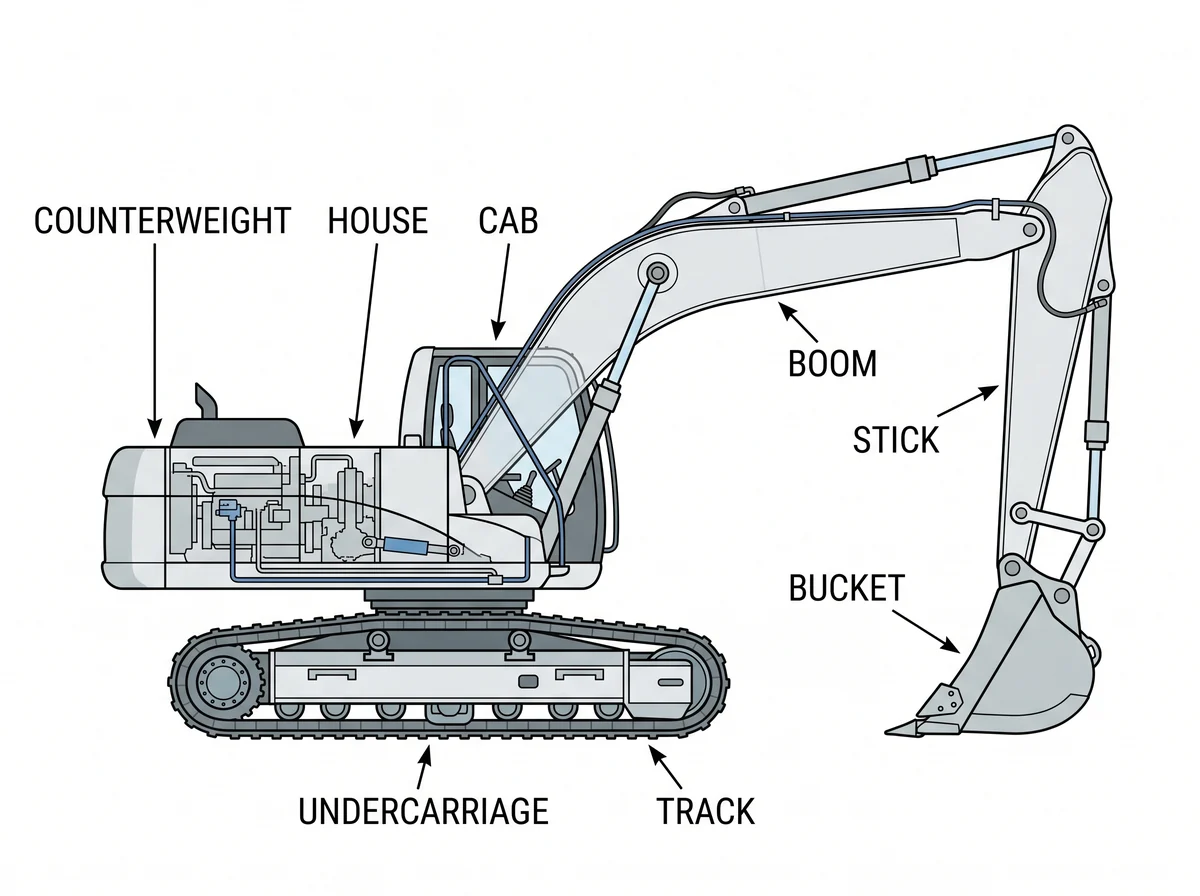
Equipment anatomy — Excavating Machinery & Hydraulic Boom-Truck Hoisting
Labeled diagram of a hydraulic excavator: boom, stick, bucket, cab, house, counterweight, undercarriage, track.

Resources

Self-Check Questions

Question 1: A crew uses a crawler excavator to dig a utility trench, then uses a knuckle-boom truck to set pipe sections from the truck. Which restriction(s) does the operator need?

  1. A. Only 2A
  2. B. Only 1C
  3. C. Both 2A (for the excavator) and 1C (for the knuckle-boom truck)(correct)
  4. D. Only a 1B license
Show Explanation

Explanation:

The excavator falls under 2A and the hydraulic knuckle-boom truck falls under 1C. Because the operator runs both, they must hold both restrictions — this is exactly what the combined 2A/1C credential covers.

Question 2: A contractor needs to set roof trusses using a truck-mounted hydraulic telescoping crane that lifts with the boom and has no wire-rope hoist line. Which restriction applies?

  1. A. 2A
  2. B. 1C(correct)
  3. C. 1B
  4. D. 3A
Show Explanation

Explanation:

A hydraulic telescoping boom truck that lifts with the boom and has no wire-rope hoist line is 1C equipment. If it used a wire-rope hoist line, it would be 1B instead.

Question 3: A front-end loader is being used to move gravel on site. Under which restriction is it operated?

  1. A. 1C, because it has hydraulics
  2. B. 2A, because 2A includes front-end loaders (2C)(correct)
  3. C. 3A
  4. D. It is unlicensed
Show Explanation

Explanation:

A front-end loader is 2C equipment, and the 2A restriction nests over 2C. So a 2A operator may run it. It is not a 1C machine — 1C is hydraulic boom-truck hoisting, not loaders.

Question 4: A boom truck must lift a 4,000 lb load. At the planned radius and boom length, the load chart shows 5,000 lb gross capacity, and the hook plus rigging weigh 600 lb. Is the lift within capacity?

  1. A. No — 4,000 lb exceeds the chart
  2. B. Yes — net capacity is 4,400 lb (5,000 minus 600), which exceeds the 4,000 lb load(correct)
  3. C. Cannot tell without the truck's GVWR
  4. D. Yes, but only with the outriggers retracted
Show Explanation

Explanation:

Net capacity equals chart (gross) capacity minus the hook and rigging: 5,000 − 600 = 4,400 lb. Since 4,400 lb exceeds the 4,000 lb load, the lift is within capacity — assuming outriggers are properly set on firm, level ground.

Question 5: Which task falls OUTSIDE both the 2A and 1C restrictions?

  1. A. Digging a footing with a crawler excavator
  2. B. Setting a pallet of brick with a knuckle-boom loader crane
  3. C. Operating a lattice-boom crawler crane to erect steel(correct)
  4. D. Loading a truck with a front-end loader
Show Explanation

Explanation:

A lattice-boom crawler crane is 1A-class equipment, outside both 2A and 1C. The excavator and front-end loader are 2A, and the knuckle-boom loader crane is 1C.

In-depth reference for this session →

A deeper, regulation-by-regulation companion page for this lesson.