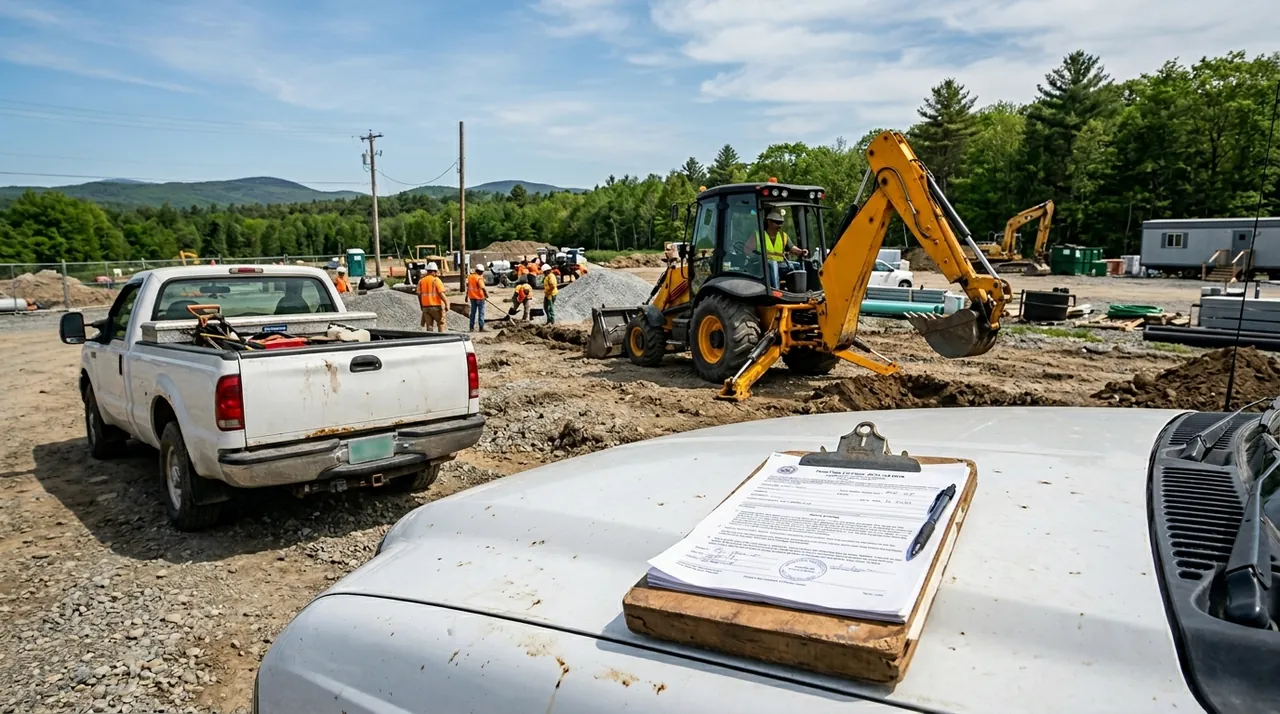
Before you sit in the cab of a backhoe loader on a Massachusetts job site, the law requires you to hold the right license. That is not a formality — it is a condition of employment, and the consequences fall on both the operator and the employer. This lesson covers the legal foundation for the 2B hoisting license: the statute that created the requirement, the regulation that enforces it, the agency that issues it, and the practical details every apprentice needs before exam day.
The statute and regulation behind every MA hoisting license
Massachusetts hoisting law starts with M.G.L. Chapter 146, Sections 53 through 54A. These sections establish the requirement: any person who operates hoisting machinery meeting the threshold conditions must hold a valid license for that class of equipment. The implementing regulation is 230 CMR 6.00, titled Hoisting Machinery. If you have seen older references to 520 CMR 6.00, that designation is outdated — the regulation was recodified and is now 230 CMR 6.00, which is the citation you use on the exam and in the field. Note that 520 CMR 14.00 still governs trench safety, so if you encounter that number, it belongs to a different subject entirely.
The statute gives the legal authority; the regulation provides the day-to-day technical requirements. Both apply to you as a 2B operator, and understanding which document does which job helps you look up the right source when a question comes up on a job site.
Who issues the license and what the 2B restriction covers
Hoisting engineer licenses are issued by the Division of Occupational Licensure (DOL) through its Office of Public Safety and Inspections, known as OPSI. Older operators may still refer to the Department of Public Safety — that agency has been restructured, and OPSI under DOL is the correct authority today.
The 2B restriction authorizes you to operate combination loader/backhoe machines — the backhoe loader or TLB — along with manufacturer-approved attachments. The attachment language matters: the tool must be approved by the manufacturer for that specific machine, not just something that physically bolts on. A 2B license also nests 2C (front-end loaders) and 2D (compact hoisting machinery up to 10,000 pounds GVW), so a single 2B card covers more equipment than just the backhoe loader.
License terms, fees, and continuing education
To apply you must be at least 18 years old. The application fee is $75 per restriction and is nonrefundable regardless of exam outcome. The license is valid for two years and can be renewed up to 60 days before the expiration date. Under 230 CMR 6.04, continuing education is required before each renewal — you cannot renew without completing it.
An expired license is an unlicensed operator as far as the law is concerned. Operating without a valid license exposes both the operator and the employer to liability. Keeping your renewal current is one of the basic professional obligations of a licensed hoisting engineer.
Exemptions from the licensing requirement
Not every backhoe loader operator needs a 2B license. The most commonly tested exemption is the agricultural operator working exclusively on their own land. Take away either element — the agricultural activity or the operator's own property — and the exemption no longer applies.
Other exemptions cover participants in approved apprenticeship programs, certain supervised public-utility training programs, and vocational school programs operating under regulatory approval. These exemptions exist because the supervised context provides an alternative safety structure. Outside of a specific, approved program, the license is required.
Key Takeaways
- •M.G.L. c. 146 is the statute that requires a hoisting license; 230 CMR 6.00 is the current implementing regulation — never cite the old 520 CMR 6.00 for hoisting machinery.
- •The issuing agency is OPSI under DOL — not the Department of Public Safety.
- •The 2B restriction covers combination loader/backhoe machines with manufacturer-approved attachments and nests 2C and 2D authority.
- •Minimum age is 18, the fee is $75 nonrefundable per restriction, and the two-year license requires continuing education before each renewal.
- •Key exemptions include agricultural operators on their own land and participants in approved apprenticeship, public-utility, and vocational programs.