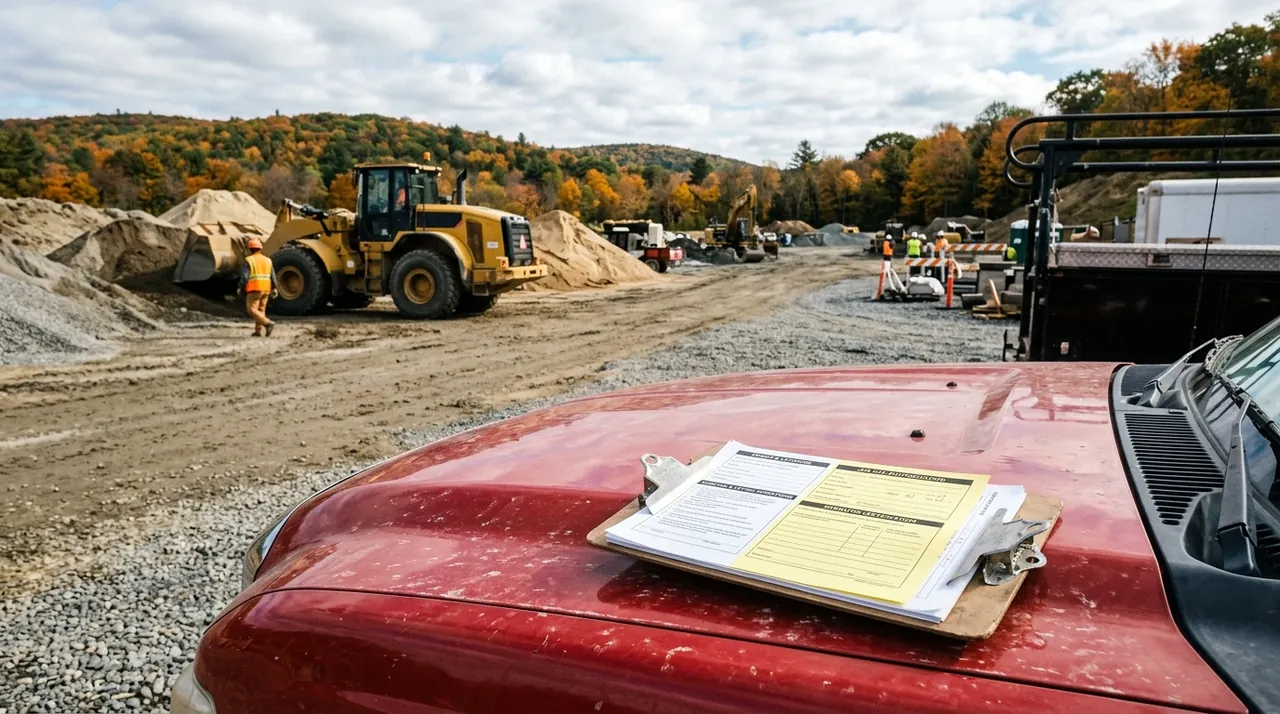
Before you can legally sit in the seat of a front-end loader on a Massachusetts job site, two pieces of paper govern your right to be there: a state statute and its implementing regulation. This lesson covers those two documents, the agency that enforces them, and the specific licensing rules that apply to the 2C restriction. It is not abstract law review — the exam tests these details directly, and knowing them cold also protects you from costly mistakes in the field.
The statute, the regulation, and the agency that issues your license
Massachusetts hoisting law starts with M.G.L. c. 146, specifically sections 53 through 54A and sections 65 through 67. These sections collectively define who must hold a hoisting license, govern examination and licensing requirements, and impose safety obligations on operators and employers.
The statute alone does not tell you how to operate safely — it sets the legal framework. The technical details live in the regulation: 230 CMR 6.00, titled Hoisting Machinery. This regulation was recodified from the old 520 CMR 6.00, so if you see older references to that citation in study materials, they point to the same underlying rules. On the exam and on the job, always cite 230 CMR 6.00.
The agency responsible for issuing hoisting licenses is the Division of Occupational Licensure (DOL), specifically its Office of Public Safety and Inspections (OPSI). This is not the Department of Public Safety, which is a common mix-up. Applications and renewals go through DOL/OPSI.
What a 2C license actually covers — and what it does not
Class 2C is the rubber-tired front-end wheel loader restriction. If your license bears the 2C designation, you are authorized to operate wheel loaders and, importantly, Class 2D compact machinery as well. That bundled 2D authority is worth knowing for the exam.
What 2C does not cover is equally important. Aerial lifts, cherry pickers, and scissor lifts are not Class 2 equipment. Operators who run those machines need a different restriction entirely. If you ever move from a front-end loader to a boom lift on the same site, your 2C license does not follow you — you need the correct class for that machine.
The numbers every 2C candidate must know cold
The exam consistently tests the administrative details, so commit these to memory before exam day. You must be at least 18 years old to obtain any Massachusetts hoisting engineer license. The application fee is $75, nonrefundable, per restriction class. Your license is valid for two years and can be renewed up to 60 days before it expires. Letting it expire is not an option with a grace period attached — an expired license is an invalid license, and operating on one exposes you to penalties.
Renewal is not automatic. Under 230 CMR 6.04, continuing education is required before the Division will issue you a renewed license. The regulation mandates that you complete the required coursework before renewal, not afterward, so plan ahead before your two-year cycle ends.
Exemptions: who does not need a 2C license
The statute carves out a limited set of operators who are not required to hold a hoisting license. Agricultural operators working on their own land fall outside the requirement. Certain supervised public-utility workers, participants in approved apprenticeship programs, and students in authorized vocational programs also qualify for exemptions under specific conditions.
The exemptions are narrow and conditional — they do not create a general carve-out for anyone who thinks the job is simple enough. A worker running a wheel loader on a commercial construction site in Massachusetts almost certainly needs the license. The exam will present exemption scenarios, and the correct answer almost always turns on whether the specific conditions spelled out in the statute are actually met.
Key Takeaways
- •M.G.L. c. 146 is the governing statute; 230 CMR 6.00 is the implementing regulation — always cite 230 CMR 6.00, not the old 520 CMR 6.00.
- •Licenses are issued by DOL/OPSI (Office of Public Safety and Inspections), not the Department of Public Safety.
- •A 2C license covers rubber-tired wheel loaders and also authorizes Class 2D compact machinery; it does not cover aerial lifts or scissor lifts.
- •Key numbers: minimum age 18, $75 nonrefundable fee per restriction, 2-year license term, renewal allowed up to 60 days early, continuing education required before renewal under 230 CMR 6.04.
- •Exemptions are narrow — agricultural operators on their own land and certain supervised program participants; a commercial job-site loader operator almost always needs the license.