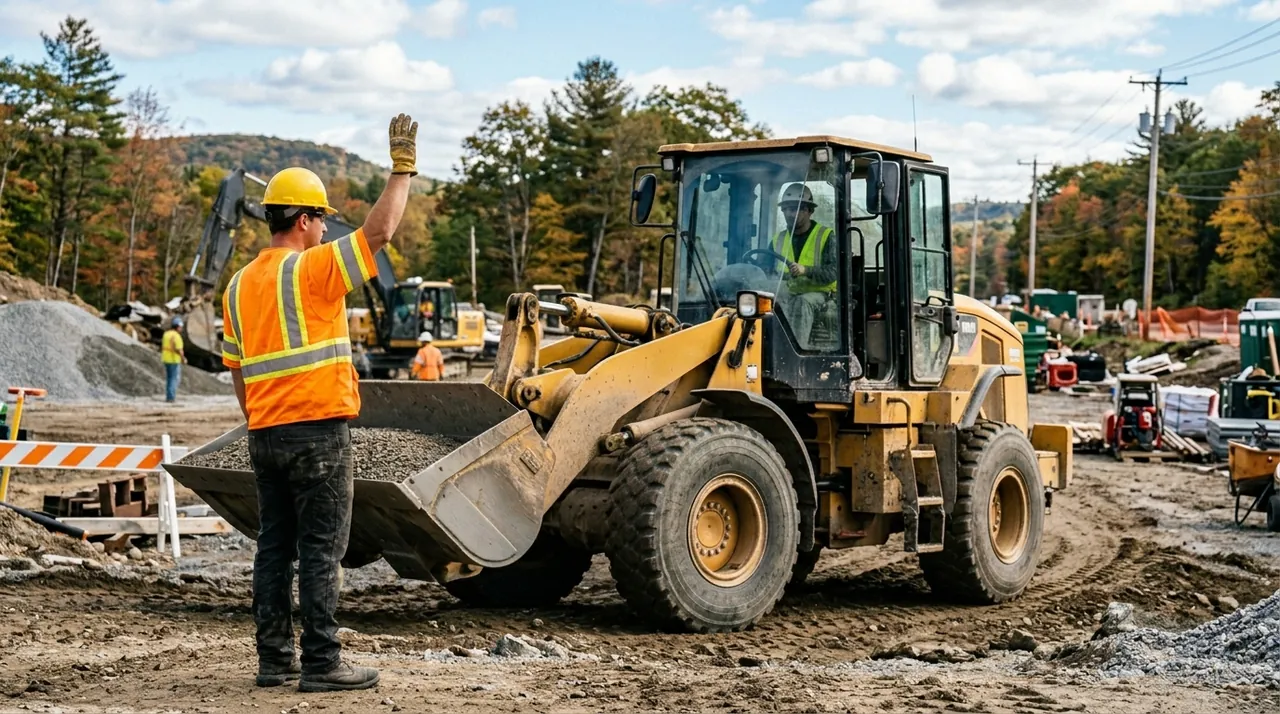
A wheel loader is a large machine operating in a busy site, which means the operator cannot see everything around it and cannot rely on workers to stay clear on their own. Hand signals, designated spotters, and a clear communication protocol are what bridge that gap. On the 2C exam, these topics are core competencies — not soft skills — because failures in communication are among the most common causes of struck-by and run-over incidents. This session covers the signal system, the spotter's role, and the habits that keep pedestrians and ground workers safe.
The standard hand signals and who gives them
Every wheel loader operation involving a signaler runs on a small, fixed set of hand signals: Stop, Emergency Stop, Travel toward me, Move away, Raise, Lower, Dump, and Curl or retract the bucket. The set is deliberately limited so there is no ambiguity — each signal has one meaning.
Only one designated signaler directs the operator at any given time. When two people give conflicting signals, the operator cannot determine whose guidance reflects the actual site conditions. The sole exception is the Stop signal: any person may give a stop, and the operator must honor it immediately, regardless of who it comes from. The Emergency Stop carries that same universal authority and overrides every other signal the operator has received. When it comes, the machine stops.
Spotter positioning and maintaining visual contact
Where the spotter stands matters as much as the signals they give. The signaler must stay where the operator has a clear, unobstructed view at all times — out of the travel path, out of the swing area, and well clear of the articulation pinch zone between the front and rear frames.
If the operator loses sight of the signaler for any reason — the signaler steps behind a stockpile, drifts out of the cab-window sight line, or is blocked by the raised bucket — the operator stops and does not move again until contact is re-established. There is no guessing. Once the signaler is out of view, the only safe action is to hold position.
When two-way radios supplement hand signals, the operator and spotter must agree in advance on the protocol, including what happens if the radio link drops. The same rule applies: stop on lost comms.
Horn use and pedestrian exclusion zones
The horn is a required warning device, not a courtesy. Sound it before starting, before moving forward into a work area, and before backing — especially when the rear view is obstructed. When the operator cannot clearly see behind the machine while backing, a spotter is required and the backup alarm must be functional.
Beyond the alarm and the spotter, the most reliable protection for ground workers is exclusion. No one who does not have a specific task near the machine should be in the working zone of an operating loader. High-visibility apparel helps, but apparel is not a safety plan. Positive acknowledgment — eye contact between the operator and any ground worker, confirming their positions before the machine moves — is what turns a high-risk moment into a controlled one. On a congested site, that coordination must happen before the machine is in motion, not during.
Loading trucks and working in tight spaces
Loading trucks is one of the most common situations where communication discipline breaks down. The cycle is fast, production pressure is real, and both the truck driver and loader operator may feel the urge to cut corners. That is exactly when the exclusion zone and the signal protocol matter most.
Before the loader approaches a truck to dump, the truck cab must be clear of the loader's path and the driver must stay in or behind the cab — never standing between the vehicles. The loader's path passes over or alongside the truck bed, and there is no safe place for a bystander in that zone during the dump. The operator sets the pace and does not move until the site is clear and the spotter has given the travel signal. On a congested site, that discipline holds even when it slows things down.
Key Takeaways
- •Only one designated signaler directs the operator at a time, but any person may give a Stop or Emergency Stop — and the operator always honors it immediately.
- •The signaler must remain visible to the operator at all times; if visual contact is lost, the operator stops and holds until contact is re-established.
- •Sound the horn before starting, before moving forward, and before backing; use a spotter whenever the rear view is obstructed.
- •Pedestrian and ground-worker exclusion zones around the loader are not optional — make eye contact and get positive acknowledgment before the machine moves.
- •During truck loading, the truck cab must be clear and no one may stand between the vehicles while the loader is maneuvering.