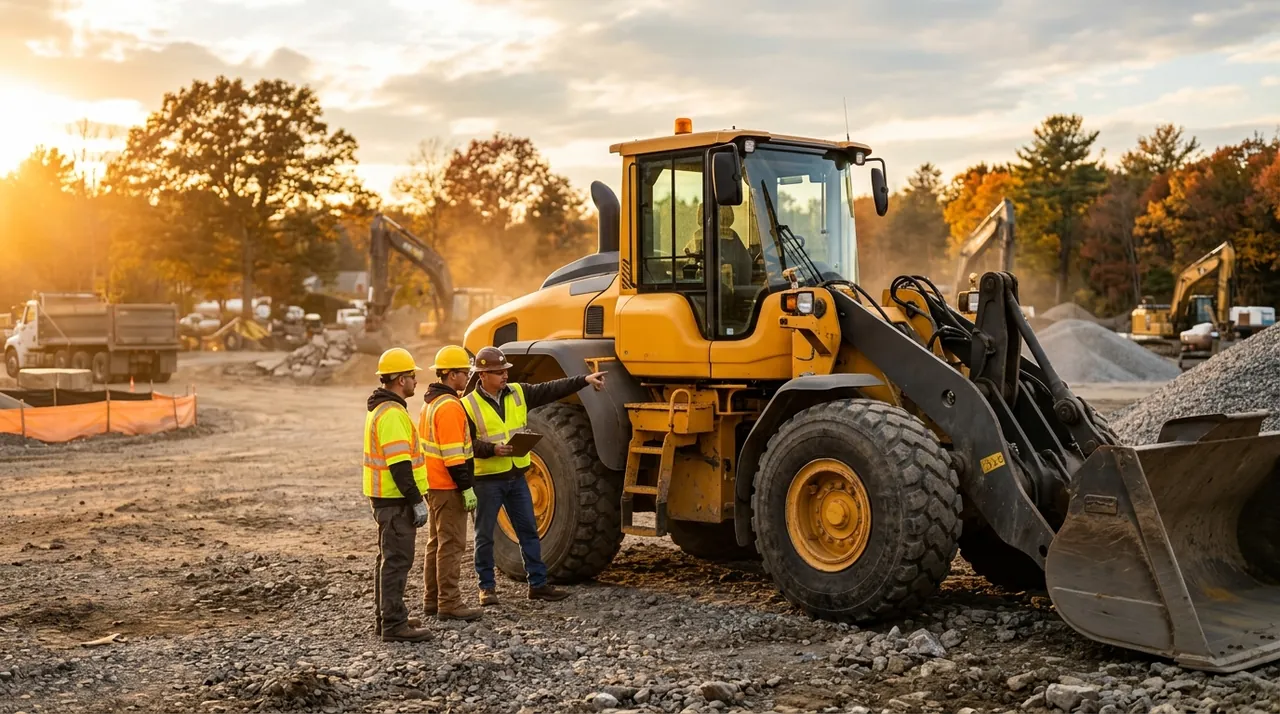
Once you understand how to inspect your loader and how to communicate on the job site, the next question is: which rules actually require those things? For the 2C exam — and for every day you operate in Massachusetts — the answer comes from two overlapping bodies of law. Federal OSHA sets the construction-industry baseline through 29 CFR 1926.602. Massachusetts adds its own layer through 230 CMR 6.00. Understanding how they fit together tells you exactly where to look when a question arises in the field.
What 29 CFR 1926.602 covers and why it matters to you
The OSHA standard 29 CFR 1926.602 is the primary federal rule governing earthmoving and material-handling equipment on construction sites. A rubber-tired front-end loader squarely fits that description, so this standard applies to virtually every loader job you will do.
The regulation covers the core safety systems your machine must have and how you must use them. Seat belts are required on all equipment fitted with a rollover protective structure — you must wear it, not just have one in the cab. The machine must be equipped with a reverse signal alarm audible above surrounding noise levels if the operator's rear view is obstructed; alternatively, a designated signaler may be used, but the default solution is an automatic alarm. Brakes and service brake systems must meet the requirements set for earthmoving equipment, and a functional audible warning device (horn) is required — and you as the operator have a responsibility to use it. Defective equipment must be removed from service. You cannot keep running a loader because the job is busy; the regulation gives you both the obligation and the authority to tag it out.
ROPS and the relationship to seat belts
Rollover protective structures exist to keep the cab from collapsing around you in a tip-over. OSHA requires that loaders be equipped with ROPS meeting applicable standards. But the ROPS only protects you if you stay inside it. That is why the seat belt requirement is inseparable from the ROPS requirement: if you are not belted in and the machine rolls, you can be ejected and then struck by the very cab that was supposed to save you.
For the exam, keep this linkage clear: ROPS present plus seat belt worn equals the system working as designed. Modify or damage the ROPS without manufacturer-approved engineering, and you have voided the protection those structures were designed to provide.
Where 1926.602 ends and other standards begin
A common exam trap is confusing construction-site loader rules with powered industrial truck rules. OSHA's 29 CFR 1910.178 governs forklifts in general industry — warehouses, manufacturing floors. A wheel loader on a construction site falls under 1926.602, not 1910.178. The two standards have different requirements, and applying the wrong one leads you to the wrong answer.
Beyond OSHA, the ASME B30 family of standards serves as the consensus reference set for hoisting and material-handling equipment. These are the technical standards that OSHA frequently references or incorporates. Knowing what B30 is helps you locate the right authority when a question goes beyond the basics.
The manufacturer's operation and maintenance manual is not optional reading. Both OSHA and 230 CMR 6.00 impose a duty on operators to follow manufacturer specifications. If the manual sets a capacity limit or maintenance interval, that limit carries regulatory force.
How MA 230 CMR 6.00 and OSHA work together
Massachusetts does not replace federal OSHA with its own program — it operates under federal OSHA jurisdiction. What 230 CMR 6.00 does is add Massachusetts-specific licensing and operating requirements on top of the federal OSHA baseline. As a 2C operator in Massachusetts, you are bound by both layers simultaneously. OSHA sets the floor; 230 CMR 6.00 may require more in certain areas.
In practice this means you need to know where to find each authority. The Massachusetts statutes live at malegislature.gov. The current hoisting regulation — 230 CMR 6.00 — and related licensing information are found through the mass.gov hoisting pages. Federal OSHA standards are at osha.gov. When a field question arises, knowing which source to consult gets you the right answer faster than guessing.
Key Takeaways
- •29 CFR 1926.602 is the primary federal standard for wheel loaders on construction sites, covering seat belts, reverse alarms, brakes, horns, and defective-equipment removal.
- •Seat belts and ROPS work as a system — the ROPS protects you only if you stay inside it, which means the belt must be worn.
- •The reverse alarm requirement under 1926.602 applies when the operator's rear view is obstructed; a designated signaler is an accepted alternative.
- •1926.602 governs construction-site loaders; 29 CFR 1910.178 governs industrial forklifts in general industry — know the difference for the exam.
- •Massachusetts 230 CMR 6.00 adds state-specific requirements on top of OSHA; both apply simultaneously to a 2C operator working in the Commonwealth.