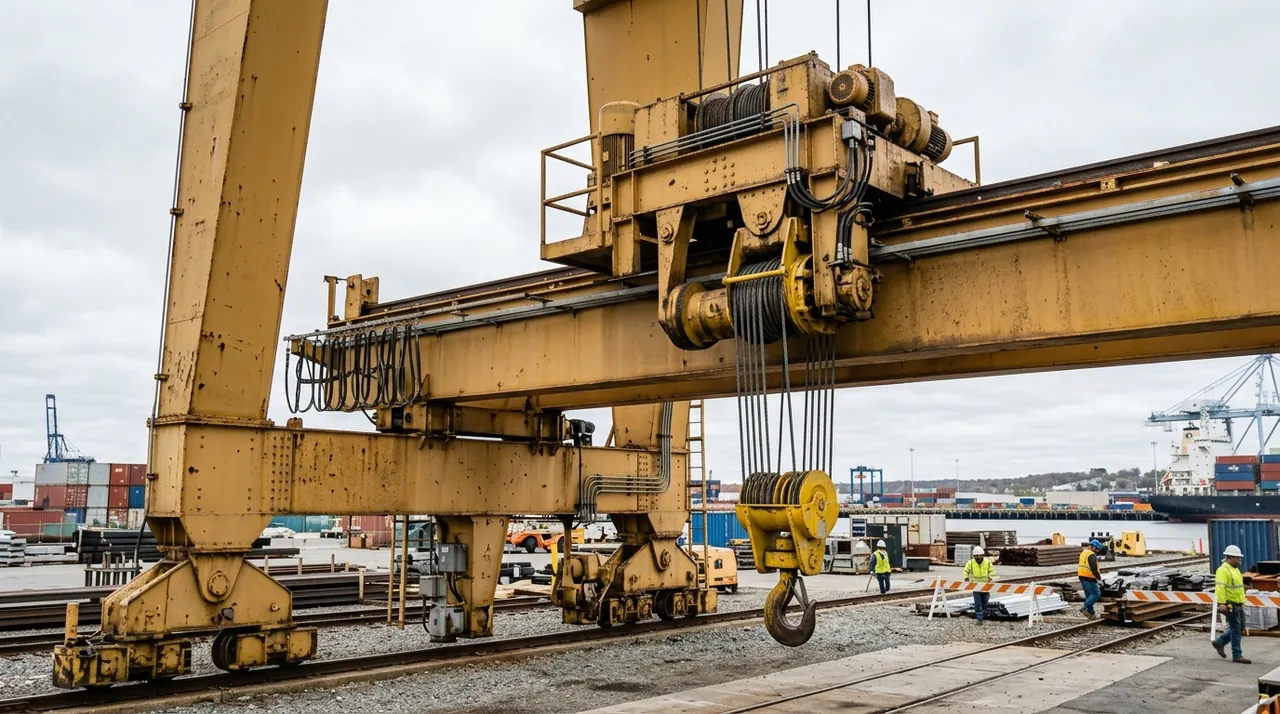
Before you can safely operate an overhead or gantry crane, you need to know what every part does and how the parts connect. A crane operator who cannot name the bridge, trolley, end trucks, and limit switches is missing the vocabulary behind every inspection, every hand signal, and every troubleshooting call on the floor. This session walks the anatomy of the overhead bridge crane from the runway rails to the hoist hook, then shows you how gantry configurations differ and where the critical safety devices live.
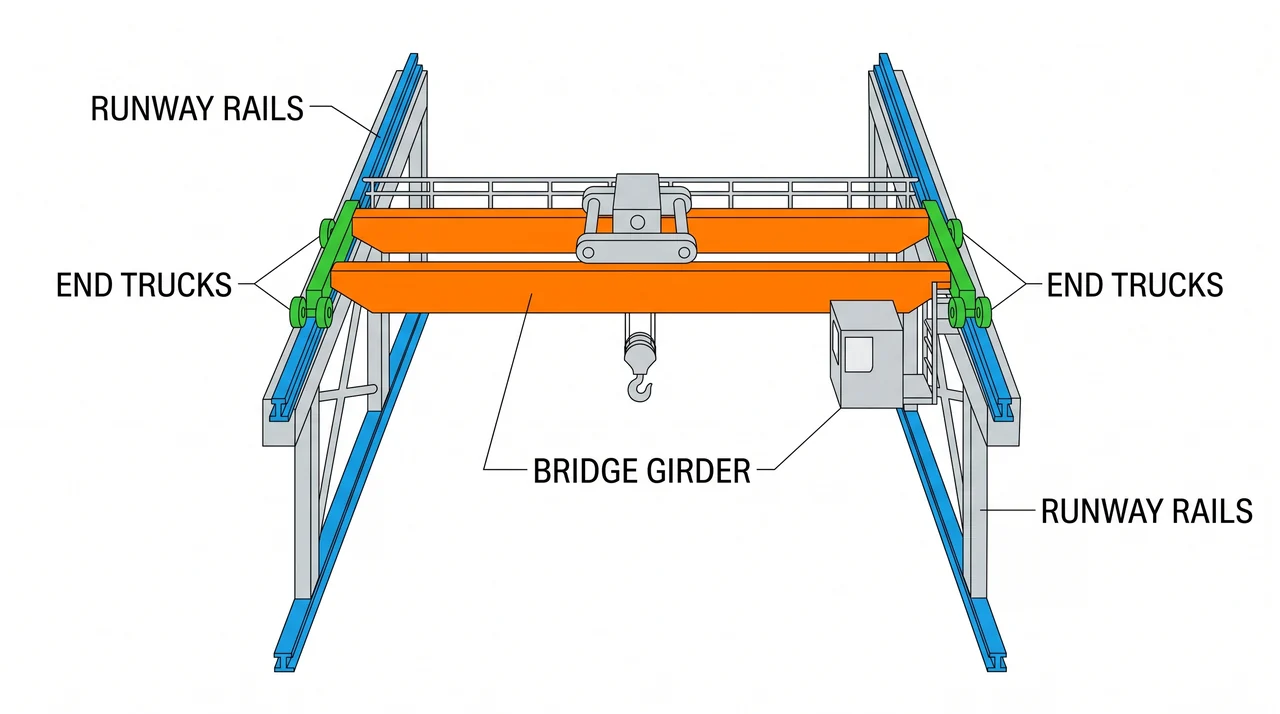
The structural frame: runway, bridge, and end trucks
The runway is the fixed infrastructure of the system — a pair of elevated rails anchored to the building structure that define the crane's long axis of travel. The bridge, also called the girder, is the main horizontal beam spanning the gap between the two runway rails. End trucks are the wheeled assemblies at each end of the bridge that ride the runway rails and carry the weight of the bridge, trolley, and load. When you drive the crane in the long direction — moving material down the bay — you are moving the bridge and its end trucks along the runway.
Each interface in this frame is a wear point. End truck wheels, rail clamps, and bridge connections all require periodic inspection; a defect at any one can derail the bridge or cause it to skew on the rails. ASME B30.2 governs overhead and gantry cranes and sets requirements for runway alignment, end-stop placement, and bridge travel limits.
Trolley and hoist: where the lifting happens
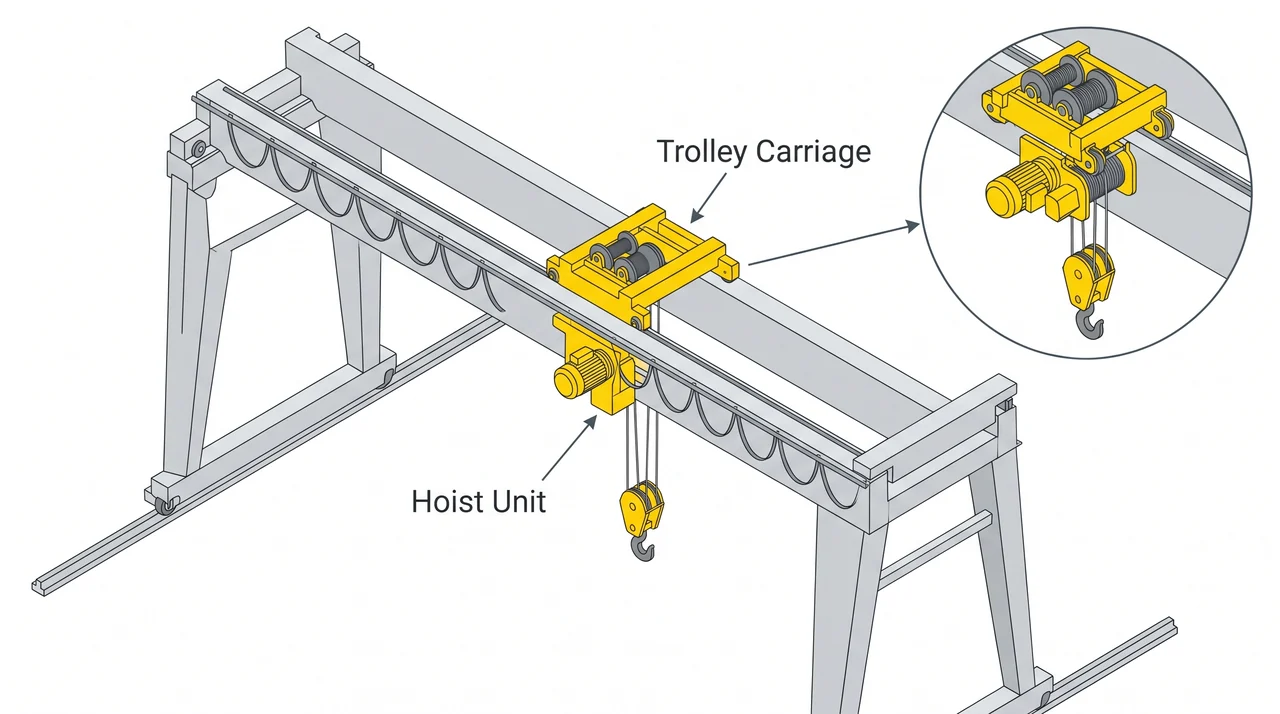
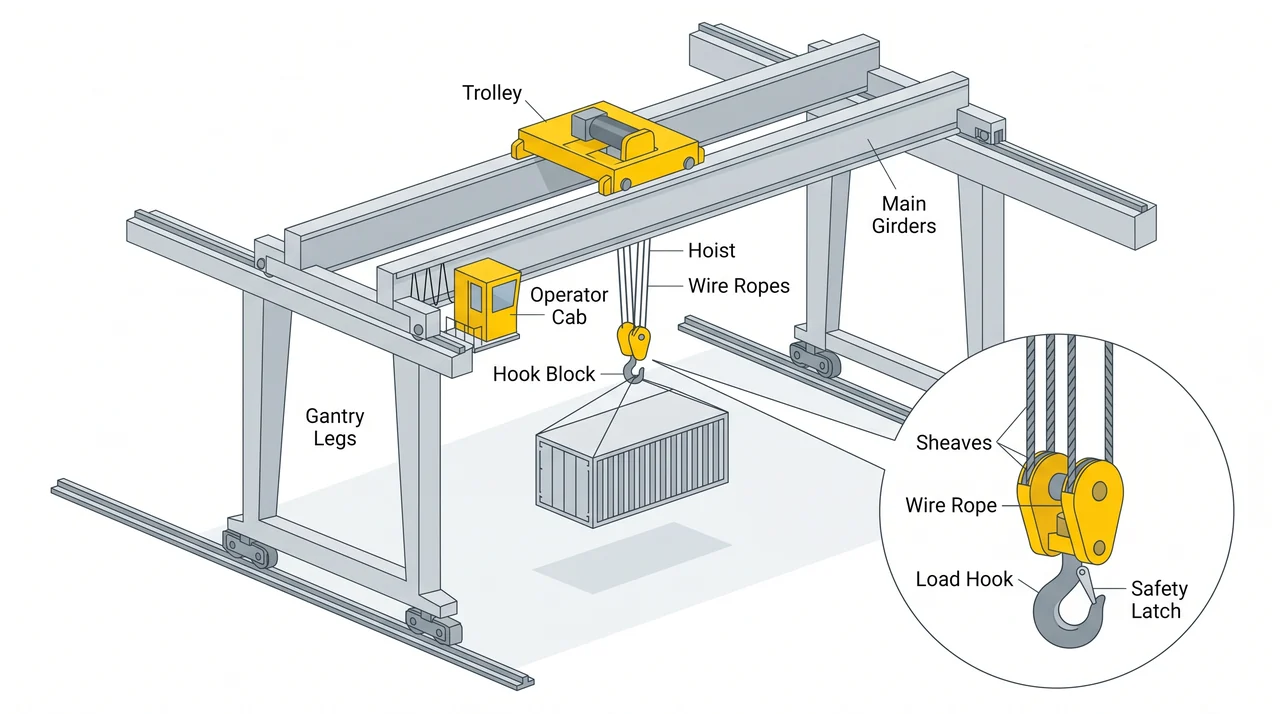
The trolley is a wheeled carriage that travels across the bridge — or below it on an underhung crane — to position the hoist directly over the load. Picking a load that is not directly below the hook creates a side-pull, which imposes bending stress on the hoist and bridge that neither component is designed to handle.
The hoist is the lifting unit mounted on the trolley: motor, gearbox, drum or chain wheel, and the hook block. Together, the crane has three independent motions — hoisting moves the load vertically, trolley travel moves it across the bay, and bridge travel moves it along the bay. Being fluent with all three, and knowing when to combine them smoothly, is the core operating skill.
Top-running, under-running, and gantry configurations
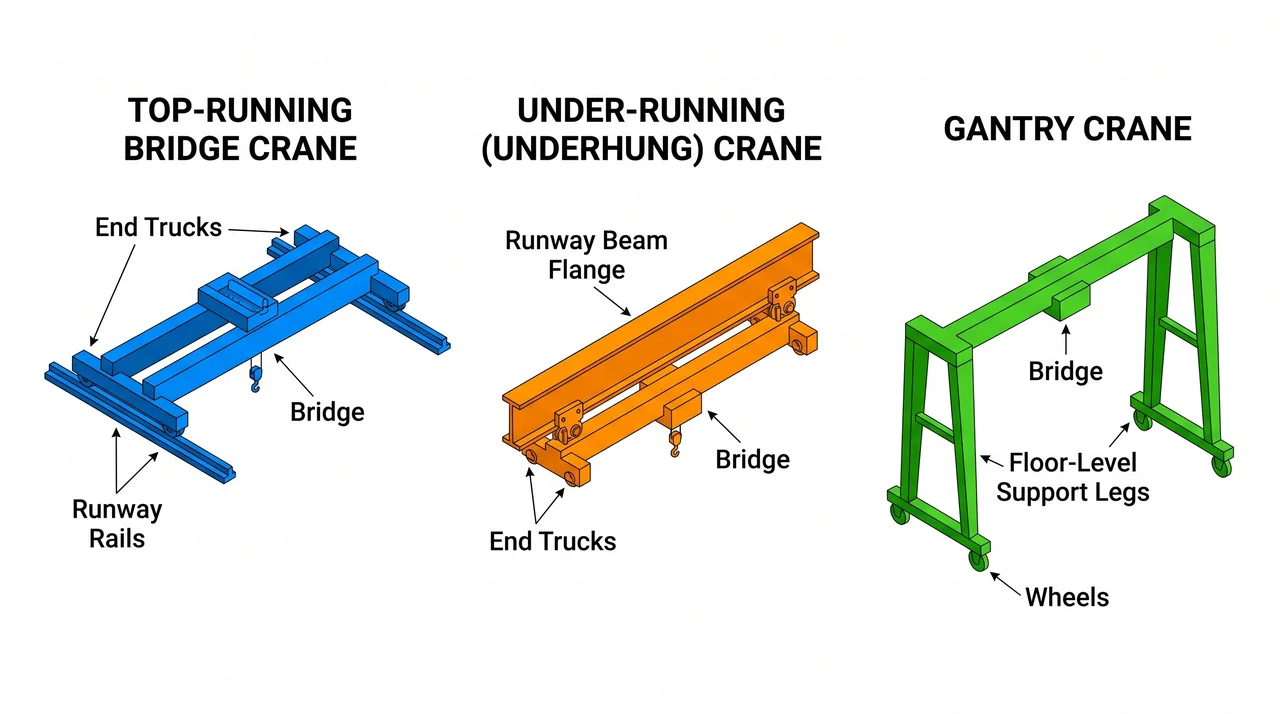
A top-running bridge crane has its end trucks riding on top of the runway rail, maximizing hook height. An under-running, or underhung, crane has the bridge suspended from trolleys below the runway beam flange, which allows curved runways and bay switching but reduces hook height. ASME B30.11 covers monorails and underhung cranes specifically, because their load path differs from the top-running design under B30.2.
A gantry crane eliminates the building-mounted runway entirely. The bridge is supported by two rigid legs that ride on floor-level rails or rubber-tired wheels, making gantry cranes portable and practical outdoors. A semi-gantry has one leg on the floor and the opposite end of the bridge on a wall-mounted rail. A portable A-frame gantry is a light-duty version that can be rolled by hand. Knowing the configuration tells you immediately where the travel limits and tipping hazards are.
Limit switches, bumpers, and end stops
Limit switches are electrical interlocks that cut motor power when a moving component reaches its travel boundary. The upper limit switch is the most critical: it stops the hoist before the hook block can be pulled up into the drum, a condition called two-blocking that can snap the rope or destroy the hoist. A lower limit switch prevents the rope from paying out past the minimum wraps on the drum. Trolley and bridge limit switches do the same at the ends of those travel ranges.
Bumpers and end stops are the mechanical backup if a limit switch fails. End stops are fixed steel barriers that physically block over-travel; bumpers cushion the impact when a bridge or trolley contacts a stop. If you are hitting bumpers routinely, your technique or the limit switch setting needs correction — they are a last resort, not a normal operating boundary.
Key Takeaways
- •The runway, bridge, and end trucks form the structural frame; the trolley and hoist mount on the bridge and perform the actual lifting.
- •Three independent motions — hoisting, trolley travel, and bridge travel — give the operator full coverage of the work area.
- •Top-running cranes ride on top of runway rails; underhung cranes hang below the beam; gantry cranes use floor-level legs and need no building runway.
- •The upper limit switch prevents two-blocking; bumpers and end stops are the mechanical backup when electrical switches fail.
- •ASME B30.2 governs overhead and gantry cranes; ASME B30.11 covers monorails and underhung cranes.