Every fatality investigation involving an overhead crane or hoist traces back to one of a small set of recurring hazards: a load that was too heavy, a hook block that traveled too far, a worker who got too close to a moving part, or a power source that was never accounted for. This lesson covers those hazards directly — two-blocking, overload conditions, pinch and crush points, and the electrical and environmental exposures that make outdoor and marine hoist work especially demanding.
Two-Blocking: What Happens and How to Stop It
Two-blocking occurs when the hook block travels upward until it contacts the hoist drum or sheave above it. At that point the rope or chain has nowhere to go. If the hoist keeps running, it will snap the rope, shear the hook, or overload the structural assembly — and the load drops. It is not a near miss; it is a pre-catastrophic condition that unfolds in seconds.
The upper-limit switch cuts power before the block reaches its travel limit, and anti-two-block devices add a second layer of protection. Both are backups, not substitutes for watching your block travel. Limit switches can fail or be bypassed after maintenance. Never allow anyone to defeat limit protection, and report a hoist with non-functioning limit devices before the next lift.
Overload Conditions and the Role of Protection Devices
Overloading stresses the entire system — rope breaks, hooks deform, trolley frames crack, bridge girders deflect beyond their design limits. Any of these failures can be fatal to workers in the bay, not only the person at the pendant.
Load-limiting devices interrupt the hoist circuit when the detected load exceeds a rated threshold, but they depend on calibration and periodic testing to stay accurate. They also cannot compensate for dynamic loading — the surge when a hoist snatches a load or when a suspended load swings and generates side-pull forces. Confirm the load weight and compare it to the rated capacity before every lift. Smooth operation reduces dynamic forces that no device can fully guard against.
Pinch, Crush, and Shear Points on the Floor and at the Load
A moving crane creates closing gaps between the trolley, bridge, runway, and fixed building columns. These pinch points can trap a hand or an arm before a person on the floor even registers the movement. During marine operations, workers handling slings must get close to the load — a position where any unintended hoist motion becomes a caught-between incident. Halt all crane movement while anyone is in contact with the load or rigging, and use a single designated signal person so there is no ambiguity about who is giving directions.
Crush and shear hazards also exist at the load boundary. A swinging load converging with a wall, column, or stationary equipment creates a lethal zone. The operator has the best view of these conditions and is responsible for holding position until those zones are clear.
Electrical Hazards, Wind, and Emergency Response
Conductor bars, festoon cables, and pendant cords are live whenever the crane is powered. Conductor bars are exposed and energized at all times; any contact — including through wet rope or wet clothing — is a potential shock. A hoist with a suspected grounding failure must be taken out of service immediately.
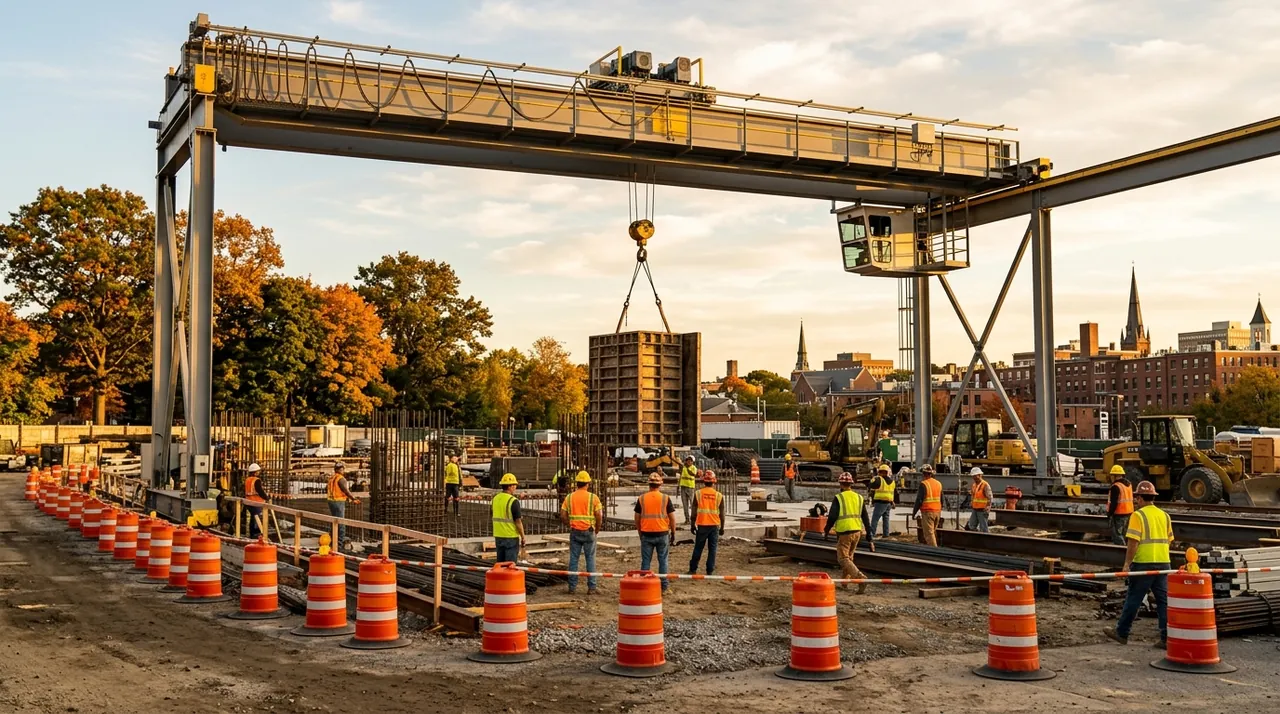
Outdoor gantry cranes and travel-lifts add the hazard of overhead power lines. Required clearances from energized lines are not adjustable based on schedule pressure. Wind loading can cause a suspended load to swing without warning, so the operator must know the equipment's rated wind limits and secure loads when conditions approach them. If a load begins to drop or swing uncontrollably, the response is immediate: emergency stop, clear all personnel from below and around the load, and do not restart until the cause is found. Keep the area under any suspended load clear throughout the entire lift — not just at the start.
Key Takeaways
- •Two-blocking sends the hook block into the hoist structure above it and can drop a load in seconds. Upper-limit switches and anti-two-block devices are backups — watching your block travel is the first line of defense.
- •Confirm load weight against rated capacity before every lift. Overload-protection devices need calibration and cannot handle the dynamic surges caused by snatching or swinging.
- •Halt all crane movement whenever workers are in contact with the load or rigging. Use a single designated signal person to eliminate ambiguity about directions.
- •Conductor bars are live and exposed whenever power is on. A grounding failure is a removal-from-service condition. On outdoor equipment, maintain required clearances from overhead lines and know the wind limits.
- •Emergency stop is the first response to any uncontrolled drop or swing — then clear the area and find the cause before restarting. The zone below a suspended load must stay clear for the entire lift.