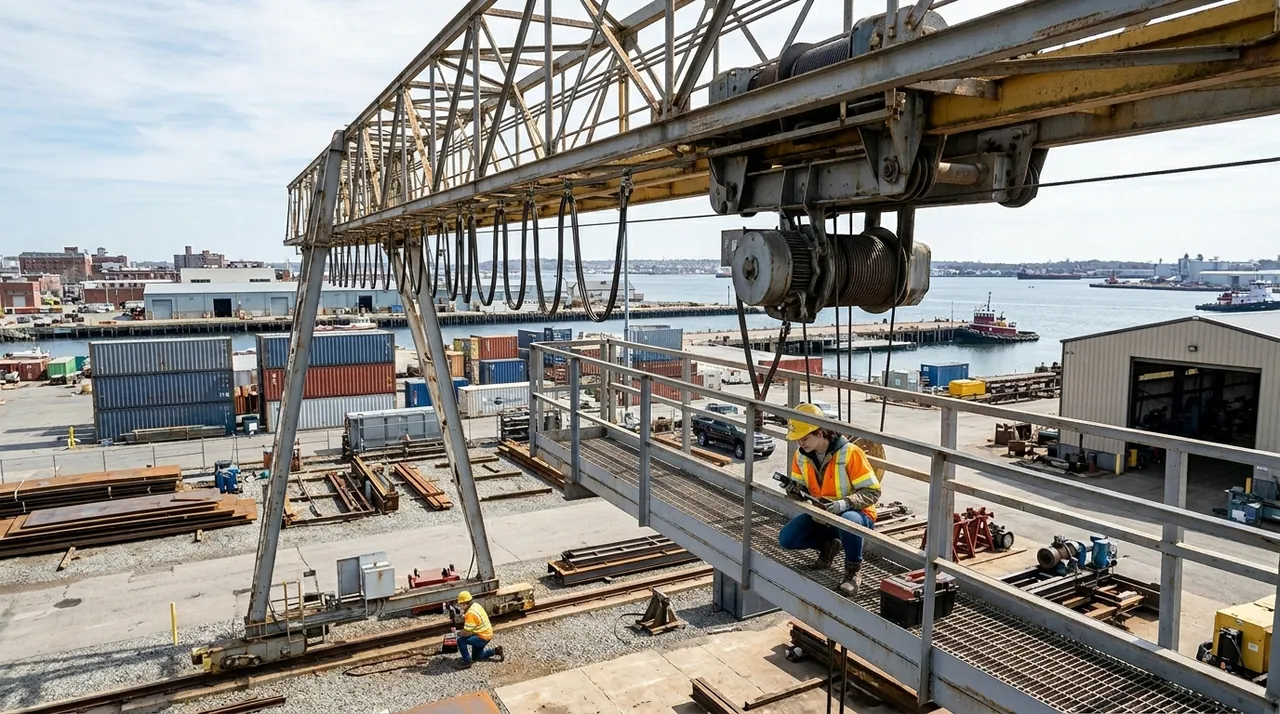
Running cranes, hoists, and marine travel-lifts safely does not end when the lift is complete. Ropes fatigue, brakes wear, hydraulic fluid breaks down, and limit switches drift out of calibration. Routine maintenance intercepts those failures before they become incidents. This session covers the maintenance points every 3A operator needs to understand, the lockout/tagout discipline required before any service work begins, the extra demands of marine equipment, and the recordkeeping practices that prove your equipment is being managed properly.
Lubrication and Wear Monitoring
Wire ropes, chains, sheaves, hooks, and gear cases all require periodic lubrication to function within their rated capacity. A rope running dry through a sheave groove loses flexibility faster than design engineers assume, and individual wires begin breaking at a much higher rate. Sheave grooves themselves wear into shapes that pinch rope strands, so checking groove profile is part of any responsible inspection. Gear cases need oil at the correct level and viscosity — running low or with degraded oil accelerates gear and bearing failure in ways that are rarely visible until the gearbox is already compromised.
Brake lining wears with every cycle, and as it wears, adjustment is required to maintain stopping torque. When the manufacturer's wear limit is reached, the lining must be replaced — not shimmed or improvised around. Limit switches and overload protection devices must be tested at the intervals ASME B30 and the manufacturer require. A limit switch that has drifted out of position or an overload device that has been bypassed is equipment that is waiting to fail under load.
Lockout/Tagout and the Operator's Role
Powered hoisting equipment must be locked out and tagged out before anyone performs electrical or mechanical service on it. De-energize the equipment, apply a lock keyed to the person doing the work, and attach a tag identifying who applied it and why. If multiple workers are servicing the same equipment, each person applies their own lock — the equipment does not move until every lock is removed.
As an operator, your role is clearly separated from that of qualified maintenance personnel. Pre-use inspections and defect reporting are operator responsibilities. Replacing electrical components, rebuilding gearboxes, or adjusting load-limiting devices belong to qualified mechanics and electricians. Knowing where that boundary is keeps you from attempting repairs beyond your training and keeps the maintenance record clean.
Marine Travel-Lift Specifics
A travel-lift operates in an environment far harder on equipment than a dry indoor facility. Salt air corrodes metal surfaces, sling hardware, and electrical connections faster than most operators expect. Tires carry enormous loads when a vessel is suspended and operate on wet, algae-coated, or frost-damaged surfaces — tire inflation and sidewall condition must be checked regularly. The hydraulic system that drives steering, travel, and hoist functions needs extra attention because saltwater contamination shortens fluid life and corrodes fittings.
Sling condition is critical. The wide fabric or wire-rope slings that cradle a hull absorb saltwater and grit, which accelerates deterioration. Inspect slings for cuts, abrasion, and corrosion after every use, and store them off the ground, coiled or hung, and protected from sunlight when not in service. Seasonal transitions also matter: before cold weather, hydraulic fluids may need viscosity adjustments and pneumatic circuits must be purged of water to prevent freeze damage.
Inspection Intervals and Recordkeeping
ASME B30 standards and manufacturer documentation establish inspection intervals — some items before every use, others on a periodic schedule. When the manufacturer's interval and ASME B30 conflict, apply the more conservative requirement.
Every inspection, repair, and out-of-service event must be recorded with the date, the finding, the corrective action, and the name of the person who did the work. These records show regulators and insurers that maintenance is performed as required, help identify patterns of recurring failure, and establish a defensible history if equipment is ever involved in an incident. Out-of-service tags stay in place until repairs are complete and documented — production pressure never justifies removing them early.
Key Takeaways
- •Lubricate ropes, chains, sheaves, and gear cases on schedule — dry or degraded components wear faster and can fail below rated capacity.
- •Lock out and tag out every energy source before electrical or mechanical service; each worker applies their own lock.
- •Operators inspect and report; qualified maintenance personnel perform repairs — that boundary protects everyone.
- •Travel-lift maintenance adds tire condition, hydraulic fluid integrity, and sling corrosion to the standard checklist because of the marine environment.
- •Document every inspection, repair, and out-of-service event with date, finding, action, and name — records prove compliance and reveal failure patterns.