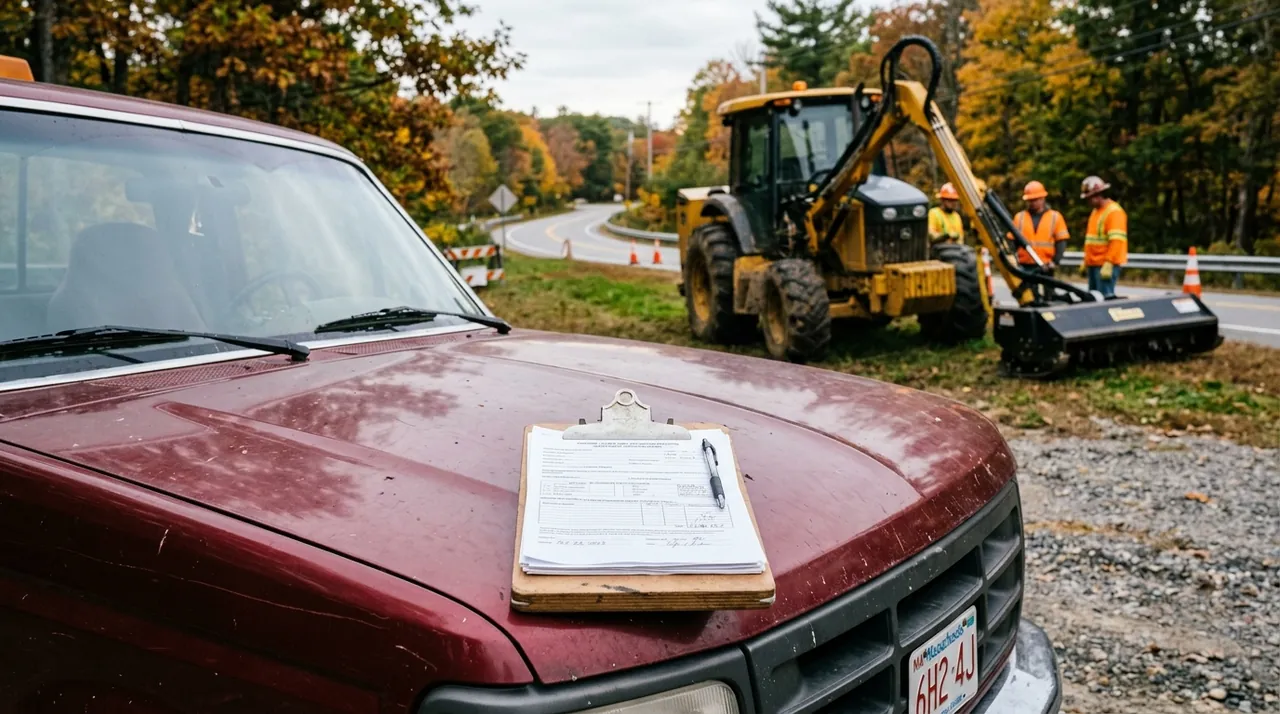
Before you ever touch the controls of a side-boom mower on a Massachusetts roadside, the law requires you to carry a valid hoisting license with the 4G restriction. That is not a technicality — it is the first thing an inspector will ask to see, and operating without it carries real penalty exposure. This session explains where that requirement comes from, which agency enforces it, and the situations where a worker is legitimately exempt. Understanding the legal framework now means you can answer the exam questions cold and stay on the right side of the law on every job.
The statute and the regulation that create the 4G requirement
Massachusetts General Laws chapter 146, sections 53 through 54A, is the legislature's grant of authority: it defines who must hold a hoisting license and empowers a state agency to administer the program. That statute, by itself, does not list every machine type or spell out every application rule. That detail lives in 230 CMR 6.00, the Hoisting Machinery regulation issued by the Division of Occupational Licensure. Together they form a two-layer system that is common in Massachusetts licensing law — the statute sets the mandate, the regulation provides the operational specifics.
One fact the exam tests directly: the current citation is 230 CMR 6.00, not 520 CMR 6.00. The code was recodified, and older study materials sometimes reference the superseded number. Citing 230 CMR 6.00 is not just a formality; it signals that you know which version of the regulation is actually in force.
Why a side-boom mower counts as hoisting machinery
You might wonder why a mower falls under a law built around cranes and hoists. The answer is in the mechanics. A side-boom mower uses a powered, hydraulically actuated articulating boom to extend a cutting head well beyond the tractor's footprint — sometimes several feet out over a ditch or embankment. That moving, load-bearing hydraulic boom places the machine in the same regulatory category as other hoisting equipment. Boom failure, sudden drop, or uncontrolled swing creates hazards that require a trained, licensed operator, regardless of whether the payload is a cutting head or a steel beam.
When regulators or inspectors refer to 'hoisting machinery,' they are using a statutory definition, not a common-sense description. The side-boom mower qualifies under that definition, which is why the 4G restriction exists as its own category.
The issuing agency and the basics of the license
The Division of Occupational Licensure, through its Office of Public Safety and Inspections, issues hoisting licenses in Massachusetts. When you apply for or renew your 4G license, you are dealing with OPSI. Knowing the correct agency name is a routine exam question and also practical — if you need to verify a co-worker's license status or resolve a discrepancy, OPSI is the office you contact.
Every applicant must be at least 18 years old. The application fee is $75 per restriction and is nonrefundable. The license is valid for two years and can be renewed starting up to 60 days before it expires. Letting it lapse means you cannot legally operate until renewal is complete, so tracking your expiration date is part of staying licensed.
Exemptions and the cost of operating unlicensed
The regulation recognizes narrow exemptions, and the exam expects you to know them precisely. Agricultural operators mowing on their own land are exempt — a farmer running a boom mower across his own fields does not need a 4G license. Certain supervised programs also qualify: workers in approved public-utility, apprenticeship, or vocational training programs may operate under supervision without holding a license. Outside those specific situations, the exemption does not apply. A contractor mowing a highway right-of-way needs the license.
Operating without a valid 4G license on a public roadside exposes the operator and potentially the employer to penalties under chapter 146. On a job site with DOT oversight, operating unlicensed is a fast way to shut down the work and generate consequences that follow both the worker and the company. The $75 application fee is not a hardship; the penalty for ignoring the requirement is.
Key Takeaways
- •M.G.L. c. 146 sections 53-54A is the governing statute; 230 CMR 6.00 is the current implementing regulation — cite 230, not the superseded 520.
- •The Division of Occupational Licensure, Office of Public Safety and Inspections, issues the Massachusetts hoisting license with the 4G restriction.
- •A side-boom mower qualifies as hoisting machinery because its powered, hydraulically actuated articulating boom places it within the statutory definition.
- •License basics: minimum age 18, $75 nonrefundable fee per restriction, 2-year term, renewable up to 60 days before expiration.
- •Exemptions are narrow: agricultural operators on their own land and certain supervised training programs — everyone else operating on a public roadside needs the license.