Free MA Hoist

Operating Hazards & Safe Procedures

2 hours

1A — Operating Hazards & Safe Procedures (Hoisting apparatus w/ friction winch drum).
1Ahoisting apparatus w/ friction winch drum.

A crane is the most hazardous piece of hoisting equipment on any jobsite, and most serious crane accidents trace back to a small set of predictable operating hazards. This session covers four of the most critical: two-blocking, swing radius crush zones, power line proximity, and uncontrolled load movement. Understand why each is dangerous — not just that it is — and you will make better decisions under real conditions and be ready for the exam questions that probe exactly that understanding.

Two-Blocking: When the Hoist Line Runs Out of Travel

Two-blocking happens when the load block is raised until it contacts the upper block or boom tip. At that point the hoist line goes taut between two fixed points and something gives — usually the wire rope or sheave hardware — and the load drops with no warning.

On a friction winch drum, the hazard is compounded. A friction drum relies on the operator's feel of the clutch and visual cues. If the moment of contact is missed, the clutch can re-engage before the problem is recognized, adding more upward force just as the system is about to fail. Anti-two-block devices are required on lattice boom cranes placed in service after November 8, 2011 — the device cuts hoist power before contact occurs. On older equipment, visual spotters and line markings are the primary defense. Know whether your machine has the device, verify it works before the shift, and never treat it as a substitute for knowing where your block is.

Swing Radius: The Rotating Crush Zone

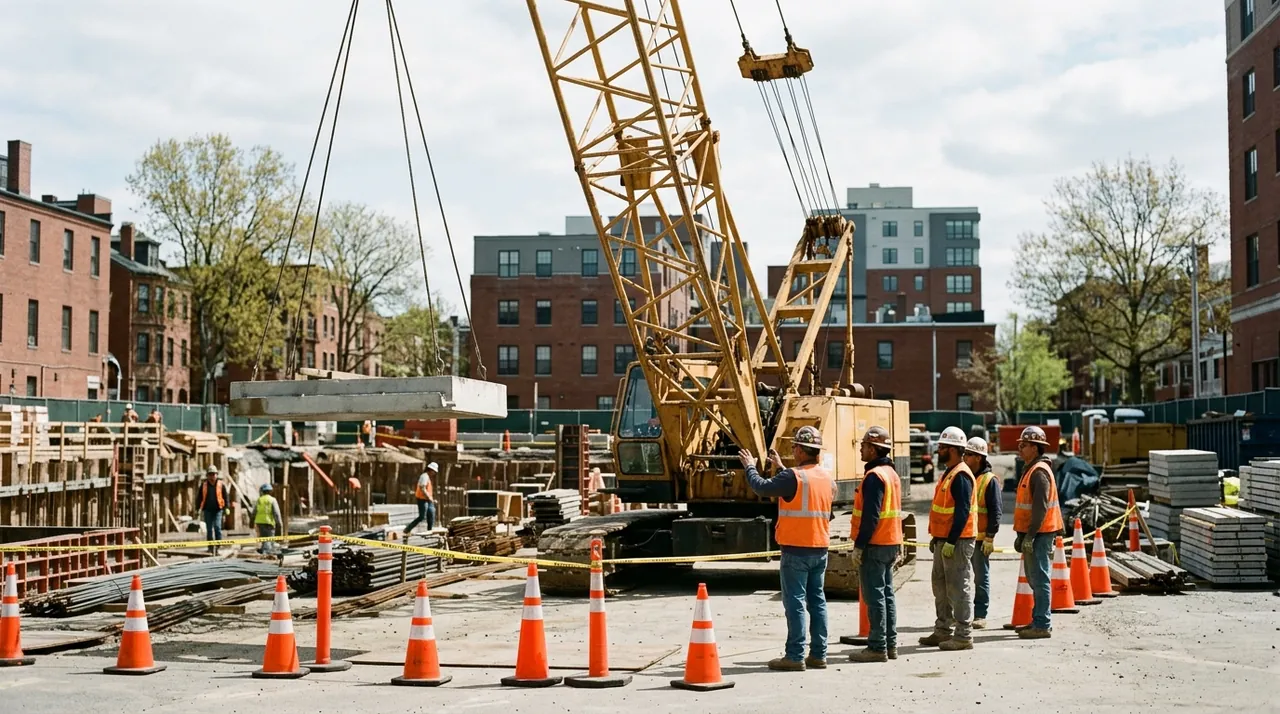
When the superstructure rotates, every part of it sweeps an arc — boom, load line, and counterweight. Workers who stay back from the load assume they are safe. They are not. The counterweight extends well behind the carrier and sweeps in the opposite direction from the boom, which means a worker standing at the rear of the machine can be struck without ever seeing the load move.

OSHA 1926.1424 requires that the swing radius be controlled by barriers, control lines, warning lines, or railings that mark the boundary and keep workers out while the machine rotates. Confirm the zone is established before any swing, and stop rotation immediately if anyone enters it. OSHA 1926.1418 gives the operator both the right and the obligation to halt operations when a safety concern arises — this is exactly the situation that rule covers.

Power Line Clearance: Distance Is the Only Safe Option

Electricity can arc through air before the boom touches a wire, so the safe distance is a meaningful standoff, not nearly zero. Under OSHA 1926.1408, the default minimum clearance from power lines rated up to 350 kV is 20 feet — unless the utility has confirmed in writing that a lesser distance is safe.

If operations will bring the crane within the Table A distances, an encroachment prevention plan must be developed and in place before work begins. That plan identifies who contacts the utility, how the crane is spotted, and what physical measures — insulating links, dedicated spotters — will be used. The 20-foot number matters for the exam, but the deeper lesson is that power line work requires deliberate pre-planning, not improvisation.

Controlled Load Movement: No Free Falls, No Side-Loading

OSHA 1926.1426 prohibits free-fall of loads. On a friction drum, free-fall means releasing the clutch so the drum spins without braking force, dropping the load at gravity's full acceleration. Controlled lowering means the load descends under friction drum braking at a rate the operator can adjust or stop. A controlled lower can be interrupted; a free-fall cannot.

OSHA 1926.1417 prohibits side-loading — using the boom to drag or pull a load sideways rather than lifting it vertically. The boom is designed for vertical compressive loads; side loads introduce bending stress the structure was never rated for, and the load chart no longer applies. The same is true when operating outside the manufacturer's minimum or maximum boom angle range. Tag lines, handled by a ground person, are the correct way to control load rotation without putting a side force on the boom.

Operating on Slopes: When Level Ground Is Not Available

Every crane has manufacturer-specified limits for both side slope (lateral tilt) and fore-aft slope (front-to-back tilt). Operating beyond these limits changes the machine's center of gravity in ways the load chart does not account for — the rated capacities on the chart assume the crane is within spec on a level, firm surface.

Before setting up on a grade, consult the crane's Operation and Maintenance Manual for the allowable slope limits. If the site slope exceeds those limits, the crane must be repositioned or the ground must be graded and compacted to bring it within range. No amount of blocking or cribbing substitutes for meeting the manufacturer's slope specifications. This is a setup decision, not a mid-lift adjustment — the assessment must happen before the first load leaves the ground.

Key Takeaways

  • Two-blocking causes instant load drop when the load block contacts the upper block. Anti-two-block devices are required on lattice boom cranes placed in service after November 8, 2011; on older friction drum equipment, spotters and line markings are the backup.
  • The entire rotating superstructure is a hazard zone, including the counterweight. OSHA 1926.1424 requires barriers or control lines around the swing radius before any rotation begins.
  • The default minimum clearance from power lines up to 350 kV is 20 feet under OSHA 1926.1408. Closer work requires utility confirmation and a written encroachment prevention plan.
  • OSHA 1926.1426 prohibits free-fall of loads — all lowering must be controlled through the friction drum brake under positive operator control.
  • Side-loading the boom and operating outside manufacturer boom angle limits void load chart ratings and risk structural failure. Use tag lines to guide loads, never the boom.
  • Cranes must be operated within the manufacturer's specified side slope and fore-aft slope limits. Exceeding those limits invalidates the load chart. Assess ground slope before setup — not after the lift begins.

Learning Objectives

  • Identify two-blocking and explain why it is catastrophic on friction winch cranes
  • Apply the swing radius exclusion requirements of OSHA 1926.1424
  • Explain the hazards of operating a crane near power lines and the clearance distances under OSHA 1926.1408
  • Describe the free-fall prohibition under OSHA 1926.1426 and conditions for controlled load lowering

Topics Covered

  • Two-blocking: the load block (bottom block) contacts the boom top (upper block) — the hoist line goes slack and the load free-falls
  • Two-blocking on friction drums: particularly dangerous because the clutch can re-engage before the block is seen to contact
  • Prevention: anti-two-block device (required on lattice boom cranes post-November 8, 2011); visual spotters; marking hoist line
  • OSHA 1926.1424 swing radius hazard: the rotating superstructure, boom, and counterweight can strike workers
  • Control measures: control lines, warning lines, railings, or barriers marking the swing/crush zone boundary
  • Counterweight swing zone: the counterweight extends beyond the carrier and rotates — workers must be kept clear
  • OSHA 1926.1408 power line safety (up to 350 kV): minimum clearance 20 feet unless the utility has confirmed a lower safe distance
  • Encroachment prevention plan: required before operating within the Table A distance from power lines
  • OSHA 1926.1418 — authority to stop operation: the operator has the right AND obligation to stop if a safety concern arises
  • OSHA 1926.1426 free fall prohibition: equipment must not be used to free-fall loads except in specific conditions
  • Controlled load lowering: the load must be lowered using the friction drum brake under positive operator control at all times
  • No side-loading: the boom must not be used to drag or pull loads sideways — this is an operational prohibition under OSHA 1926.1417
  • Load swing hazards: tag lines used by a ground person to control load rotation and prevent swinging into structures
  • Boom angle limits: operating outside the manufacturer's minimum and maximum boom angle range voids load chart ratings and risks boom failure
  • Operating on slopes: manufacturer specifications govern maximum allowable side slope and fore-aft slope during operation

Resources

Self-Check Questions

Question 1: What is two-blocking and why is it especially dangerous on friction winch cranes?

  1. A. When the boom contacts a power line — dangerous because the drum cannot be stopped quickly
  2. B. When the load block contacts the boom top sheave — on friction drums, the rope can go slack and the load falls(correct)
  3. C. When two cranes lift the same load simultaneously without a critical lift plan
  4. D. When the hoist drum is blocked by a mechanical brake failure
Show Explanation

Explanation:

Two-blocking occurs when the load block is hoisted until it contacts the upper block or boom tip. On a friction winch crane, the hoist line goes slack above the contact point, allowing the load to fall freely. The operator's clutch and brake have no effect on the falling load once rope tension is lost.

Question 2: Under OSHA 1926.1408, what is the default minimum safe distance from a power line (up to 350 kV) when operating crane equipment?

  1. A. 5 feet
  2. B. 10 feet
  3. C. 20 feet(correct)
  4. D. 50 feet
Show Explanation

Explanation:

OSHA 1926.1408 Table A establishes a default minimum approach distance of 20 feet from power lines up to 350 kV. A reduced distance may be permitted only after the utility owner confirms the specific safe distance in writing. The 20-foot default applies to all parts of the crane — boom, load, rope, and load.

Question 3: You are operating a crane and see a worker enter the counterweight swing zone while you are rotating. What must you do?

  1. A. Sound the horn continuously and complete the swing
  2. B. Slow the rotation and warn the worker verbally
  3. C. Stop rotation immediately — do not resume until the area is confirmed clear(correct)
  4. D. Ask the signaler to wave the worker out; continue rotating slowly
Show Explanation

Explanation:

OSHA 1926.1424 requires stopping all rotation when workers are in the swing/crush zone. A crane counterweight can weigh tens of thousands of pounds and cannot stop instantaneously. The only safe action is to stop immediately and wait for the area to be confirmed clear.

Question 4: Under OSHA 1926.1418, who has the authority to stop crane operations when a safety concern is identified?

  1. A. Only the site safety officer
  2. B. Only the project manager or general contractor
  3. C. The crane operator, who has the right and obligation to stop operations(correct)
  4. D. OSHA inspectors only, who must be called to the site
Show Explanation

Explanation:

OSHA 1926.1418 specifically grants the operator authority to stop operations when they believe a safety concern warrants it. This is not optional — the operator has both the right and the obligation to stop. No employer directive may override this safety authority.

Question 5: A flagman is directing the crane operator to swing the boom. The flagman's view of the load is blocked by a building. What must the operator do?

  1. A. Proceed slowly based on the flagman's last known position
  2. B. Stop and do not resume until the signaler has a clear view of both the operator and the load(correct)
  3. C. Switch to radio communication for this portion of the lift
  4. D. Ask another worker to relay the flagman's signals
Show Explanation

Explanation:

The signaler must be able to see both the operator's control zone and the load at all times. If the signaler's view of the load is obstructed, signals cannot be given safely. The operator must stop until the signaler is repositioned with a clear view, or a secondary signaler is designated for the obstructed zone.

Question 6: OSHA 1926.1426 prohibits the free-fall of loads on cranes. What does "free fall" mean in this context?

  1. A. The load falling faster than the boom can be lowered
  2. B. The uncontrolled descent of the load — hoist drum spinning freely without brake or clutch engagement(correct)
  3. C. The load swinging freely on the hook without a tag line
  4. D. Lowering the load faster than 50 feet per minute
Show Explanation

Explanation:

Free fall means the hoist drum spins without positive brake or clutch engagement — the load descends under gravity alone, uncontrolled. OSHA 1926.1426 prohibits this mode of operation. On friction drum cranes, the operator must maintain positive brake control throughout any load lowering.