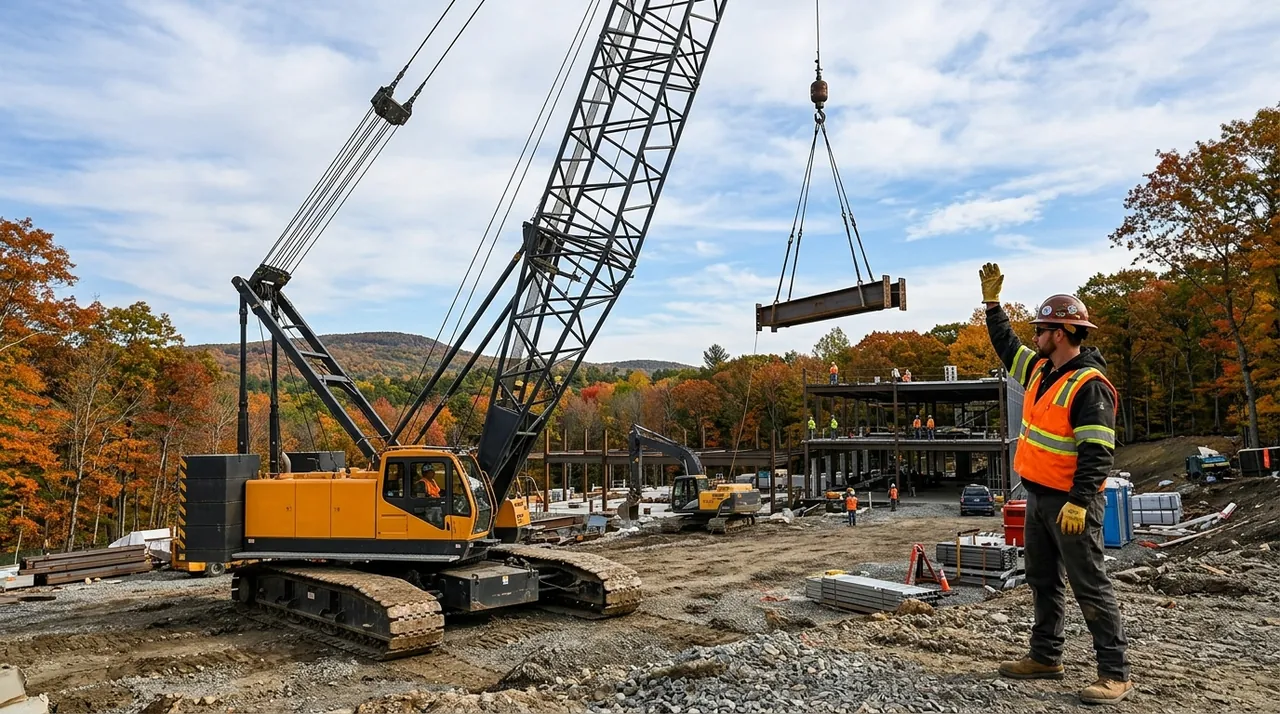
Every crane lift depends on a clear conversation between the operator inside the cab and the signal person on the ground. The operator controls tons of steel moving through the air, often with limited sight lines, while the signal person is the operator's eyes at the load. That conversation must be precise, unambiguous, and governed by a shared language — which is exactly what standardized hand signals provide. Massachusetts law requires crane operators to know and follow the SAE J1307 hand signal standard, and the OSHA crane rules add the framework for when those signals are used and who may give them.
The signal standards Massachusetts requires
Massachusetts crane operations are governed by 230 CMR 6.00, which adopts the SAE J1307-2023 hand signal standard. OSHA's crane rules under 1926.1422 independently require the Standard Method signals defined in Subpart CC Appendix A — the same core set. Standardization matters because it eliminates guesswork: an operator and signal person who have never worked together can step onto any jobsite and communicate immediately if they both know the standard vocabulary.
All signals are given and interpreted from the operator's perspective, not the signal person's. Swing left means the load moves to the operator's left. Travel forward means the crane moves in the direction the operator faces. This prevents the mirror-image confusion that develops when operator and signaler are standing on opposite sides of the machine.
The core hand signal vocabulary
The standard signals cover every primary crane function: Hoist, Lower, Stop, Swing, Raise Boom, Lower Boom, Travel, Use Main Hoist, and Use Whipline. Two signals deserve extra attention because the exam tests them specifically.
Dog Everything tells the operator to stop all crane functions and hold position — not lower the load, not swing to a landing zone, just freeze everything in place. Use it when people need to reposition, rigging needs adjustment, or a safety question needs resolving.
Emergency Stop overrides all other signals. It is the only signal anyone on the jobsite may give — not just the designated signal person. When anyone signals Emergency Stop, the operator stops immediately, without question.
Signal person qualifications and chain of command
OSHA 1926.1428 requires signal persons to demonstrate knowledge of the applicable signal methods and enough awareness of crane operations to understand what effect each signal has. No formal third-party certification is required, but the knowledge must be shown — it cannot be assumed.
Only one signal person may direct the crane at a time, with the single exception of Emergency Stop. If a foreman, superintendent, or bystander starts giving hand signals and they are not the designated signal person, the operator ignores those signals completely. This is a firm rule: taking direction from multiple people simultaneously is exactly the kind of ambiguity the standard exists to prevent.
Alternative communication and what to do when signals are lost
Hand signals are the default. When the operator's view is obstructed or the working distance makes visual signals impractical, radio communication is permitted under OSHA 1926.1420. Voice signals are permitted under OSHA 1926.1421 when radio is unavailable and direct voice contact is reliable. Regardless of which method is used, the operator and signal person must agree on the meaning of any non-standard signals during a pre-lift communication meeting.
Lost visual contact triggers one required response: stop. Under 230 CMR 6.00, the operator must be able to see the signal person at all times. The moment the signaler disappears from view, all crane motion stops until visual contact is restored. Continuing to operate while guessing at signals is one of the most common contributors to lift incidents.
Key Takeaways
- •Massachusetts requires SAE J1307-2023 hand signals under 230 CMR 6.00; OSHA 1926.1422 requires the Standard Method from Subpart CC Appendix A — both align on the same core signals.
- •All signals are interpreted from the operator's perspective — swing left means left from inside the cab.
- •Dog Everything means stop and hold all crane functions in place; Emergency Stop overrides everything and anyone on site may give it.
- •Only the designated signal person directs the crane; ignore signals from anyone else except Emergency Stop.
- •If you lose sight of the signal person, stop all crane motion immediately — operating without visual contact is not permitted.