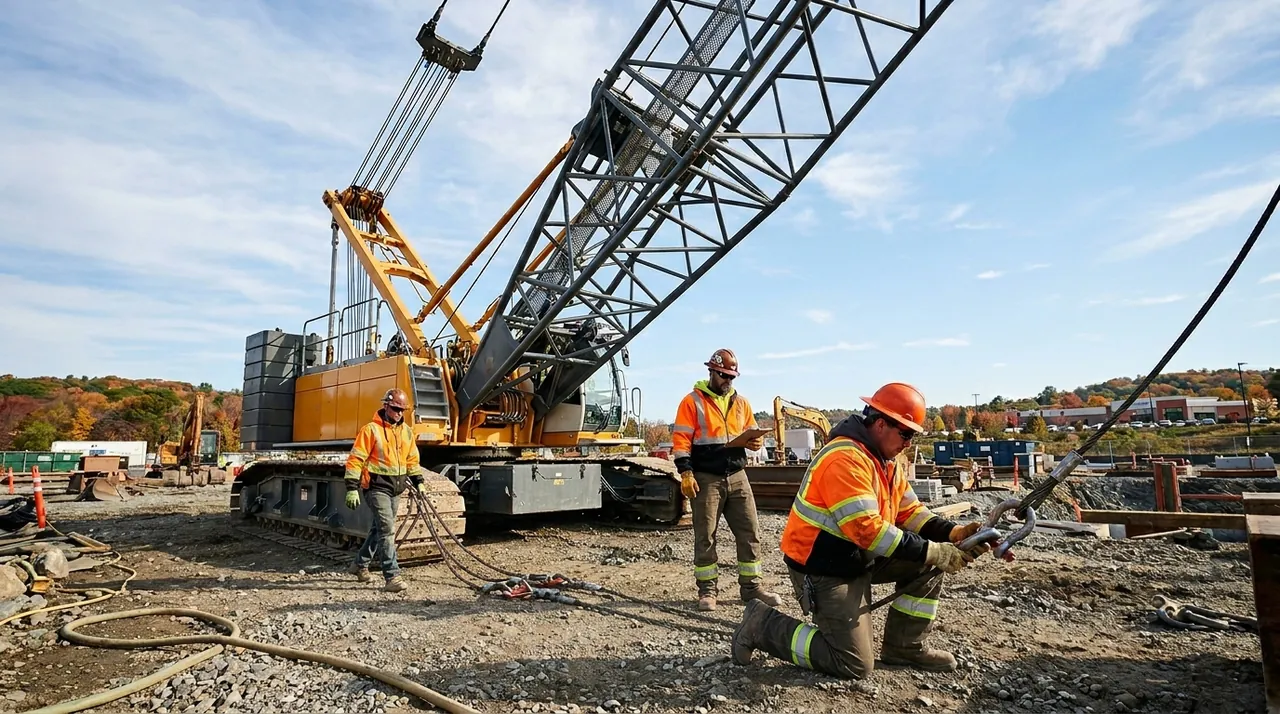
Every crane operator working in Massachusetts construction falls under a single federal rulebook: 29 CFR 1926 Subpart CC. If you hold a 1A hoisting license, this regulation is the framework your daily work lives inside. Subpart CC is organized logically — each section has a specific subject, and once you know what lives where, you can navigate it in the field and answer exam questions with confidence. This lesson maps that structure, highlights the definitions that matter most, and explains where your Massachusetts license connects directly to federal law.
What Subpart CC covers — and what it does not
Section 1926.1400 defines the scope of the regulation. Subpart CC applies to cranes and derricks used in construction: crawler cranes, truck cranes, tower cranes, and derricks all fall inside it. Floating cranes, pile driving equipment used exclusively for pile driving, and aerial lifts covered by other OSHA subparts are excluded. The regulation draws those lines deliberately — each excluded category carries its own ruleset or involves specialized hazards addressed elsewhere.
Scope matters on the job because it tells you immediately whether the equipment you are operating is subject to Subpart CC's inspection, certification, and operational requirements. If it is in scope, every section that follows applies to you.
The definitions that drive everything else
Section 1926.1401 is the definition section, and three terms from it appear throughout the regulation and on the exam. A competent person is someone who can both identify existing and predictable hazards and has the authority to take corrective action, including removing a crane from service. A qualified person has specialized knowledge or training through a degree, certification, or sufficient work experience — they can perform engineering-level analysis and direction. An operator is defined as someone licensed by a government entity or certified under section 1926.1427.
These are not interchangeable titles. On an assembly/disassembly job, for example, the regulation requires direction from both a competent person and a qualified person — the two roles carry different legal responsibilities. Mixing them up in the field or on an exam answer is a mistake that carries real consequences.
Section by section: the major operational topics
Once you move past definitions, each section of Subpart CC addresses a specific operational area. Ground conditions (1926.1402) require the crane's surface to be firm, drained, and graded, with supporting materials added when natural ground cannot carry the load. Assembly and disassembly (sections 1926.1403 through 1926.1406) require direction by both a competent and a qualified person, and prohibit removing pins from boom sections under load.
Inspections (1926.1412) run on a three-tier schedule: a competent person performs the pre-shift check, a documented monthly inspection is required, and a qualified person must complete the annual inspection. Wire rope (1926.1413) has its own parallel schedule — shift, monthly, and annual — with defined thresholds for broken wires, wear, and structural defects that require immediate removal from service. Safety devices (1926.1415) — level indicator, boom stops, jib stops, brake locks, and horn — must all function before operations begin. The operation section (1926.1417) prohibits exceeding rated capacity, requires the load chart in the cab, mandates weight verification over 75 percent of rated capacity, requires a minimum of two drum wraps, and bars side-loading or dragging.
Power line safety and operational aids
Two additional sections of Subpart CC appear frequently on the Massachusetts exam and carry serious field consequences. Power line safety is addressed in sections 1926.1407 through 1926.1411. The default minimum clearance from energized power lines is 20 feet for lines up to 350 kV. When work must be performed within the distances listed in Table A of the regulation, an encroachment prevention plan is required before operations begin. Power lines are the leading cause of crane fatalities, so OSHA treats this section with particular strictness — violations here are routinely cited at the willful level.
Operational aids are addressed in section 1926.1416. A boom angle indicator is required on all cranes with a boom angle limitation. An anti-two-block device is mandatory for lattice boom cranes manufactured after November 8, 2011, and for telescopic boom cranes manufactured after February 28, 1992. A load moment indicator is required for cranes with a rated capacity greater than 6,000 pounds manufactured after March 2003. For cranes that predate those cutoffs, equivalent measures and heightened awareness are still required. Two-blocking is the condition where the load block contacts the boom tip or headache ball — on a friction winch drum, two-blocking can cause the load to free-fall, making it one of the highest-consequence hazards in 1A crane operations.
Operator authority, signals, work area control, and your Massachusetts license
Section 1926.1418 gives the crane operator explicit authority to stop operations for safety reasons — this is a federal right, not a courtesy. A signal person is required under sections 1926.1419 through 1926.1422 when the operator cannot see the load or the landing zone, and acceptable methods include hand, radio, voice, and audible signals, each governed by a standard that must be followed. Work area control (1926.1424) requires swing radius barriers and warnings, and obligates employers to train workers on struck-by and pinch and crush hazards before they enter the work zone.
Section 1926.1427 is where your Massachusetts license connects directly to federal law. OSHA requires operators to be certified by an accredited certifier, licensed by a government entity, or qualified by an auditor. Massachusetts is a government entity that issues hoisting licenses, so a valid 1A license satisfies the federal operator certification requirement — no separate private certification is needed. For multiple crane lifts, section 1926.1432 requires a qualified person to develop the lift plan, competent and qualified personnel to direct the operation, and a pre-lift meeting before work begins.
Key Takeaways
- •Subpart CC applies to crawler, truck, and tower cranes and derricks in construction — floating cranes, dedicated pile drivers, and aerial lifts covered elsewhere are excluded.
- •Know the three definitions from 1926.1401: competent person (can identify hazards AND has authority to correct them), qualified person (specialized knowledge or training), and operator (licensed or certified under 1926.1427).
- •Assembly and disassembly requires both a competent and a qualified person directing the work — pins cannot be removed from boom sections under load.
- •Power line safety (1926.1407–1926.1411) sets a 20-foot default clearance up to 350 kV; an encroachment prevention plan is required when working within Table A distances.
- •Operational aids (1926.1416): anti-two-block devices are mandatory for lattice boom cranes manufactured after November 8, 2011, and for telescopic boom cranes after February 28, 1992; load moment indicators are required for cranes over 6,000 lb manufactured after March 2003.
- •Inspections run on three tracks: pre-shift by a competent person, documented monthly, and annual by a qualified person; wire rope has its own parallel schedule.
- •Your Massachusetts 1A hoisting license satisfies OSHA's operator certification requirement under 1926.1427 because Massachusetts is a government entity that issues operator licenses.