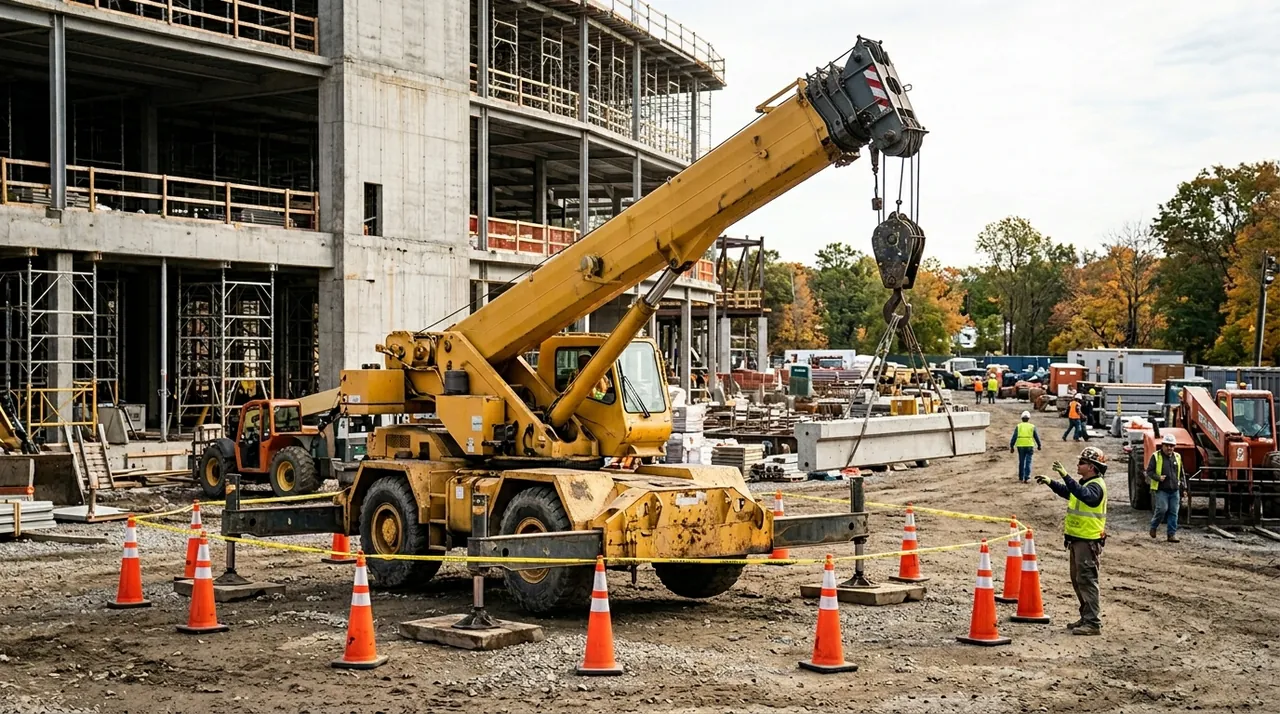
Three hazards kill crane operators and crew more consistently than any others: contact with overhead power lines, two-blocking, and tip-over. None of them are freak accidents. Each follows a predictable chain of decisions and conditions that an informed operator can identify and stop before the event occurs. This session connects those hazards to the physics behind them and to the operating practices that prevent them.
Power Lines: The Leading Cause of Crane Fatalities
Contact with an energized overhead conductor is the single leading cause of crane fatalities. The moment the boom, hoist line, or load touches an energized line, the entire crane becomes part of the electrical circuit — including any ground worker who is steadying a tag line or handling the load block.
OSHA Subpart CC requires operators to treat every overhead line as energized unless the utility confirms in writing that it has been de-energized and visibly grounded. The regulations set minimum clearance distances based on the line's voltage, and no lift or travel path should bring the boom, load, or hoist line within those distances. When work must occur near lines, the preferred control is to have the utility de-energize the conductors before the crane arrives. If that is not possible, the operator must use a dedicated spotter whose only job is to watch the line and call a stop before the equipment enters the minimum clearance distance. Ground crew handling tag lines or load rigging are equally at risk and must be part of the briefing before any lift near conductors.
Two-Blocking: What It Is and Why It Cannot Be Ignored
Two-blocking occurs when the hook block is hoisted until it contacts the boom-head sheaves at the tip of the boom. At that point the hoist line has nowhere to go, and continued drum rotation parts the rope — the load drops without warning. On a telescoping-boom crane the hazard is easy to misjudge because the operator's sightline to the boom tip is limited and boom extension can combine with load-line travel in unexpected ways.
The anti-two-block device — the ATB — is the primary safeguard. A weighted switch at the boom head cuts power to the hoist before the block makes contact. The load moment indicator (LMI, also called a rated capacity indicator) adds a second layer by warning the operator as the suspended load approaches the rated capacity limit. Both must be verified at the start of every shift. A malfunctioning ATB is an immediate out-of-service condition; there is no workaround, and bypassing the device is prohibited.
Tip-Over: Radius, Dynamic Loading, and Ground Conditions
A crane tips when the combined center of gravity of machine and load moves outside the tipping fulcrum. The load chart rates capacity at a specific load radius, and the farther out the radius the lower the rating. Exceeding the chart radius is the most common tip-over trigger — and radius can grow during a lift. When a load swings, centrifugal force pushes it outward, increasing the actual radius beyond the planned value. Sudden starts and stops make this worse.
Other factors reduce the stability margin below what the chart shows. Operating on rubber instead of fully extended outriggers cuts capacity significantly, and the configuration in the field must match the configuration the load chart rating was calculated for. An out-of-level setup shifts the load and counterweight moments in ways the chart does not account for. Soft ground can let an outrigger pad sink mid-lift, changing the crane's level and effective radius without the operator noticing. Wind adds lateral force on the load and increases the sail area of a large, flat object — manufacturer wind speed limits are a hard stop that operators must observe.
The counterweight tail-swing is a separate crushing hazard. The counterweight of a telescoping-boom crane sweeps a wide arc during rotation. Workers caught between the counterweight and a fixed object have been killed. Ground personnel must stay out of the full tail-swing radius and from under suspended loads at all times.
Boom Buckling, Side-Loading, and Pinch Points
A telescoping boom is engineered to carry compressive loads along its centerline. Side-loading — where the force on the boom is applied from an angle rather than straight down — stresses the sections in a way they are not designed for and can cause the boom to buckle. Common causes of side-loading include dragging a load across the ground instead of lifting it straight up, allowing a suspended load to pendulum sharply, and operating on a slope that angles the boom off its rated centerline.
Pinch points around the crane are a separate category of hazard that ground personnel must understand. The area between the rotating superstructure and the carrier frame creates a crushing zone that can close without warning as the operator swings. Outrigger pads and beams pin anything caught beneath them. No worker should position themselves where the crane's movement could trap them against a fixed object, and exclusion zones around the crane must be established and maintained for the full duration of every operation.
Key Takeaways
- •Power line contact is the leading cause of crane fatalities — treat every line as energized, maintain OSHA Subpart CC minimum clearances by voltage, and use a dedicated spotter or de-energize the line before working nearby.
- •Two-blocking parts the hoist line and drops the load — verify the ATB and LMI every shift, and a malfunctioning ATB is an immediate out-of-service condition with no workaround.
- •Exceeding the load chart radius is the most common tip-over trigger — load swing-out during rotation increases actual radius, so control swing speed and confirm radius before every lift.
- •Dynamic factors — wind, sudden starts or stops, off-level setups, and soft ground — all reduce safe capacity below what the load chart shows for ideal static conditions.
- •Side-loading and angled forces can buckle the boom — never drag a load and avoid sharp pendulum swings.
- •No personnel under suspended loads, within the counterweight tail-swing arc, or in any pinch point around the crane — establish and maintain exclusion zones for the entire duration of every lift.