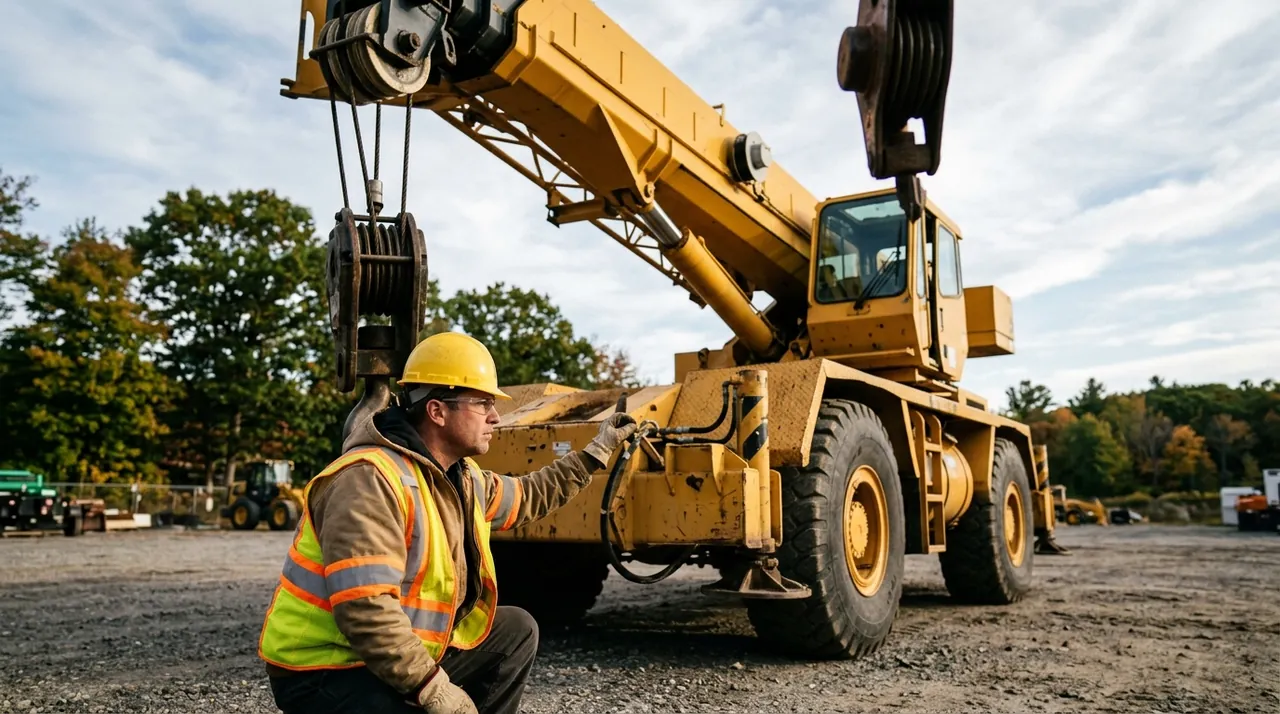
Before you make a single lift, you need to know the condition of your crane. The pre-operation inspection is how you find the hydraulic hose that is about to let go, the rope that has worn past its limit, or the load moment indicator that went dark overnight. This session covers the complete pre-operation routine: the walk-around, the systems check, the function test, and the standards that require all of it.
The OSHA framework: shift, monthly, and annual inspections
OSHA Subpart CC establishes three tiers of crane inspection. The shift inspection happens before each shift, performed by a competent person — someone who can recognize hazards and has the authority to pull the crane from service. It does not require detailed paperwork, but it must happen every day before work begins.
The monthly inspection adds a documentation requirement: the date, inspector name, and findings must be recorded and retained. The annual inspection goes deeper, covering structural members, welds, brakes, and sheaves, and must be done by a qualified person with crane-specific expertise. For the 1B exam, know that the shift inspection is the baseline minimum before every shift, and a competent person sets the standard for who performs it.
The walk-around: structure, outriggers, and the boom
Start at one fixed point on the machine and work completely around it in one direction. Check under the carrier first for fresh fluid — that is the fastest sign of a developing leak. Scan the frame and upperstructure for cracks, bent members, or impact damage. Then work through the outriggers: extend each beam, deploy each jack, and confirm the float pad seats squarely and holds position. A jack that bleeds down under the crane's weight is a removal-from-service condition because it means the machine is unstable before the lift even starts. Check the boom in the stowed position — section alignment, wear pad condition, and the sheaves at the boom head for cracked flanges or worn grooves.
Hydraulics, hoist, and safety devices
Inspect every accessible hydraulic hose and fitting for chafing, kinks, bulges, and weeping at connections. A bulging hose has already failed internally and will rupture under load. Check fluid level and condition with the boom stowed.
The hoist inspection runs from the drum outward to the hook. Look for broken wires, kinks, birdcaging, and diameter reduction on the wire rope. The drum brake must hold rated load without slipping. The hook should be free of cracks or deformation and the safety latch must close and spring back fully.
Every safety device must be confirmed operational before the first lift. Test the anti-two-block (ATB) by slowly hoisting until it triggers — power should cut and an alarm should sound. An inoperative ATB is a hard no-go; there is no workaround. Verify the load moment indicator (LMI) powers on, shows a realistic reading, and that its audible and visual warnings activate as capacity is approached. Confirm the boom angle indicator, boom length indicator, and crane level indicator are reading correctly, since the LMI depends on those inputs to calculate capacity.
The function test and cab check
After the systems inspection, cycle each crane function — hoist up and down, boom up and down, telescope in and out, and swing in both directions — through part of its range. You are confirming that controls respond correctly, brakes hold, and nothing binds or drifts unexpectedly. Inside the cab, check the seat belt, clear glass, mirrors, functional gauges, a working horn, and that every control is labeled so its function is unambiguous. Verify the fire extinguisher is mounted in its designated location and the gauge reads in the charged range — this is a required item on every pre-operation checklist. Finally, confirm the load chart in the cab matches the crane's actual configuration. A chart from a different setup will produce wrong capacity numbers — and relying on a mismatched chart is a violation under OSHA's operating requirements.
Key Takeaways
- •OSHA Subpart CC requires three inspection tiers: shift (competent person, before every shift), monthly (documented), and annual (qualified person).
- •The walk-around covers ground leaks, structural cracks, outrigger beams and jacks, float pad seating, and boom section alignment.
- •Bulging hoses, weeping fittings, and wire rope at removal criteria are immediate out-of-service conditions.
- •An inoperative ATB or LMI is a no-go — function-test both before the first lift with no exceptions.
- •The fire extinguisher must be mounted, accessible, and in the charged range — verify it during every cab check.
- •The load chart in the cab must match the crane's actual configuration before any lift begins.