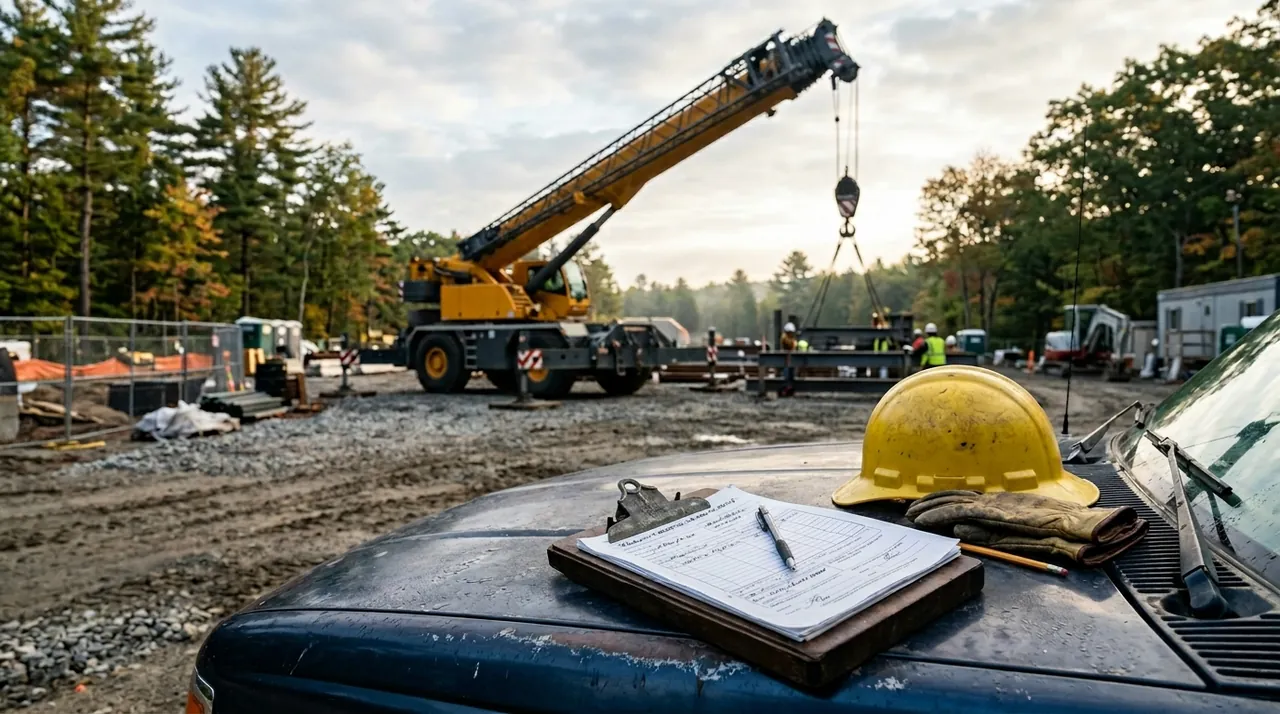
Operating a telescoping-boom crane in Massachusetts means answering to more than one set of rules simultaneously. There is the licensing statute, the state operating regulation, and the body of federal and industry standards that runs alongside both. This session ties those layers together so that on the job — and on the exam — you understand not just what the rules say but why they exist and who enforces what.
What 230 CMR 6.00 actually requires of you
The regulation that governs day-to-day operation of a 1B crane in Massachusetts is 230 CMR 6.00, the Hoisting Machinery regulation issued under M.G.L. c. 146. Think of the statute as the law that says you need a license; think of 230 CMR 6.00 as the rule book that tells you how to use the machine once you have one.
The core obligations run through every lift. You must follow the manufacturer's specifications and the load chart without exception — the chart is a legal document, not a suggestion. You must keep all personnel out of the swing radius while the boom, load, or counterweight is moving, and no one may stand or work beneath a suspended load under any circumstances. You must use a designated signal person and follow the required hand-signal standard; if a signal is unclear or you lose sight of the signaler, you stop immediately. These are not isolated rules — they describe a system of continuous situational awareness that the regulation expects you to maintain throughout the shift.
The operator's authority and duty to stop
One of the most important principles in 230 CMR 6.00 and M.G.L. c. 146 is that the operator bears personal responsibility for the lift. That responsibility includes the authority — and the obligation — to refuse or stop an unsafe operation. If the ground conditions are questionable, if the load weight is uncertain, if visibility is compromised, or if you receive conflicting signals, you have both the right and the duty to halt. No supervisor, foreman, or schedule pressure overrides this obligation.
M.G.L. c. 146 §§ 65 through 67 reinforce this point from multiple angles, addressing operator examination, employer responsibilities, and mandatory accident-reporting requirements. On the operator side, you must work within rated capacity at all times. On the employer side, the law places responsibility on those directing the work to ensure every operator holds a valid license. When an incident occurs involving hoisting machinery, it must be reported as prescribed — delay or omission is itself a violation. Understanding these provisions tells you that compliance is a shared obligation, but the operator is never absolved of individual accountability.
How federal and industry standards fit in
Massachusetts licensing law does not replace federal OSHA or industry standards — it layers on top of them. When a 1B crane is used on a construction site, OSHA 29 CFR 1926 Subpart CC applies in full, covering inspection requirements, wire-rope removal criteria, power-line clearances, and signal-person qualifications. Where Massachusetts and federal standards address the same issue, the stricter requirement controls.
ASME B30.5 is the industry consensus standard for mobile and locomotive cranes. OSHA references B30.5 concepts in its crane rules, and most manufacturer specifications are written to satisfy B30.5 criteria. In practice, if you follow the load chart, complete the required inspections, and operate within the manufacturer's limits, you are satisfying the state regulation, OSHA, and the ASME standard simultaneously.
Keeping your license current: renewal and continuing education
A 1B hoisting license is valid for two years. The renewal window opens up to 60 days before the expiration date, and 230 CMR 6.04 requires you to complete continuing education before the license can be renewed. An expired license is an invalid license from the moment it lapses — there is no grace period that lets you keep operating while the paperwork catches up, and running a crane on an expired license carries the same penalties as operating without one.
You must carry your license and produce it on request. The application/processing fee is $75 per restriction (nonrefundable); check mass.gov for the current renewal fee when you file. On the recordkeeping side, 230 CMR 6.00 requires that inspection records be maintained and that any crane tagged out of service carries documentation of the defect. Those records create accountability and protect you professionally if a question about equipment condition arises later.
Key Takeaways
- •230 CMR 6.00 is the Massachusetts operating rulebook: follow the load chart and manufacturer specs, keep people out of the swing radius and from under loads, and stop immediately on an unclear or emergency signal.
- •The operator has the authority and the duty to refuse or halt any lift judged unsafe — no schedule or supervisor pressure overrides this personal responsibility.
- •M.G.L. c. 146 §§ 65–67 cover operator examination, employer responsibilities (ensuring valid licenses), and mandatory accident reporting.
- •OSHA 29 CFR 1926 Subpart CC and ASME B30.5 apply alongside Massachusetts law on construction sites; where standards overlap, the stricter requirement controls.
- •Renew before expiration (the window opens up to 60 days out), complete required continuing education under 230 CMR 6.04, and carry your license — an expired license is invalid with no grace period. The application/processing fee is $75 per restriction (nonrefundable); verify the current renewal fee at mass.gov when you file.