Before you walk into the exam room, two things need to be locked down: the licensing facts cold, and the machine laid out clearly in your head. This review consolidates Massachusetts law, the class-boundary distinctions, and the crane-component knowledge that appear most often on the 1B written exam. The goal is not to introduce anything new — it is to tighten what you already know so answers come quickly and without second-guessing.
Licensing law: the numbers and the names that matter
Massachusetts hoisting law rests on two documents. The statute is M.G.L. c. 146, which establishes who must hold a license. The implementing regulation is 230 CMR 6.00, which adds technical operating requirements on top of the statute. The issuing agency is the Division of Occupational Licensure through its Office of Public Safety and Inspections — DOL/OPSI. A common exam distractor substitutes the former Department of Public Safety or the old regulation number, 520 CMR 6.00. Neither is current; eliminate them on sight.
Numbers to know: minimum age 18, fee $75 per restriction class, license term two years, 60-day renewal window before expiration. Continuing education under 230 CMR 6.04 is required before a 1B license renews. Exemptions are narrow: agricultural operators on their own land, and workers in supervised utility, apprenticeship, or vocational programs that meet the regulatory criteria.
Class boundaries: where 1B fits in the hierarchy
The 1B restriction covers telescoping-boom cranes that use a wire-rope hoist line over a drum — hydraulic truck cranes and rough-terrain cranes are the primary examples. The hierarchy runs from broadest to narrowest: 1A (friction-clutch, lattice-boom machines, and derricks) automatically includes 1B authority. Below 1B sits 1C, which covers hydraulic telescoping equipment where the load is raised and lowered entirely by hydraulics with no wire-rope hoist line over a drum. That single detail — wire rope over a drum versus pure hydraulic lift — is the dividing line the exam tests directly. A machine with a telescoping boom that raises loads with a hydraulic cylinder rather than a rope and drum is a 1C machine, not a 1B. Below 1C is 1D, covering industrial forklifts. A 1B license carries 1C and 1D authority — the hierarchy is inclusive downward.
Crane components: carrier, upperworks, and the hoist path
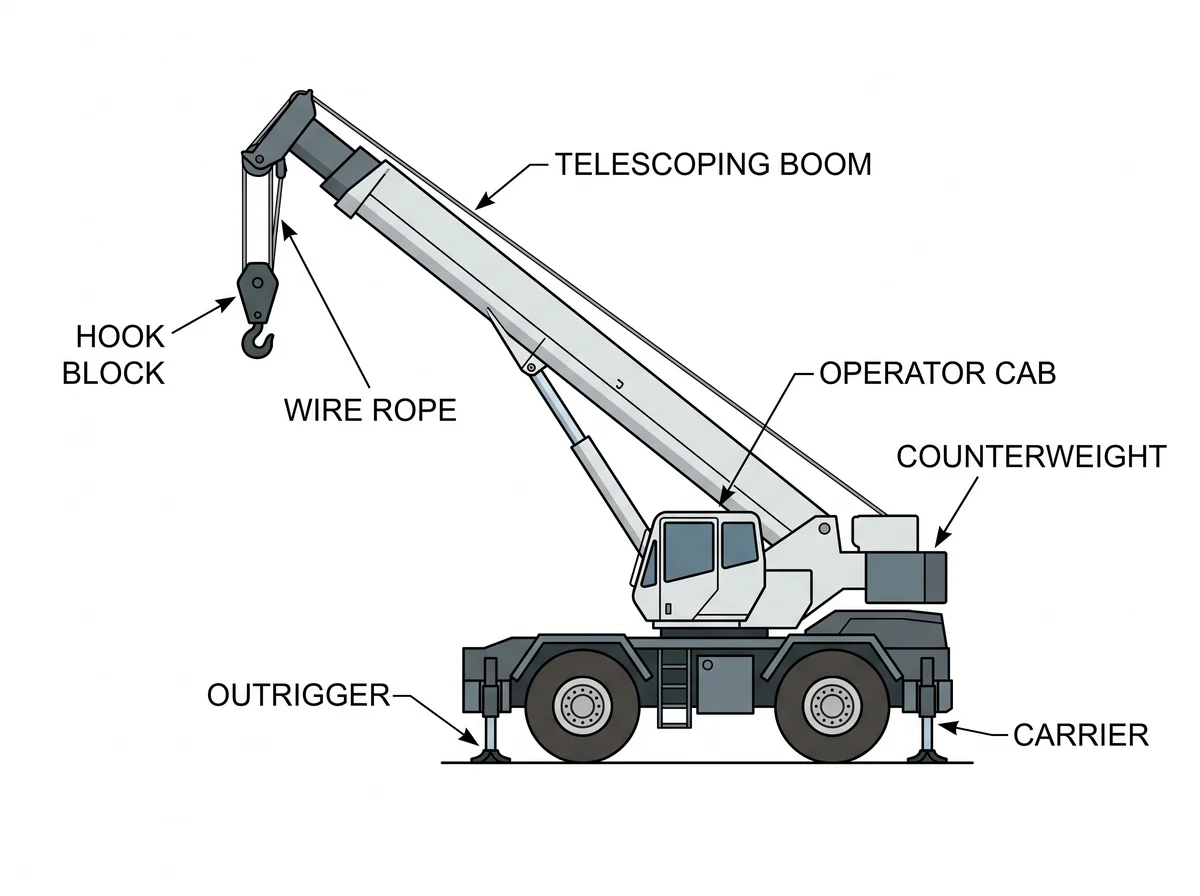
A telescoping-boom crane has two main assemblies. The carrier is the truck chassis built for road travel. The upperworks sits on the carrier via a turntable and swing bearing that allows 360-degree rotation. The telescoping boom mounts on the upperworks, with wear pads at the extension joints protecting the inner surfaces as sections slide in and out.
Trace the wire-rope hoist path: rope pays off the hoist drum, runs up through sheaves at the boom tip, and down to the hook block below. The rope is reeved back and forth between the tip sheaves and the hook-block sheaves to create multiple parts of line — more parts increase the lifting force the drum applies but slow hook travel speed. The fixed rope end at the hook block is called the becket — a term the exam tests. Outriggers extend from the carrier to spread the load and level the machine; on-outrigger ratings are substantially higher than on-rubber ratings because outriggers eliminate tire deflection and suspension movement.
Safety devices you must know cold
Three safety devices carry the most exam and field weight. The anti-two-block device monitors the gap between the hook block and the boom-tip sheaves. When the hook rises too close — the two-block condition — it cuts hoist power before the rope parts and drops the load. Bypassing it is never permitted. The load moment indicator, or LMI/RCI, tracks the relationship between the actual load and rated capacity at the current configuration, warning the operator as the limit approaches. It is a safeguard, not a substitute for reading the load chart before the lift. The level indicator confirms the crane is within the manufacturer's leveling tolerance; even a small out-of-level condition reduces rated capacity and increases tip risk. Know what each device does, and know that none may be disabled under any operating condition.
Key Takeaways
- •The governing law is M.G.L. c. 146 and the regulation is 230 CMR 6.00, issued by DOL/OPSI — not the Department of Public Safety, not 520 CMR.
- •Key numbers: minimum age 18, $75 per restriction class, 2-year term, 60-day renewal window, CE required under 230 CMR 6.04.
- •Class hierarchy broadest to narrowest: 1A includes 1B authority; 1B is telescoping boom plus wire-rope hoist drum; 1C is hydraulic with no wire-rope drum; 1D is forklift.
- •The fixed end of the wire rope at the hook block is the becket; reeving through multiple sheave sets creates parts of line that multiply drum pulling force.
- •Anti-two-block device, LMI/RCI, and level indicator are required safety devices — none may be bypassed or disabled.