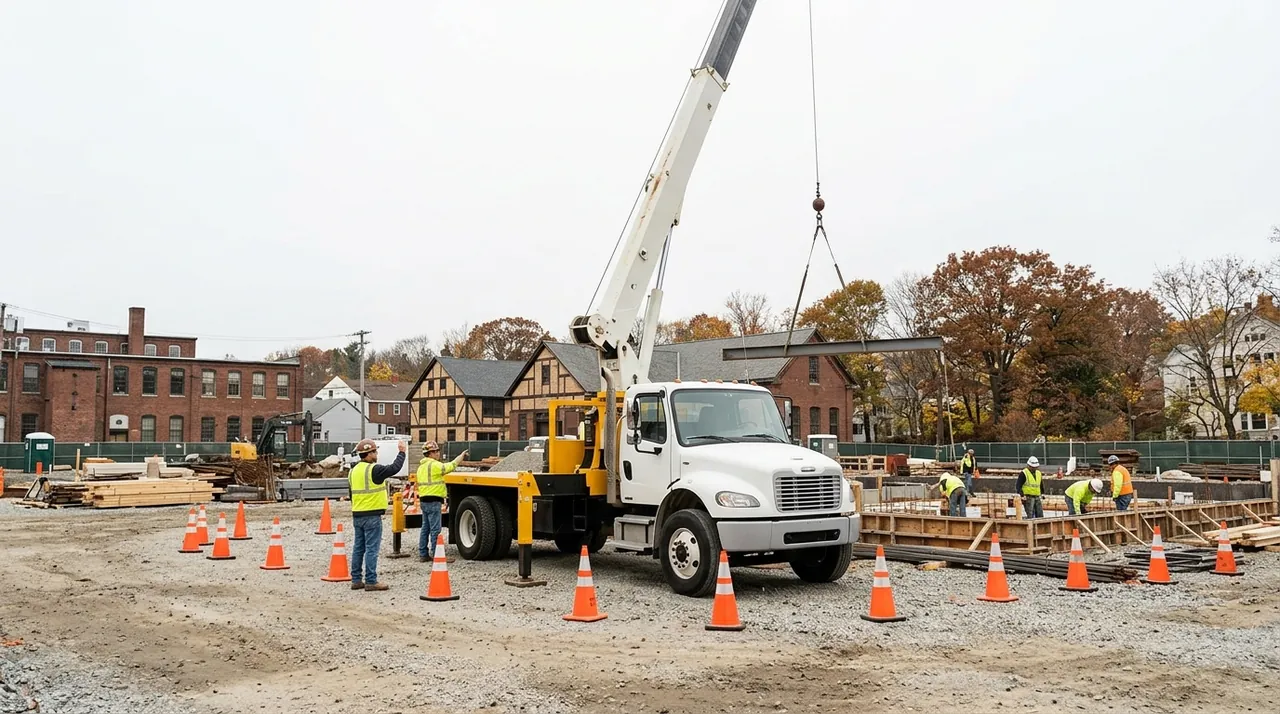
Of all the hazards a 1C operator faces, the two that kill or destroy equipment fastest are electrocution and tip-over. Neither announces itself in advance. This lesson walks through power-line clearance, the mechanics of boom-crane instability, structural overload, and the site conditions that compound every risk. Understanding the mechanics — not just the rules — is what keeps you safe and what the exam tests.
Power lines: the hazard that does not forgive mistakes
Electrocution is one of the leading causes of crane operator fatalities, and the cause is almost always the same: the operator assumed a line was de-energized or misjudged the distance. OSHA Subpart CC sets mandatory minimum clearance distances from energized overhead lines based on line voltage — for lines up to 50 kV the minimum clearance is 10 feet, with greater distances required for higher voltages. These are hard limits, not guidelines.
The preferred solution is to have the utility owner de-energize and ground the line before you work near it. When that is not possible, maintain the required clearance and use a dedicated spotter whose only job is watching the gap between the boom tip and the line. Assume every overhead line is energized until the utility confirms otherwise.
If the boom does contact a line, do not jump off the machine. Stay on, warn ground workers to stay clear, and swing clear of the line if that movement is safe. Anyone who steps off or runs toward the machine can complete the circuit through the earth.
Tip-over: how a stable machine becomes unstable
A boom crane tips when the combined center of gravity of the machine and its load moves outside the tipping fulcrum. Several things cause this, and they often combine. An out-of-level setup shifts the effective load radius before you pick anything up. Soft or voided ground lets an outrigger sink mid-lift, changing the geometry underneath you. Partial outrigger extension cuts rated capacity sharply. Exceeding the load chart removes the built-in stability margin entirely.
Side-loading, swinging too fast, and stopping suddenly all add dynamic force beyond what the chart accounts for. Wind pushing on a large load surface acts as a side load the chart did not include.
Prevention starts at setup: level to manufacturer tolerances, extend all outriggers fully, confirm each float is on solid ground or adequate cribbing, and never exceed the chart for the configuration you are actually in. Slow, controlled swings protect you during the lift.
Structural overload and two-blocking
A load chart has two regions separated by a bold line. Above that line the limiting factor is stability — tip-over is the risk. Below it the limiting factor is structural strength — you can exceed the structural rating without tipping, and the result is a bent or buckled boom. Operators focused on tip-over sometimes miss that a close-radius, low-angle pick with a heavy load can fail the boom before the machine ever starts to tip.
Two-blocking — allowing the load block to travel up until it strikes the boom head — creates an instant structural overload at the worst possible location. On hydraulic telescoping equipment, this can damage the extending sections or the sheave assembly. The anti-two-block device stops hoist-in or boom-down motion before impact, but only if it is working. Confirm ATB function every pre-shift.
Ground conditions, traffic, and overhead obstructions
Setting up near an open trench multiplies every stability risk. Soil adjacent to an open cut is already weakened, and an outrigger load can collapse the edge. The required setback must account for both soil conditions and the magnitude of the outrigger load. On public roads and active job sites, work-zone protection keeps vehicles and workers out of the operating radius.
Overhead obstructions — building eaves, signs, adjacent crane booms — demand the same discipline as power lines. Map them before the lift and verify the boom path clears them throughout the full swing. Wind is the final variable: manufacturer charts include wind speed limits, and as wind rises the effective load increases. Reduce loads or stop work as conditions approach those limits.
Key Takeaways
- •Treat every overhead line as energized — follow OSHA Subpart CC minimum clearance distances, with at least 10 feet required for lines up to 50 kV.
- •If the boom contacts a power line, stay on the machine; stepping off completes the ground circuit through the earth.
- •Tip-over prevention requires level setup, fully extended outriggers on solid ground, no side-loading, and staying within the load chart.
- •Below the bold line on the load chart, the risk shifts from tip-over to structural boom failure — the chart limits apply in both regions.
- •Confirm ATB function every pre-shift, observe trench setbacks, control traffic in the work zone, and stop work as wind approaches manufacturer limits.