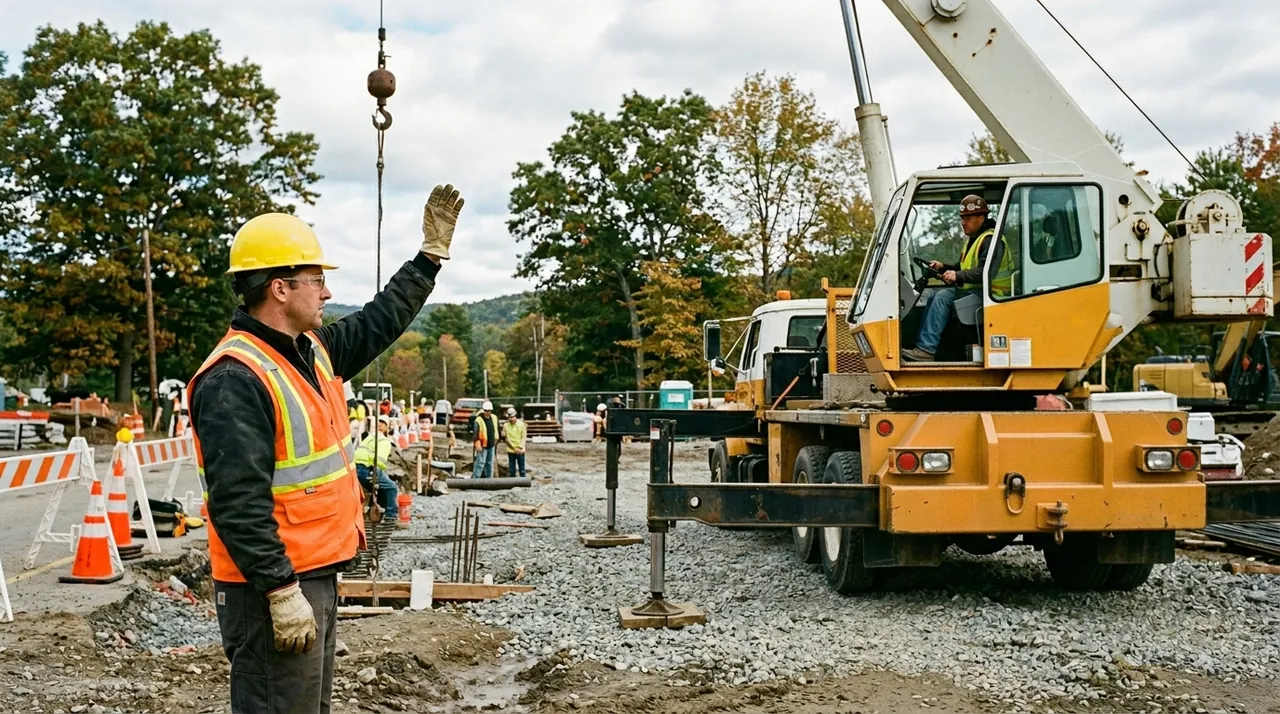
Every lift on a hydraulic boom crane is a team operation. The operator controls the machine, but the signal person controls what the operator does — and both rely on a shared language of hand signals, radio calls, and agreed procedures to move steel safely through the air. On the Massachusetts 1C exam and on the job, knowing that language precisely is not optional. This lesson covers the standard crane hand signals, the rules governing who gives them and when, the basics of rigging a load correctly, and the communication discipline that keeps everyone on the ground safe while the hook is in the air.
Standard hand signals and who controls the operator
The standard crane hand signals — hoist, lower, boom up, boom down, telescope out, telescope in, swing, stop, and dog everything — are the core vocabulary of crane operations. Massachusetts licensing requirements for 1C equipment mandate these signals because noise, distance, and limited sight lines make verbal communication unreliable. The operator is required to obey them immediately and precisely.
Only one person is authorized to direct the operator: the designated signal person. No one else on the site — not the foreman, not the superintendent — may give directional signals while that person is on the job. This single-authority rule prevents the confusion that arises when an operator hears one signal and sees another. The signal person must be qualified, remain in clear view of the operator, and never position themselves under the load or in the swing path of the boom.
Emergency stop and the dog-everything signal
Two signals stand apart from all others. The emergency stop — both arms extended with wrists crossed — carries absolute priority. Any person present, not just the designated signal person, may give it, and the operator must obey it immediately. That exception to the single-authority rule exists because an emergency does not wait: a worker about to be struck, a failing sling, a sudden overhead hazard — any of these justifies an emergency stop from anyone in sight of the operator.
The dog-everything signal is different. It means stop all crane functions and hold position — nothing moves. It is used to pause operations while conditions are evaluated. Understanding the difference between these two signals is a common exam topic and matters equally on the job.
Rigging principles: sling angle, capacity, and load control
Every sling, shackle, and hook used on a 1C pick must carry a visible Working Load Limit rating. Never use unmarked hardware. Inspect each piece before the lift for cuts, kinking, crushed webbing, missing latch pins, and deformation.
Sling angle is the concept that surprises most apprentices. When two sling legs hang nearly vertical, each carries close to half the load. As the legs spread outward and the angle to horizontal decreases, tension in each leg increases — sometimes far beyond the load's own weight. Keep sling angles as steep as practical. Locating the load's center of gravity before the pick prevents the load from tilting, keeps forces balanced, and makes placement predictable. Tag lines, handled by a ground person, control rotation and swing during the move.
Communication and the pre-lift plan
Radio communication is acceptable when both parties have reliable two-way radios and confirmed contact. If communication is lost — the radio cuts out or the signal person moves out of sight — the operator must stop immediately. A lost signal is a stop command. The crane does not move again until communication is restored and conditions are confirmed safe.
Before any pick, the operator and signal person run through the pre-lift plan: confirmed load weight, verified radius and chart capacity, rigging setup, swing path, exclusion zone, and agreed signal method. This brief takes minutes and aligns everyone on what is about to happen before the load leaves the ground. People must be kept away from under a suspended load at all times — that is an absolute rule, not a precaution.
Key Takeaways
- •Only the designated signal person directs the operator during a lift. No one else may give directional signals except for the emergency stop.
- •The emergency stop — both arms extended, wrists crossed — may be given by any person on site, and the operator must obey it immediately.
- •Dog everything means hold all crane functions in place; it is not the same as an emergency stop.
- •Sling angle matters: as legs spread wider and the angle to horizontal decreases, tension in each leg increases beyond the simple load weight.
- •If communication with the signal person is lost for any reason, stop immediately and do not resume until contact and conditions are re-confirmed.