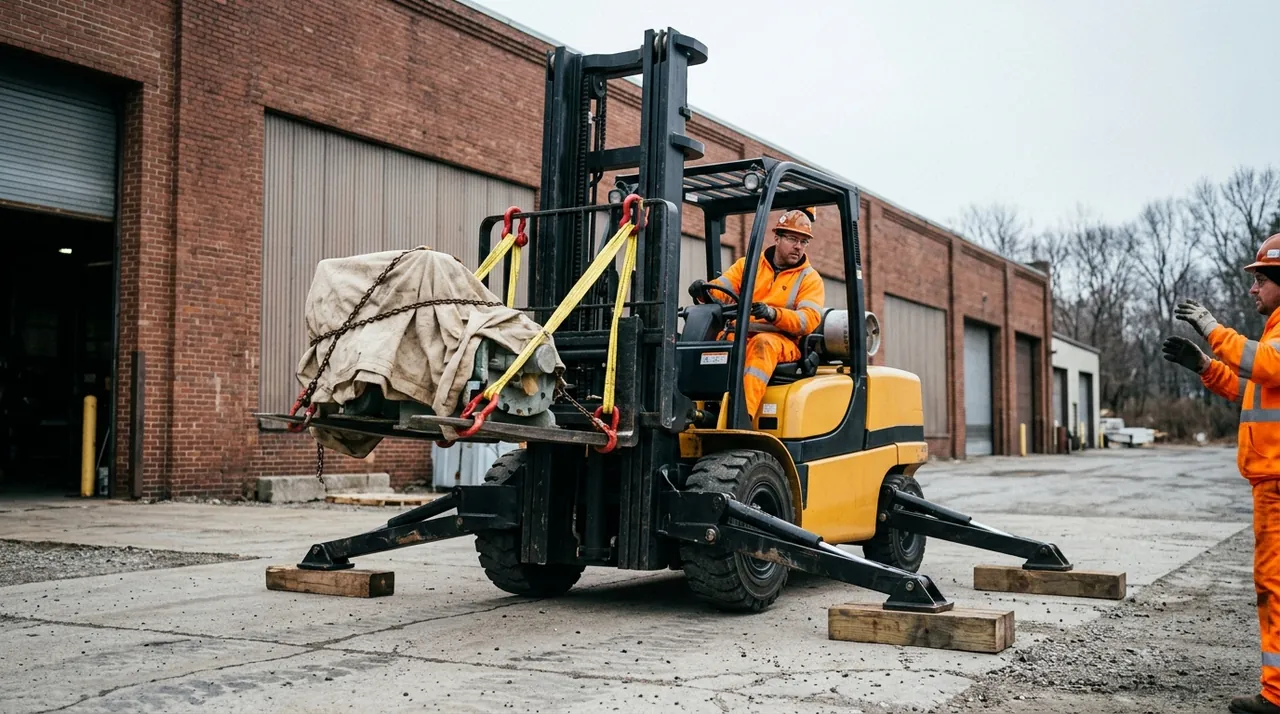
A forklift is a precision balancing machine disguised as cargo equipment. Every lift involves invisible forces — weight, geometry, and center of gravity — that determine whether the truck stays upright or tips over. The Massachusetts 1D exam tests whether you understand those forces in practical terms: what the data plate tells you, how the stability triangle works, and what happens to safe capacity when the load shifts forward or an attachment goes on.
The capacity plate: your first stop before every lift
OSHA requires that every forklift carry a data plate that is in place and legible. If the plate is missing or unreadable, the truck is out of service until it is corrected. The plate is the only authoritative source for that specific truck's rated capacity, its rated load center, maximum mast height, fuel type, and any approved attachments.
Read the rated capacity and the rated load center together, because neither number means anything without the other. A truck rated at 5,000 pounds at a 24-inch load center can safely carry that weight only when the load's center of gravity sits exactly 24 inches from the face of the forks. Change either variable — the weight or where the load's CG falls — and the original capacity number no longer applies.
Load center and load moment: the physics behind the rating
The load center is the horizontal distance from the face of the forks to the center of gravity of the load. For a uniform pallet load that center of gravity sits at roughly the midpoint of the load's depth, so a rated load center of 24 inches assumes the load's center of gravity falls at that distance — any deeper load pushes the CG farther out and reduces safe capacity.
The concept that ties weight and distance together is load moment: load weight multiplied by load center distance. A forklift stays stable as long as its vehicle moment — the counterweight and machine structure pushing back — is greater than the load moment trying to tip the truck forward. This means a load whose center of gravity sits farther out than the rated load center reduces safe capacity even if the total weight is within the rated number. You must think in terms of both dimensions on every lift.
The stability triangle: where the truck can and cannot go
Forklifts are three-point machines. The stability triangle is defined by three support points: the two front drive wheels and the center pivot point of the rear steer axle. So long as the truck's combined center of gravity — the machine's own CG plus the load's CG, taken together — falls within that triangle, the truck remains stable. The moment that combined CG moves outside the triangle in any direction, the truck tips.
When you pick up a load, the combined center of gravity shifts forward toward the load. The heavier the load and the farther out its center sits, the farther the combined CG moves toward the front edge of the stability triangle. Raising the load on the mast compounds the problem: lifting a load raises the combined CG vertically, which reduces lateral stability and makes the truck more sensitive to side slopes, uneven surfaces, and turning while loaded. This is why traveling with the load elevated is a recognized hazard — it narrows the margin between stable and tipping.
Attachments and derating: when the plate must be updated
Every attachment — sideshifter, clamp, rotator, fork extension — changes the truck's safe capacity in two ways. It adds weight to the front of the truck and it moves the effective load center further from the fork face, because the load now sits at a greater distance from the front axle. Both effects reduce safe capacity, sometimes significantly.
The regulations require that whenever an attachment is installed, the data plate must be updated to reflect the derated capacity for that configuration. Operating at the original rated capacity with an attachment in place — without a revised plate — is a regulatory violation and a genuine tip-over risk. Before using any attachment, confirm the plate accounts for it.
Key Takeaways
- •The data plate must be present and legible — it is an OSHA requirement; a missing or damaged plate takes the truck out of service.
- •Rated capacity is always paired with a rated load center; both numbers must be satisfied for the rating to apply.
- •Load moment equals load weight times load center distance — a load whose CG is farther out than the rated load center reduces safe capacity even if the weight is under the limit.
- •The stability triangle runs from the two front wheels to the rear axle pivot; the combined center of gravity of truck plus load must stay inside it.
- •Attachments add weight and push the load center forward, derating capacity — the data plate must be updated whenever an attachment is used.