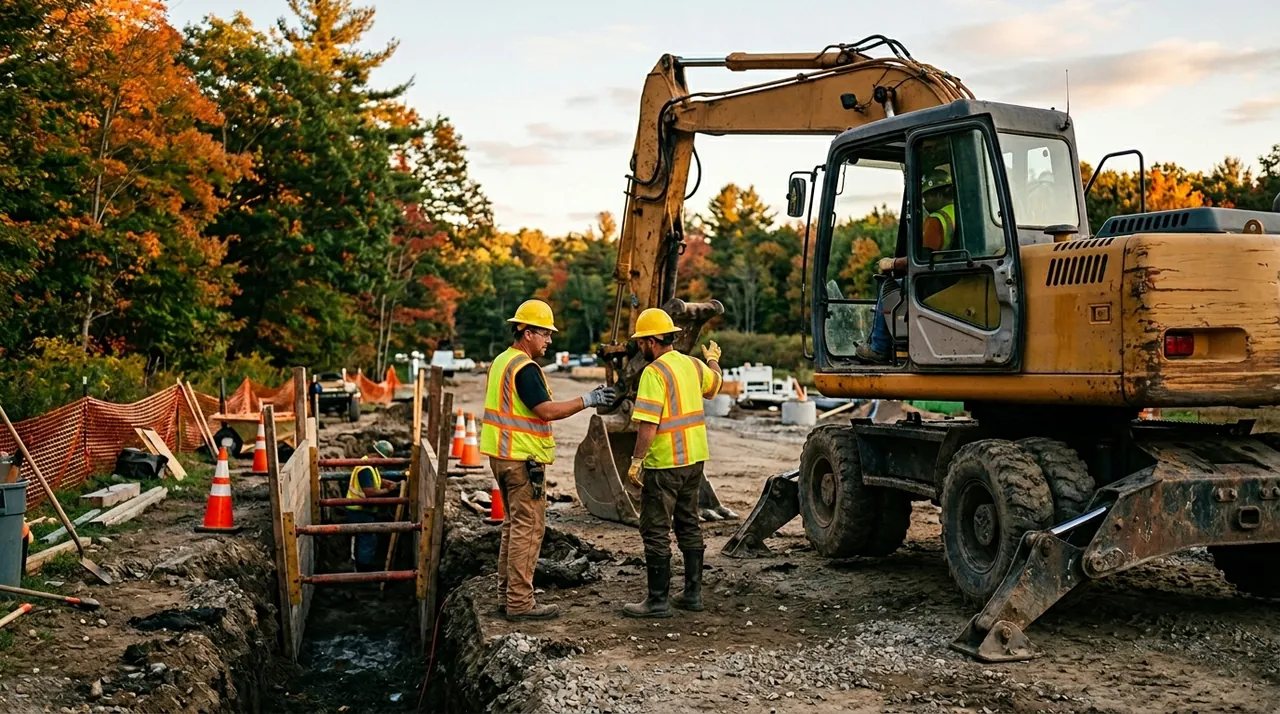
OSHA's 29 CFR 1926.602 is the federal standard governing how earthmoving equipment must be operated on construction sites, and it shows up repeatedly on the Massachusetts 2A exam. Understanding it is not just about passing a test — it is about knowing the legal floor below which no operator, employer, or equipment owner is allowed to go. This session covers the standard's main requirements: braking performance, seat belts, access roads, backup alarms, front-end loader specifics, and the prohibition on unauthorized modifications.
Braking standards and seat belts
One of the more specific things 1926.602 does is assign braking requirements by equipment type, delegating the technical detail to SAE standards. Loaders and dozers must meet SAE J237. Graders fall under SAE J236. Scrapers are governed by SAE J319b. Each standard defines what the braking system must be able to do — not just slow the machine, but stop and hold it under the conditions it actually works in. A brake that holds an empty loader but fails under a loaded bucket is not compliant, and that is exactly the kind of detail the exam tests.
High-speed equipment capable of exceeding 15 miles per hour has an additional requirement: fenders meeting SAE J321a to manage debris thrown by tires. On any equipment fitted with rollover protective structure (ROPS), seat belts complying with SAE J386-1969 are required. The logic is simple — ROPS protects you only if you stay in the cab, and a seat belt is what keeps you there during a tip. Missing seat belts on ROPS-equipped machines are one of the most commonly cited 1926.602 violations.
Access roads and the employer's site responsibility
The regulation places a direct obligation on the employer regarding every route construction equipment travels on site. Access roads must be constructed and maintained in a condition that will safely support the equipment using them. This covers formal haul roads, temporary paths, ramps, and areas near open excavations — any surface the machine crosses to reach the work area.
If a road has softened from rain, been undermined by adjacent excavation, or was never built with your machine's weight in mind, the employer has a duty to fix it or reroute. As an operator, if you see a condition that raises concern, you have both the right and the responsibility to stop and report it. Equipment going into a soft shoulder or over an undermined edge does not give second chances.
Reverse signal alarms
Backing a large piece of earthmoving equipment is one of the highest-risk movements on any site. When an operator's rear view is obstructed — which on most excavating equipment it routinely is — 1926.602 requires a reverse signal alarm that is audible above the surrounding ambient noise level. A quiet beeper next to a piling operation does not meet the standard.
The regulation offers one alternative: a designated employee whose sole job is to observe the backup path and signal that it is safe before each reverse movement. This is strictly either-or. There must be a working alarm or a designated spotter — not neither, and not an informal arrangement where someone usually keeps an eye out. The exam frequently presents a scenario where neither measure is in place and asks you to identify the violation.
Front-end loaders and the ban on unauthorized modifications
Front-end loaders get specific attention in 1926.602 because their design creates hazards unique to their geometry. Scissor points on the loader arms are a crush hazard whenever the arms move, and guarding is required. Machines must display their load capacity clearly, and operators must be trained to a recognized standard before running them.
The prohibition on unauthorized modifications applies to all covered equipment but carries particular weight for anything with ROPS or a rated capacity. Any modification not reviewed and approved in writing by the manufacturer voids the safety certification attached to that component. Cut a ROPS bar, add an unapproved counterweight, or weld a custom attachment point — and you have taken a certified machine and turned it into something with an unknown safety margin. Common violations cited under this standard include missing seat belts, inoperative backup alarms, unguarded scissor points, and unauthorized changes to ROPS.
Key Takeaways
- •29 CFR 1926.602 is the primary OSHA standard for earthmoving equipment operation — know it by number and by substance.
- •Braking standards are equipment-specific: SAE J237 for loaders and dozers, J236 for graders, J319b for scrapers; brakes must perform under actual working loads.
- •Seat belts per SAE J386-1969 are required on all ROPS-equipped machines — their absence is among the most common 1926.602 citations.
- •A backup alarm audible above ambient noise is required when rear view is obstructed; a designated spotter is the only accepted alternative.
- •Any modification without written manufacturer approval voids safety certifications, including ROPS ratings and load capacities.