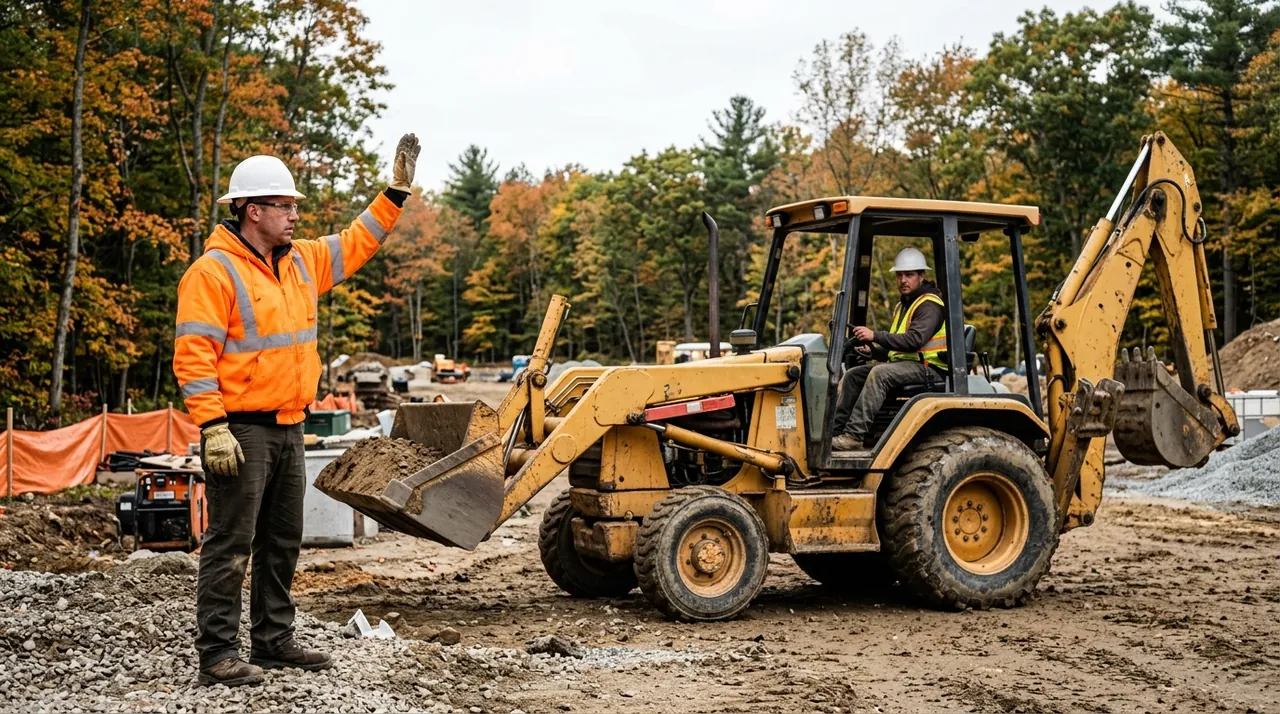
A backhoe loader can seriously injure or kill a bystander in less than a second — not because operators are reckless, but because the machine has blind spots, a sweeping tail arc, and a bucket that crushes anything in its path. The hand-signal system, spotter protocols, and exclusion-zone rules covered here are the communication infrastructure that keeps everyone on a busy job site alive when the machine is moving.
Hand signals and the rule of one signaler
Standard hand signals give operators and ground workers a shared language that works across noise, language barriers, and radio failures. The signals you must know for the 2B exam — Boom Up, Boom Down, Swing, Travel, Stop, and Move Bucket In or Out — each have a specific, nationally recognized gesture. On site you may need to read a signal at a distance in poor light, so knowing them cold is not optional.
The governing rule: one designated person signals, and only that person's directions are followed. A second worker waving from the other side of the excavation does not override your signaler. Conflicting signals are an immediate stop condition — park all motion and wait until the confusion is sorted out. Conflicting instructions almost always mean someone is in danger and neither signaler has the full picture.
The one absolute exception is the Emergency Stop: arms crossed at the wrists. Anyone on the site — superintendent, laborer, or bystander — can give it, and the operator must stop immediately. Anyone who sees an immediate threat may not have time to find the designated signaler first.
Lost visual contact and spotter use
If you lose sight of your designated signaler for any reason, stop — not slow down, not guess at the last signal. The signaler may have moved because someone walked into the swing arc or a section of ground gave way. Until you re-establish visual contact and receive a clear signal to continue, all machine motion stays off.
Spotters serve a related but different role. While the signaler directs work movements, a spotter watches hazard zones the operator cannot see from the cab — backing into congested areas, swinging blind, or working near traffic. A spotter's sole job is to stop the machine if anything enters those zones. Use one whenever the cab's sightlines are inadequate for the conditions.
Swing-radius exclusion zones and struck-by hazards
The backhoe's counterweight and boom sweep a wide arc during rotation. That entire arc — plus the tail-swing zone — must be clear of all persons before every swing. Barricades and cones help mark the zone, but the operator makes a final visual check every single time before rotating.
Struck-by and crush hazards between the machine, the load, and fixed structures are equally serious. Material in the bucket can shift or drop unexpectedly. No one walks under a suspended load, and no one stands in a pinch point between the machine and a wall, berm, or parked vehicle.
Power lines, underground utilities, and traffic control
Treat all overhead power lines as energized. Maintain the required minimum clearance — commonly cited as ten feet for lower-voltage distribution lines — and recognize that the boom extends the machine's reach well beyond what looks safe from the ground. If the line has not been de-energized and visibly grounded by the utility owner, stay out of the hazard zone.
Striking an underground utility while trenching is an emergency. Stop the machine, secure the area, and notify your supervisor and the utility owner immediately. A struck gas line can fill a trench with flammable vapor in seconds. Never assume an unmarked area is clear; call 811 before any excavation.
Near roadways, barricades, coordinated lane closures, flaggers, and high-visibility apparel are all required. The communication plan — who signals, who spots, what radio channel — must be agreed upon before work begins, so every person on the ground has the same picture of how the shift will run.
Keeping the cab a safe zone
The operator's cab is the control center of the machine and must be treated as such. Keep doors and windows in their designed position during operation — an open door can be torn off by overhead obstacles or a nearby swing, and a latched window protects against flying debris. No riders are permitted anywhere on the machine. A second person standing on the step, in the loader bucket, or clinging to the frame has no protection if the machine pitches, swings unexpectedly, or strikes an obstacle.
Horseplay near a backhoe loader is prohibited for the same reason the exclusion zone exists: the machine's size and power mean there is no margin for inattention. Ground workers must stay well clear of the machine when it is operating, and the operator must not attempt any movement — even a small adjustment — while a co-worker is working within the danger zone. These are not courtesy rules; they are the last line of defense when exclusion zones and spotters have already failed.
Key Takeaways
- •One designated signaler controls all machine movement — conflicting signals mean stop immediately.
- •Emergency Stop (crossed arms) overrides everything and can come from anyone on site.
- •Loss of visual contact with the signaler is an automatic stop — never continue on the last signal.
- •Clear the entire swing-radius arc before every rotation and verify no one is in a pinch point.
- •Treat all power lines as live; a struck underground utility is an emergency requiring machine shutdown and immediate notification.
- •No riders are permitted on the machine; keep cab doors and windows secured and prohibit all horseplay near operating equipment.