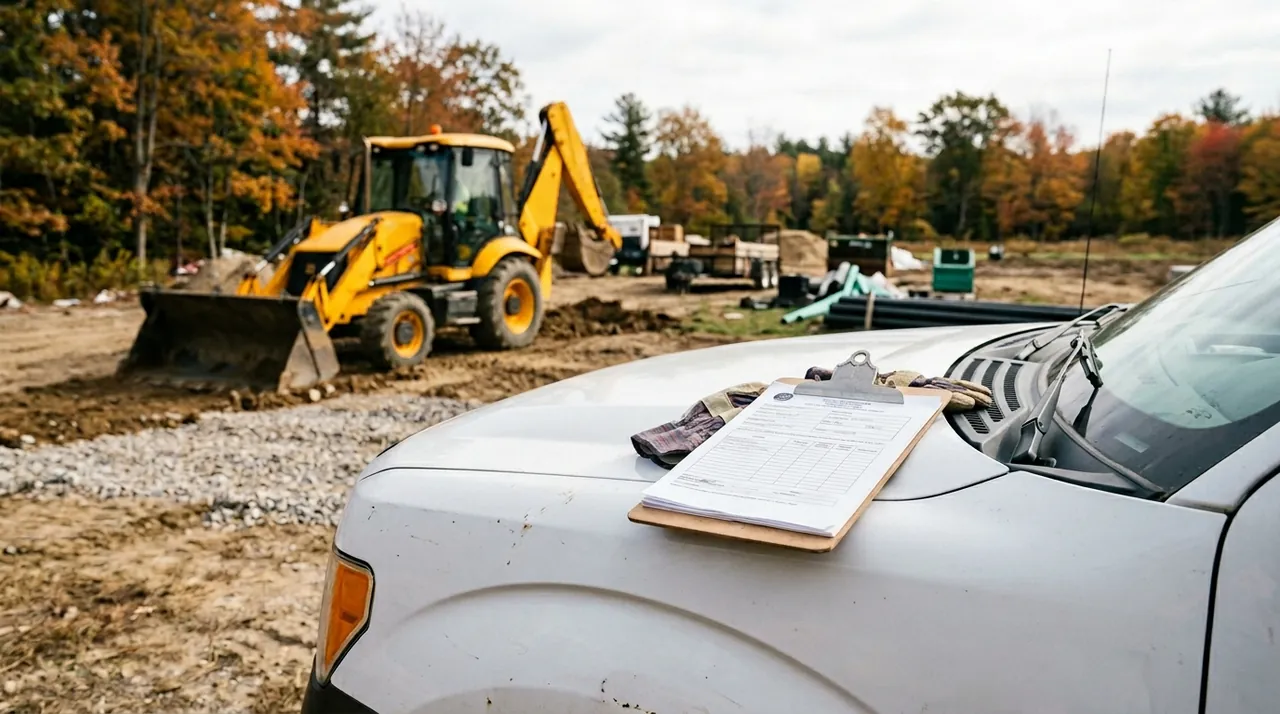
Trenches are among the deadliest hazards in construction. A cubic yard of soil weighs close to a ton, and a wall can collapse in seconds with no warning. Before you operate a backhoe loader near an excavation, you need to understand what the regulations actually require — not as trivia for the exam, but because your machine is usually the first piece of equipment on site, and you will be working at the edge of a hole that other people are about to enter.
The two regulations that apply
Federal excavation safety falls under 29 CFR 1926 Subpart P, covering sections 1926.650 through 1926.652. This is the OSHA standard that sets baseline requirements nationwide. Massachusetts adds its own layer with 520 CMR 14.00, the Massachusetts Excavation and Trench Safety regulation. On the 2B exam, know both designations — state inspectors enforce 520 CMR 14.00 independently, so federal OSHA compliance alone is not enough when working in Massachusetts. Where the two standards overlap, whichever is stricter controls.
Depth thresholds for protection and egress
Subpart P draws two hard lines based on depth. Any excavation five feet deep or more requires a protective system — no exceptions, no judgment call. For excavations under five feet, a protective system is still required unless a competent person examines the site and determines there is no cave-in risk. That exemption is narrow: it demands an affirmative determination based on soil conditions, not just an assumption that shallow means safe.
The second threshold is four feet. Any time workers enter a trench four feet deep or more, a means of egress — a ladder, stairway, or ramp — must be in place within 25 feet of lateral travel. A properly shored trench with no practical exit route is still non-compliant.
The competent person and when inspections are required
The competent person is the linchpin of Subpart P. This is someone who can identify hazardous conditions, understands soil analysis and protective systems, and has the authority to stop work or pull workers from the excavation. That authority is part of the definition — without it, the person does not qualify.
Inspections are required before work begins each day, whenever site conditions change, and after any event that could affect trench stability — rain, freezing temperatures, or nearby equipment vibration. Rain triggers a new inspection even if the competent person just finished the morning check, because saturated soil can be significantly weaker than it was an hour earlier. Water accumulation inside a trench forces an additional consideration: submerged soils default to the least stable soil classification under the regulation, which directly determines what protective system is required.
Protective-system options and machine setback
Subpart P provides four recognized protective-system options. Sloping or benching cuts the walls back to a stable angle. Manufacturer tabulated data covers engineered systems like trench boxes rated for specific soil types and depths. OSHA appendix tables give pre-calculated data a competent person can apply without a custom analysis. When none of those fit — unusual conditions, extreme depth, or complex geometry — a professional engineer must design a site-specific system.
As a backhoe operator, your position at the edge matters directly. Spoil piles, materials, and equipment must be kept at least two feet back from the trench edge to prevent material from falling in and to limit surcharge loading on the walls. Your stabilizers and the machine itself need to stay far enough back that you are not undermining the trench wall or transmitting vibration into the cut face. Getting too close is not a minor positioning error — it can trigger the collapse you were called in to prevent.
Key Takeaways
- •Two regulations apply in Massachusetts: federal 29 CFR 1926 Subpart P and state 520 CMR 14.00 — know both designations.
- •Five feet and deeper requires a protective system with no exceptions. Four feet and deeper requires a ladder, stairway, or ramp within 25 feet of lateral travel.
- •The competent person must have authority to stop work — that is part of the definition, not optional.
- •Inspections are required before each shift and again after rain, changing conditions, or nearby vibration. Rain resets the clock regardless of the morning check.
- •Keep spoil, equipment, and the backhoe at least two feet back from the trench edge to control surcharge loading and avoid undermining the wall.