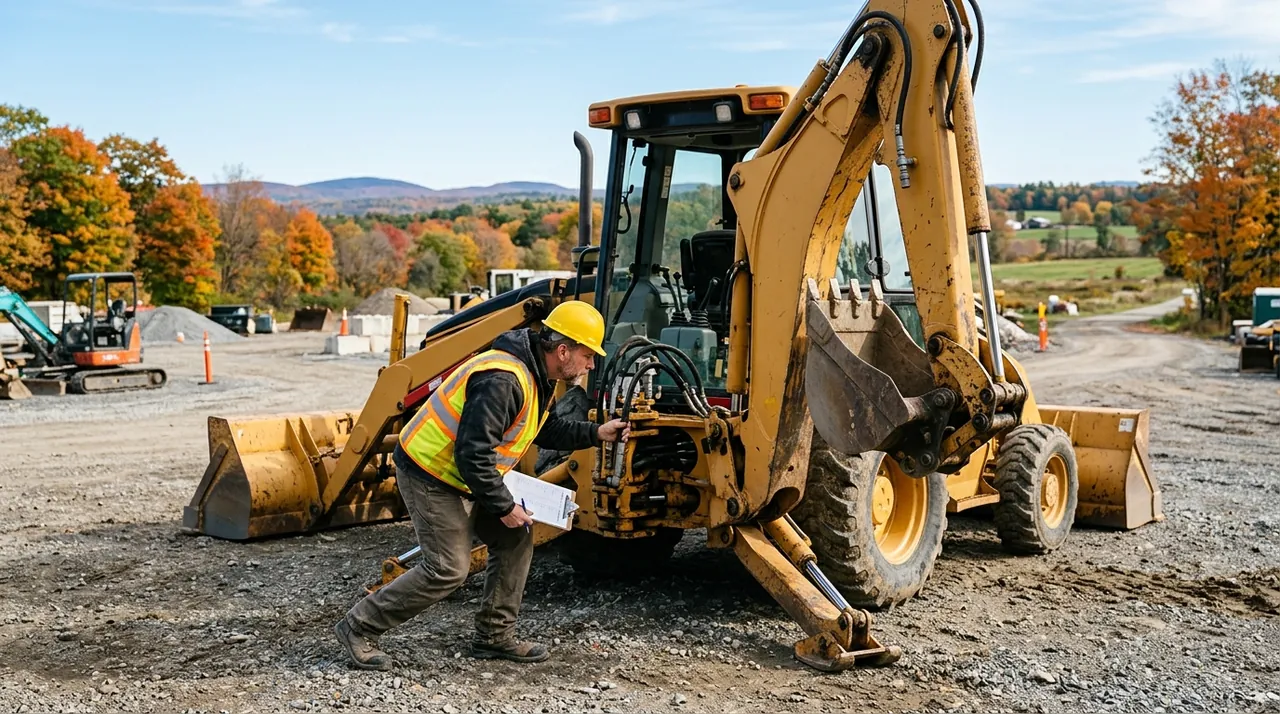
A backhoe loader is two machines in one frame — a front loader and a rear excavator sharing the same engine, the same hydraulic circuit, and the same operator. That dual nature makes the pre-shift inspection more detailed than on a single-function machine, because there are two working ends, two sets of cylinders, and a stabilizer system that has to perform reliably before the backhoe end can do any useful work. The inspection is also a legal requirement: OSHA mandates it before every shift and after every relocation. For the 2B exam, you need to know the full sequence, the specific defects to look for on each end, and which conditions mean you park it and call your supervisor.
The OSHA basis and when to inspect
Two OSHA standards establish the framework: 29 CFR 1926.602, which covers earthmoving equipment including backhoe loaders, and 29 CFR 1926.20, which requires frequent and regular inspections by a competent person on all construction equipment. In practice that means before each shift and after relocating the machine. Before the shift catches overnight changes — a slow hydraulic leak that pooled, a hose that chafed through in the last work cycle. After relocation matters because transport and new ground conditions introduce hazards the machine has not been exposed to before.
As the operator, you are usually the competent person. OSHA defines that term: someone who can recognize a hazard and has the authority to take corrective action, including pulling the machine from service. That authority is also a responsibility, which is why the inspection is yours to own.
The 360-degree walk-around: ground, fluids, and hoses
Start at a fixed reference point — the cab door works — and move around the entire machine in one direction without skipping anything. Before checking any gauge or fluid level, scan the ground under the machine. Fresh fluid pooled under the engine, the hydraulic reservoir, or a cylinder rod tells you more, faster, than any dipstick.
Then check fluid levels: engine oil, coolant, fuel, and hydraulic fluid. With hydraulic fluid, level alone is not enough — check color too. Milky fluid signals water contamination; dark and burnt signals overheating. Inspect all exposed hoses as you move around the machine, looking for chafing against frame edges, bulges, cracked outer covers, and any seepage at the fittings.
Loader end, backhoe end, and stabilizers
At the loader end, check lift arms, tilt linkage, cylinder rods, the bucket cutting edge, and the mounting pins and ears for cracks and wear. A cracked bucket ear is a structural defect, not a cosmetic one. If the machine uses a quick-coupler on the loader end, confirm it is fully engaged and locked before putting the bucket to work — a partially seated coupler can release under load.
At the backhoe end, work through the swing tower, boom, dipper, and bucket. The swing tower carries the full side load of the digging circuit — look for cracks at its base and pivot points. Inspect boom and dipper for bent or cracked structure, check all cylinder rods and hose connections, and examine the bucket teeth and their mounting hardware. Verify that the backhoe attachment pins are fully seated and that any retaining hardware is in place.
The stabilizers are the backhoe's foundation. During the operational check, extend and retract each stabilizer through its full range and observe whether the cylinder holds position under the machine's weight. A stabilizer that creeps down slowly has a seal failure — the machine cannot dig safely until that defect is corrected.
Cab, tires, and removal-from-service conditions
Inside and around the cab, inspect the ROPS/FOPS structure for any bending, cracking, or modification. The protection it provides depends on the structure being completely intact — a bent upright or a field weld changes the load path and voids the protection. Confirm the seat belt latches and holds, check mirrors and glass, then run the operational checks: horn, backup alarm, lights, brakes that hold under load, and every hydraulic control for smooth response. On wheeled units, check tire condition, inflation, and lug-nut security.
Some findings require judgment. These do not: active hydraulic leak, non-functional brakes or steering, damaged or modified ROPS/FOPS, inoperative seat belt, structural cracks in the boom, dipper, or loader arms, non-functional horn or backup alarm, and stabilizers that won't hold. Any one of these means you tag the machine, notify your supervisor, and do not operate it. The 2B exam will present scenario questions built around this list, and the correct answer is always the same — tag out and report.
Key Takeaways
- •OSHA 29 CFR 1926.602 and 1926.20 require pre-shift inspections by a competent person before every shift and after every relocation.
- •Work a fixed 360-degree route: ground scan and fluid check first, then hoses, loader end, backhoe end, stabilizers, cab, tires, and operational checks.
- •Check hydraulic fluid color as well as level — milky means water contamination, dark and burnt means overheating.
- •Stabilizers must hold the machine under load — a cylinder that creeps down is a seal failure and takes the machine out of service.
- •On quick-coupler machines, confirm the coupler is fully engaged and locked on both ends — a partially seated coupler can release under load.
- •Active leaks, failed brakes or steering, damaged ROPS/FOPS, dead seat belt, structural cracks, and non-functional horn or backup alarm all mean tag out — no exceptions.